Yoga Wheel Guide: Uses, Benefits & How to Choose a Size

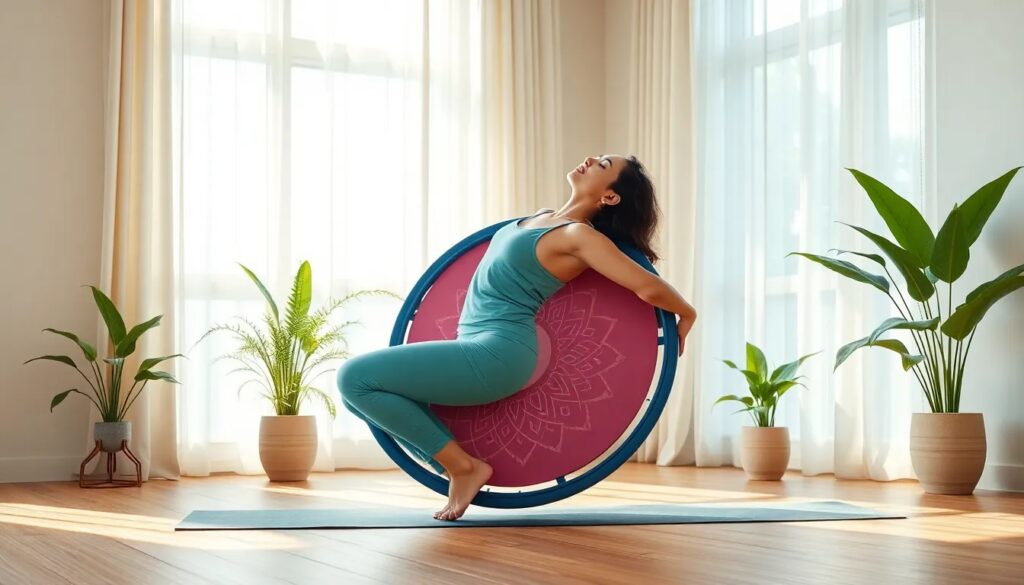
A yoga wheel is a hollow, circular prop — usually 10 to 13 inches in diameter — that you place under your spine, feet, or hands to support backbends, deepen stretches, and add instability to strength work. Its main job is letting your back arch over a stable curved surface, so you can open the chest and front body gradually instead of dropping into a full backbend cold.
The wheel earned its place among yoga props because it does something a block or strap cannot: it supports the spine through its full arc while allowing movement. Below is an honest look at what it is good for, how to start using one, the mistakes to avoid, and how to pick the right size. For a step-by-step routine, see our companion guide on how to use a yoga wheel.
What a yoga wheel is good for
- Supported backbends: rolling the spine over the wheel opens the thoracic spine — the stiffest part of the back for most people who sit at desks.
- Chest and shoulder opening: draping over the wheel with arms overhead stretches the pecs and the front of the shoulders.
- Hip flexor and quad release: the wheel supports lunging shapes so the front of the hip can lengthen without strain.
- Core and balance work: placing feet or hands on the wheel turns planks and pikes into anti-rolling stability challenges.
- Backbend progressions: the wheel lets you rehearse the shape of Urdhva Dhanurasana (Wheel Pose, the asana) and Kapotasana with support before attempting them freely.
- Myofascial release: slowly rolling the muscles alongside the spine, the lats, or the calves over the wheel works like a large massage roller.
What it is not: a magic flexibility shortcut or a substitute for strength. The wheel assists positions; the work of breathing, engaging, and progressing is still yours.
How to start: four beginner exercises
- Supported spinal extension: sit on the floor with knees bent, place the wheel behind you against your mid-back, and slowly lean back over it with hands behind your head for support. Let the wheel press into the area between your shoulder blades. Breathe for 5–10 slow breaths.
- Rolling chest opener: from the position above, use your legs to roll the wheel a few inches up and down your spine, pausing on stiff spots. Keep the neck supported by your hands or let the head rest on the wheel.
- Child's Pose with wheel: kneel, place both hands on the wheel in front of you, and roll it forward as you fold — a gentle lat and shoulder stretch that beginners find immediately accessible.
- Half-kneeling hip flexor stretch: in a low lunge, place the wheel under the back-leg shin or rest the back foot on it, then tuck the pelvis and lift the chest. Go gently — this one is stronger than it looks.
Two safety notes for every wheel exercise: keep your neck supported rather than hanging back freely, and control the roll with your legs at all times. The wheel moves — that is the point — so set up away from furniture on a non-slip surface such as a good yoga mat.
Ready to progress further? See the full set of 10 yoga wheel exercises, from beginner rolls to more advanced backbend work.
Common yoga wheel mistakes to avoid
Most yoga wheel frustrations — and most of the injuries — come down to a handful of avoidable habits rather than the prop itself.
- Letting the head drop unsupported. In backbend exercises, keep your hands behind your head or let it rest gently on the wheel — never let it hang back freely with no support.
- Losing control of the roll. Drive the wheel with your legs at all times instead of letting momentum carry you; lose that control and it can shoot out from under you.
- Setting up on the wrong surface. A polished floor or a loose rug lets the wheel skid mid-exercise. Use a non-slip mat and keep clear space around you.
- Skipping the supported variations. Going straight into a deep backbend without first practicing the supported spinal extension and rolling chest opener is how beginners strain their back.
- Buying the wrong size for the job. A 6-inch mini wheel is built for spot massage, not full backbends — check the size comparison below before deciding which one to buy.
Go slowly, breathe, and let the exercises above build your control before progressing further.
Yoga wheel sizes compared
| Size | Typical diameter | Best for | Keep in mind |
|---|---|---|---|
| Standard | 12–13 in (30–33 cm) | Most adults; backbends, chest openers, general use | The default choice if you only buy one |
| Medium | 10 in (25 cm) | Smaller frames; targeted mid-back release | Less depth of arch than a standard wheel |
| Mini | 6 in (15 cm) | Spot massage, foot and calf work | Too small to support full backbends |
Beyond size, check the weight rating (sturdy wheels are typically rated for several hundred pounds), look for a padded, non-slip outer layer, and prefer a rigid core — ABS plastic cores hold their shape better than cheap thin-walled ones that flex under load.
As an Amazon Associate, we earn from qualifying purchases.

- Yoga Wheel Set of 2: The 2 sizes wheel provide different levels of pressure to the muscles targeted to your specific training needs. Our big wheels are 13 inches in diameter with gentle pressure and are excellent for deep posture and backbending. 4'' in diameter with deep tissue pressure, perfect for massaging the neck, back and legs.
- 6MM(Regular Wheel) & 6MM (Focus Wheels) Thick Premium Padding: Made of high-density eco-friendly Cork TPE. Our wheels feature the thickest foam padding available to provide a soft, comfortable surface to cushion your back, palms or feet. Surface technology can resist water and sweat, easy to clean, and have better anti-slip effect. The strong rigid core made of ABS can support up to 500 lbs for extra toughness.
- Widen Padding: Extra wide padding improves your balance when you doing Yoga posture. This yoga wheel is perfect for more difficult stretches, helping your neck, spine, shoulders and making your yoga moves deeper. Your body will be stretched smoothly, and you'll be surprised when you finally gain flexibility and comfort.
- Improve Posture & Reless Stress: Improve your yoga practice and relieve stress. These four rollers help you practice more challenging movements and postures with ease, safety, stretch and release muscle tension such as shoulders, chest, hips and back, and release back and shoulder pain. At the same time, improve the flexibility of yoga poses, muscles and spine.
- Customer Satisfaction as Goal: Our extra-cushioned foam roller helps distribute pressure on the spine, realigns the spine's natural curvature, restores the S-curve and promotes healthy posture. If you don't get what you want, please feel free to contact us.
Yoga wheel vs. blocks and straps
Each prop solves a different problem. Blocks raise the floor toward you and add stable height. A strap extends your reach when hands cannot meet feet or each other. The wheel is the specialist for spinal extension and rolling release — if your goal is backbends and a stiff upper back, it earns its storage space; if you mainly want help with forward folds and tight hamstrings, a strap will serve you better for less money.
Using the wheel for inversions and advanced poses
More experienced practitioners use the wheel as a target and support in advanced work: resting the crown lightly toward the floor while draped over the wheel to rehearse deep backbends, placing the feet on it in Forearm Stand drills, or pressing through it in Kapotasana preparations. If inversions are your goal, build the foundations first — our guides to inversions in yoga and the yoga headstand cover the prerequisites — and treat the wheel as an assistant, not a safety device: it can roll out from under you if you load it carelessly.


Looking for other props to round out your practice? Browse our yoga equipment guides for mats, blocks, straps, and more.
Frequently asked questions
Yes, as long as you start with supported exercises like leaning back over the wheel with feet firmly on the floor. The gentle versions are accessible to most people, while unsupported balancing moves should wait until you control the roll confidently.
Many people find that rolling the upper back over a wheel relieves stiffness from sitting, because it encourages thoracic extension. It is not a treatment for diagnosed spinal conditions, disc problems, or acute pain, and anyone with those issues should ask a qualified professional before using one.
A standard 12 to 13 inch wheel suits most adults and is the right first purchase. Choose a 10 inch wheel if you have a smaller frame, and a 6 inch mini wheel only as an add-on for targeted muscle release.
No. Wheel Pose, or Urdhva Dhanurasana, is a backbend asana performed with hands and feet on the floor. The yoga wheel is a physical prop. The prop is often used to prepare the body for the pose — see our guide to Wheel Pose — which is where the shared name comes from.
The most common ones are letting your neck hang unsupported instead of resting it on your hands, losing control of the roll instead of driving it with your legs, and setting up on a slippery or uneven surface. Go slowly and keep the wheel on a stable, non-slip floor.
This article is for general information only and is not medical advice. If you have a spinal condition, injury, or are pregnant, consult a qualified professional before using a yoga wheel.
Have a correction? Contact us.
Last update 2026-09-10. Price and product availability may change.
Recommended: