What Is the Purpose of Goat Yoga? An Honest Look at the Trend

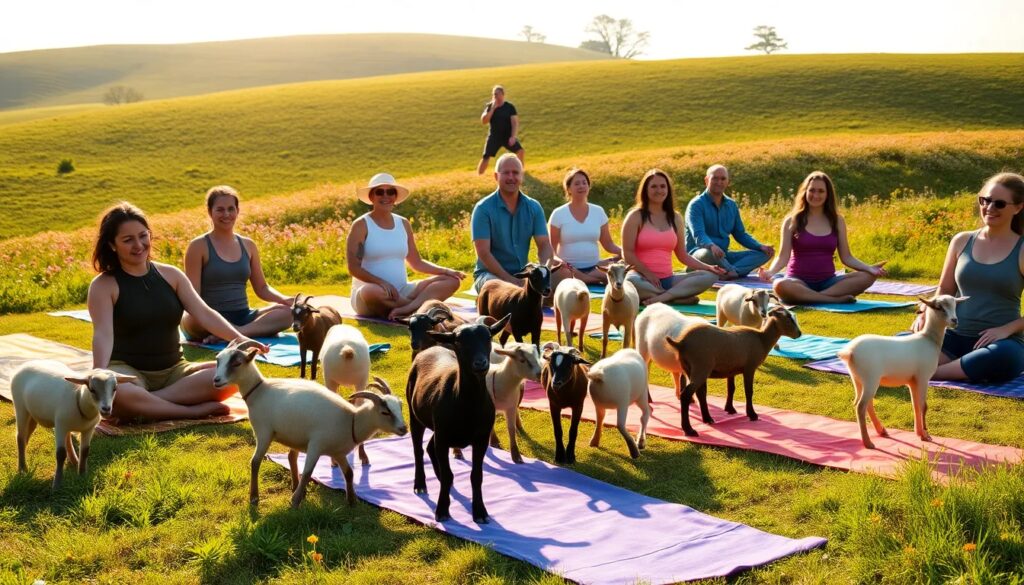
The purpose of goat yoga is to combine a gentle, beginner-level yoga class with unstructured time around friendly goats on a farm. The yoga portion is intentionally easy, and the goats are the main attraction: they wander between mats, nibble hair ties, and sometimes climb on your back while you are in tabletop. People sign up for the mood lift, the novelty, and the chance to spend an hour outdoors with animals — not for a workout.
If you are deciding whether goat yoga is worth your time, it helps to know what a class is actually like, where the idea came from, and what goat yoga is not.
The short answer: relaxation first, exercise second
Goat yoga is best understood as a recreational wellness experience, not a workout. The yoga portion is deliberately easy — mostly seated poses, gentle stretches, tabletop, and cat-cow — because the format has to accommodate constant interruption. Nobody holds a long balancing sequence while a goat chews their hair.
What the format does deliver is a combination of three things people genuinely find restorative:
- Animal interaction. Spending time with calm, friendly animals is widely associated with lower perceived stress, and it is the main reason people book these classes.
- Laughter and novelty. Goats are unpredictable. They nibble, headbutt props, and climb on people. The classes are designed so that this is funny rather than annoying.
- Time outdoors. Most sessions happen on farms or in open-air pens, which adds fresh air and a change of scenery to the experience.
What is the idea behind goat yoga?
The idea is to make yoga approachable for people who would never set foot in a studio by adding something that is hard to take too seriously: baby goats. The animal interaction does the work of lowering the stakes, and the yoga part becomes a gentle frame for being on the mat rather than a discipline to learn.
Is goat yoga still a thing?
Yes. Goat yoga classes are still offered across the United States and beyond, usually on farms rather than in studios. The format has settled into a niche of its own, separate from the original viral wave, and it survives because the experience is genuinely difficult to replicate anywhere else.
How long does goat yoga last?
Most sessions run roughly an hour, with the time typically split between simple yoga sequences and unstructured interaction with the goats. The exact breakdown varies by farm.
If your goal is flexibility, strength, or a meditative practice, a standard class will serve you far better — see our guide to how often you should do yoga for building a real routine. Goat yoga is the field trip, not the curriculum.
Where goat yoga came from
Goat yoga is widely credited to Lainey Morse, who began hosting yoga classes among the goats on her farm in Oregon in the summer of 2016. Morse has described how spending time with her own goats became a source of comfort during a difficult period in her life, and that she was already hosting informal "goat happy hours" on the property. When a yoga instructor suggested holding a class there, the combination took off. Photos and videos of goats standing on yoga practitioners spread quickly on social media, and within a couple of years farms across the United States and beyond were offering their own versions (ABC News).
The viral origin explains a lot about the format. Goat yoga was never positioned as a serious yoga lineage; it grew as a feel-good experience that photographs well, and most providers are farms running events rather than yoga studios adding livestock.
What does animal interaction actually do?
Time with calm, friendly animals is widely associated with lower perceived stress and a better mood. That is the everyday observation behind most of the marketing for goat yoga, and it is a reasonable thing to aim for. Goat yoga specifically, however, has not been studied in depth, so any claim about a measurable hormonal or therapeutic effect from a single class should be treated as marketing rather than established science.
That said, the ingredients of a session — light movement, social activity, laughter, time outside, and contact with animals — are all individually reasonable things to do for your mood. You do not need a clinical trial to justify an hour that makes you laugh. The honest framing is: goat yoga is very likely to leave you in a better mood than you arrived in, and very unlikely to change your fitness or treat any condition. If the wellness angle is what you are after, our guide to yoga for stress relief covers evidence-based options.
Goat yoga vs. a regular yoga class
| Goat yoga | Regular yoga class | |
|---|---|---|
| Primary goal | Fun, stress relief, novelty | Flexibility, strength, breath, focus |
| Physical intensity | Very low; frequent interruptions | Low to high depending on style |
| Setting | Farm, barn, or outdoor pen | Studio, gym, or home |
| Typical cost | Often more than a drop-in studio class | Varies; memberships lower the per-class cost |
| Best for | One-off experiences, groups, animal lovers | Building an ongoing practice |
| Repeatability | Usually a once-or-twice experience | Designed for weekly practice |
If you enjoy the slow, calming end of the spectrum, a restorative yoga class delivers deeper relaxation than goat yoga, with props instead of livestock. And if you are wondering whether gentle classes count as a workout at all, our article on whether yoga is considered exercise breaks down the numbers by style.
How much do people pay for goat yoga?
The price of a goat yoga session varies widely by provider, region, and what is included. Some farms bundle in extras like a professional photographer, snacks, or time to simply hang out with the goats after the movement portion. The most reliable way to know is to check the specific farm or booking platform you are considering.
Practical tips for your first goat yoga class
- Wear clothes you do not mind getting dirty. Goats have hooves, and farms have farm floors. Our guide on what to wear to goat yoga covers this in detail.
- Use an old mat or a towel, or ask whether mats are provided. Many farms supply mats precisely because goats are hard on them.
- Leave jewelry and loose items at home. Dangling straps, tassels, and hair ties read as snacks to a goat.
- Expect interruptions, not instruction. Teachers keep sequences simple and pause constantly for goat moments and photos.
- Ask about age and accessibility policies. Many farms welcome kids and absolute beginners; some sessions are adults-only.
- Wash your hands afterward. Standard practice after handling any farm animal.
Is goat yoga worth it?
As a yoga class, no — the practice is too diluted to build skill or fitness. As an experience, often yes: it is a low-pressure, genuinely funny group activity that gets people who would never enter a studio onto a mat. Plenty of participants later try a conventional beginner class, which makes goat yoga a friendly side door into the practice. For more on how the two fit together, see our companion piece on the point of goat yoga.
Not really. The poses are gentle and frequently interrupted, so the physical demand is very low. Treat it as a fun recreational experience and use regular classes for fitness goals.
Yes. Goat yoga classes are still offered across the U.S. and beyond, usually on farms rather than in studios. Availability and format vary by region.
Most sessions run roughly an hour, with time split between simple yoga sequences and unstructured time with the goats. The exact breakdown varies by farm.
Often, yes — especially baby goats, which like elevated surfaces. Poses such as tabletop invite them to hop on your back. Handlers usually supervise, and you can always ask to be left out of the climbing.
Yes. Classes are intentionally easy and assume no yoga experience. The bigger considerations are comfort around animals and being okay with dirt, nibbling, and the occasional hoof.
Have a correction? Contact us.
Recommended: