Yoga Towels: How to Choose the Right One for Hot or Regular Practice

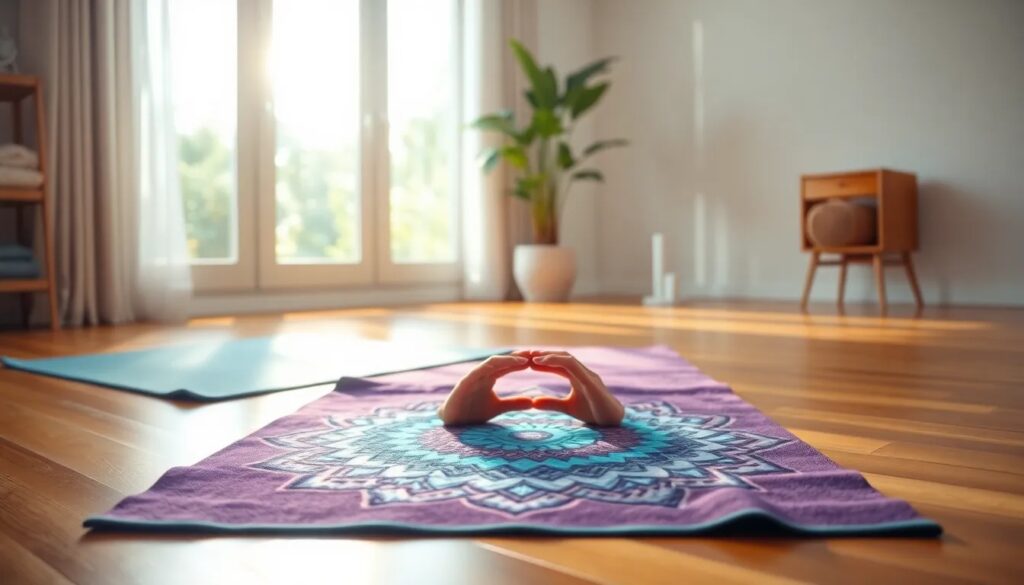
A yoga towel is a thin, mat-sized microfiber towel that lies on top of your yoga mat to absorb sweat and improve grip — and unlike a regular towel, most are engineered to get grippier as they get damp. If you practice hot yoga, sweat heavily in any class, or use rental mats, a yoga towel is one of the most useful accessories you can buy. If you do a gentle or unheated practice and rarely sweat, you probably do not need one.
This guide covers what makes a yoga towel different from a beach towel, what actually changes between hot and regular practice, and the five things to check before buying.
What Is a Yoga Towel, Exactly?
It is a flat-woven microfiber towel cut to standard mat dimensions — typically about 72 by 24 inches, the same footprint as a full-size mat. The microfiber construction does two jobs at once: it absorbs several times its weight in sweat, and its dense, suede-like surface creates friction against your palms and feet. Many models add silicone dots or nubs on the underside so the towel locks onto the mat instead of sliding, and some include corner pockets that wrap around the mat ends. Manduka's Yogitoes towels, for example, anchor to the mat with a pattern of patented silicone nubs on the underside rather than pockets.
Smaller hand-towel versions (around 24 by 15 inches) exist for wiping your face and hands mid-class; here we focus on the full mat-size version.
Yoga Towel vs. Regular Towel vs. Just the Mat
| Yoga towel | Regular cotton towel | Mat alone | |
|---|---|---|---|
| Grip when wet | Improves as it dampens | Gets slippery and bunches | Most mats lose grip when sweaty |
| Stays in place | Yes (silicone underside / corner pockets) | No — slides and wrinkles under moving feet | n/a |
| Fits the mat | Cut to mat dimensions | Wrong shape, edges fold over | n/a |
| Hygiene | Machine wash after every class | Washable but heavy and slow-drying | Mats are awkward to deep-clean |
| Weight in your bag | Light (a standard mat-size towel is about 1 lb / 0.45 kg) | Heavy when damp | — |
The short version: a regular towel solves the sweat problem but creates a sliding problem. A yoga towel solves both.
Who Actually Needs One
- Hot yoga practitioners. In heated rooms a towel is close to mandatory — many studios require one. A soaked bare mat becomes genuinely hazardous in standing poses.
- Heavy sweaters in any style. If your hands slide forward in Downward Dog by mid-class, a towel fixes that more cheaply than a new mat.
- Anyone using studio or gym rental mats. The towel becomes a clean, washable barrier between you and a mat used by dozens of strangers.
- Travelers. A folded towel takes a fraction of the space of a travel mat and works over carpet or a rental mat in a pinch.
Who can skip it: practitioners of slow, unheated styles who rarely break a sweat, and anyone whose mat already grips well dry and wet. If slipping is your problem even without sweat, the issue is probably the mat itself — see our Liforme mat review for an example of a grip-first mat, and our guide to yoga mat thickness if comfort is the complaint.
Hot Yoga Towel vs. Regular Yoga Towel: What Actually Changes
The same product solves two different problems, and the difference is mostly about how much sweat the towel has to manage.
Hot yoga (Bikram, hot vinyasa, hot 26)
Rooms run hot and humid, mats get soaked within minutes, and slipping in standing or balance poses is a real safety issue. For this context the priorities are: a non-slip silicone underside (you cannot rely on dampness alone when your hands are bone-dry at the start of class), corner pockets or anchor points so the towel does not migrate mid-flow, and a towel at least as long and wide as your mat. Mid-weight microfiber dries overnight so the towel is ready for the next class.
Regular (unheated) yoga — Vinyasa, Hatha, Yin, restorative
Most people sweat far less, and the towel's main job is to add grip on days when palms get clammy and to keep the mat clean. A lighter, plain microfiber towel works fine here, and some practitioners only mist it lightly before class to activate the grip. If your hands and feet stay dry through a slow flow, you likely do not need one at all — your mat's own surface is enough.
How to read marketing copy
Most "yoga towel" listings work for both. What changes between a hot-rated and a regular-rated towel is the grip mechanism (silicone vs plain microfiber) and the weight. If you only do unheated classes, the extra cost of a premium hot-yoga towel is hard to justify; if you ever drop into a heated class, the silicone underside earns its keep the first time you need it.
How to Choose a Yoga Towel: 5 Things to Check
- Size match. Measure your mat first. Standard towels fit 68–72 inch mats; if you use a long 84 inch mat, look for an XL towel or the edges of the mat will stay slick.
- Grip mechanism. Plain microfiber relies on dampness for grip (some people lightly spray it before a dry class). Silicone-dotted undersides grip the mat from the first minute — worth it if you do dynamic, jump-through transitions.
- Absorbency vs. drying time. Thicker towels absorb more but dry slower and feel heavier in the bag. For most people a mid-weight towel that dries overnight is the right trade.
- Edge construction. Cheap towels curl at the corners after a few washes. Hemmed edges and corner pockets keep the towel flat under moving feet.
- Washability. It should survive frequent machine washing. Skip fabric softener — it coats microfiber and ruins both absorbency and grip.
Using and Caring for a Yoga Towel
- Lay it flat and anchor it. Smooth out wrinkles before class; a folded ridge under your foot in a balance pose is worse than no towel.
- Dampen the corners for dry classes. A light mist where your hands and feet land activates microfiber grip before you start sweating.
- Wash after every sweaty session. Cold or warm machine wash, mild detergent, no softener, hang dry or low tumble. Microfiber holds odors if left damp in a bag.
- Replace when grip fades. With weekly hot classes, expect one to two years of useful life before the surface wears smooth.
A towel pairs naturally with the rest of a minimal prop kit — a yoga strap for reach and alignment is the other accessory most practitioners actually use. And if you are still assembling your kit for a first heated class, our guide to what people wear to yoga covers the clothing side.
As an Amazon Associate, we earn from qualifying purchases.


- GRIP DOT: Fusing the bottom of the yoga towel with grip dots creates maximum grip for all forms of Yoga,Bikram(hot yoga), Vinyasa, Hatha, Ashtanga, Pilates, Asana and meditation.Stay grounded, focused, and in perfect balance during your practice
- SUPER ABSORBENT: Excellent water absorption effect can keep your yoga posture for a long time and ensure safety without worrying about sweating and slipping issues during exercise. In fact, the more you sweat, the more grippy the towel gets
- PORTABLE & LIGHTWEIGHT: 72" long X 24" wide, suitable for most yoga mats. You can pack your yoga towel for easy carrying and storage. It can also be used as beach towel, camping towel, beach body wrap, rest towel, blanket, table cloth and bath towel
- CATCHING EYES DESIGN: Embrace vibrant color patterns and eye-catching contrast stitching design to infuse excitement into your yoga routine, ensuring motivation remains high. Our water-based print inks guarantee enduring vibrancy, even after multiple washes
- EASY TO CARE: Washable with wash machine and tumble dry on low or simply hang dry


Frequently Asked Questions
You can, but it solves one problem and creates another. A cotton beach towel absorbs sweat yet slides on the mat, bunches under your feet, and gets slippery once damp. Yoga towels are cut to mat size, grip better when wet, and usually have a non-slip underside, which is the whole point.
In practice, yes. Many hot yoga studios require one, and even where optional, a bare mat soaked with sweat becomes slippery enough to be a safety issue in standing and balancing poses. A mat-size microfiber towel is the standard solution.
After every sweaty class. Machine wash cold or warm with mild detergent, skip fabric softener since it coats the microfiber and kills absorbency, and hang dry or tumble on low. Left damp in a gym bag, microfiber develops odors quickly.
Only in limited situations. On carpet or over a rental mat while traveling, a towel alone can work for a gentle practice. It provides no cushioning or stable base on hard floors, so for regular practice it is a layer on top of a mat, not a substitute for one.
Not strictly. In Vinyasa, Hatha, Yin, or restorative classes where your hands and feet stay dry, the mat's own surface usually provides enough grip. A towel is useful if you are a heavy sweater, use rental mats, or want a washable hygienic layer between you and the mat.
Have a correction? Contact us.
Last update 2026-09-10. Price and product availability may change.
Recommended: