Wall Yoga: Poses, Benefits, and a Home Practice for Beginners

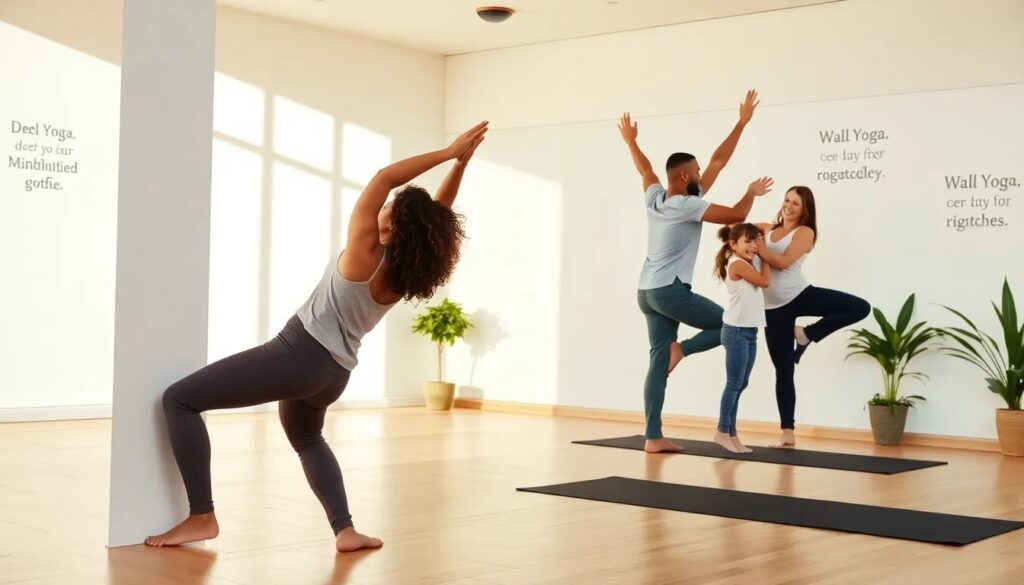
Wall yoga is the practice of using a flat wall as a prop: a stable surface that supports your balance, guides your alignment, and lets you hold or deepen poses you might not manage unassisted. It is not a separate lineage of yoga but an approach you can layer onto almost any style, and it is especially useful at home, where most people do not have a studio mirror. This guide covers the practical version: a regular wall in a regular room, used as a beginner-friendly support for standing, balance, and restorative poses.
- What is wall yoga?
- Is wall yoga good for you?
- Who wall yoga works best for
- Wall yoga vs. mat yoga vs. chair yoga
- What you need: setting up your space
- 8 wall yoga poses to try at home
- A 20-minute wall yoga sequence for beginners
- How often should you practice wall yoga?
- Safety and contraindications
- Wall yoga vs. a yoga wall (Iyengar ropes): what this article does not cover
What is wall yoga?
In a wall yoga session, the wall plays one of three roles depending on the pose:
- Support. You lean on or press against the wall to stay steady in balance poses such as Tree Pose, removing the fear of falling.
- Resistance. You push into the wall to activate muscles, as in a wall plank or wall push-up, which builds strength with less load on the wrists and shoulders.
- Traction and alignment. The wall gives immediate feedback on whether your spine, hips, or heels are where you think they are, which helps correct posture habits you cannot see in a mirror.
Because the wall does part of the stabilizing work, you can stay in poses longer, breathe more calmly, and focus on form. That is the same reason props are central to restorative yoga: support allows the body to release tension instead of bracing against gravity.
Is wall yoga good for you?
For most healthy adults, wall yoga is a sensible, low-risk way to build the habits that matter for long-term mobility and balance:
- Alignment feedback without a mirror. A flat surface tells you in real time whether your hips, shoulders, or heels are stacked, which is what makes a wall so useful for solo home practice.
- Balance training with a safety net. Standing poses that feel wobbly become steadier with a fingertip against the wall, so you can hold the pose long enough to train the ankle and hip stabilizers.
- Lower fall risk. For older adults and anyone returning after a break, the wall reduces the consequence of a wobble, and the fear that keeps many people off the mat in the first place.
- Accessible strength work. Wall planks, wall push-ups, and Wall Chair build upper-body and thigh strength with much less load on the wrists than floor equivalents.
- Easier recovery poses. Inversions such as Legs Up the Wall can be held longer because the wall takes the leg weight, which is why restorative teachers use them to close a session.
None of this replaces medical advice for specific conditions; the safety section below covers who should check with a doctor first.
Who wall yoga works best for
Beginners
If you are new to yoga, the wall removes two common obstacles: wobbling in standing poses and not knowing whether your alignment is correct. Many of the foundations covered in the guide to yoga for beginners can be practiced at a wall first.
Seniors
Balance naturally declines with age, and fear of falling keeps many older adults from exercising at all. A wall provides a fixed point of contact that makes standing work feel safe, while still training the balance and leg strength that help prevent falls. Wall yoga pairs well with the seated options in the guide to yoga for seniors.
People with limited mobility or returning from a break
The wall lets you scale almost any pose down to your current range of motion, then gradually reduce the support as strength returns. If standing is difficult altogether, chair yoga is the natural companion practice.
Practitioners refining alignment
Even experienced students use the wall as a teacher. Triangle Pose, Warrior II, and Half Moon all become self-correcting when the back body is against a flat surface, because you can feel rather than guess at whether your hips and shoulders are square.
Wall yoga vs. mat yoga vs. chair yoga
| Aspect | Wall yoga | Traditional mat yoga | Chair yoga |
|---|---|---|---|
| Balance demand | Low to moderate (wall assists) | Moderate to high | Very low |
| Best for | Beginners, seniors, alignment work | General practice, all levels | Limited mobility, office breaks |
| Equipment | Clear wall space, mat optional | Yoga mat | Sturdy chair without wheels |
| Strength building | Moderate (wall resistance work) | High potential | Gentle |
| Fall risk | Low | Varies by pose | Lowest |
| Typical session length | 15 to 30 minutes | 30 to 75 minutes | 10 to 30 minutes |
What you need: setting up your space
You can start wall yoga with almost no equipment, but a small setup checklist makes practice safer and more comfortable:
- Wall space. A clear stretch of wall roughly as wide as your arm span, free of frames, shelves, or sticking-out furniture. An interior wall without windows is most stable for leaning poses.
- Floor. A flat, non-slip surface. A yoga mat or thin rug is enough for floor-based poses like Legs Up the Wall.
- Yoga blocks. Optional but very useful. Yoga blocks shorten the distance to the floor in supported lunges, Tree Pose, and Bridge, which keeps the pose accessible when your hamstrings or hips are tight.
- Strap. A yoga strap helps when your hands cannot comfortably reach your foot in hamstring stretches.
- Bare feet or grippy socks. Socks on a hard floor are a slipping hazard in standing poses; barefoot is the default. If your room is cold, non-slip yoga socks are the safer choice.
As an Amazon Associate, we earn from qualifying purchases.


8 wall yoga poses to try at home
The poses below use a flat wall and, where noted, the props above. Names follow the most common English and Sanskrit labels you will see in classes and apps.
- Wall Mountain Pose (Tadasana at the wall). Stand with your heels, sacrum, mid-back, and the back of your head touching the wall. Hold 30 to 60 seconds. The wall tells you instantly if your lower back is collapsing or your chin is jutting forward.
- Legs Up the Wall (Viparita Karani). Lie on your back with your hips close to the wall and rest your legs vertically against it. Hold 5 to 10 minutes. A classic restorative pose for tired legs and a busy mind.
- Wall Downward Dog. Palms on the wall at hip height, walk your feet back, and hinge until your torso is parallel to the floor. You get the hamstring and shoulder stretch of Downward Dog without weight on the wrists.
- Wall Warrior II. Stand with one side about a foot from the wall, extend your arms parallel to the floor, and turn the far leg parallel to the wall behind you. The wall behind your back leg keeps your hips from sinking forward.
- Wall Chair (Utkatasana variation). Slide your back down the wall until your knees bend at roughly 90 degrees. Hold 20 to 60 seconds to build thigh and glute strength.
- Wall Plank. Hands on the wall, step back and lean in, keeping a straight line from head to heels. A gentle entry to core work; step farther back to increase the challenge.
- Supported Tree Pose. Stand with one side near the wall, touch it lightly with your fingertips, and bring one foot to your inner calf or thigh. Train balance with a safety net. Place a block under the lifted foot if it does not reach the leg.
- Wall Bridge. Lie on your back with your feet on the wall and knees bent at 90 degrees. Lift your hips and slide a block under your sacrum. Hold 1 to 3 minutes for a gentle chest opener.
Move slowly, breathe through the nose, and exit any pose that causes pain rather than a working stretch.

- Natural Cork: Elevate your yoga practice with our eco-friendly, non-slip Gaiam Cork Yoga Brick, perfect for yoga, Pilates, and more.
- Modify Your Poses: Ideal for all skill levels; shorten or deepen your stretches effortlessly. Dimensions: 9"W x 5.5"H x 3"D, lightweight at 1.5 lbs.
- Rounded Edges & Superior Grip: Designed for your comfort, the rounded edges and textured surface provide excellent grip and control during challenging poses.
- Perfect Dimensions: Measuring at 9"W x 5.5"H x 3"D, this yoga brick provides ample support for optimal alignment and posture.
- Versatile & Portable: Compact and lightweight, this cork yoga brick is your go-to fitness accessory for home or gym workouts.

A 20-minute wall yoga sequence for beginners
Run the sequence in order, once or twice a week to start. The shape is: warm up at the wall, work standing poses, then finish on the floor. Times are a sensible starting point, not a rule; shorten or lengthen to your capacity.
- Wall Mountain Pose, 1 minute. Notice where the body touches the wall and where it lifts away.
- Wall Downward Dog, 5 to 8 breaths.
- Wall Warrior II, 30 seconds each side.
- Wall Chair, 30 to 60 seconds. Optional second round.
- Supported Tree Pose, 30 seconds each side. Fingertips on the wall.
- Wall Plank, 20 to 40 seconds. Step back to make it easier, closer to the wall to make it harder.
- Wall Bridge with block, 1 to 3 minutes.
- Legs Up the Wall, 5 to 10 minutes. Cover yourself with a blanket if you cool down. End here.

- Home PT Strap for Independence (3 Recovery Stages) – A physical therapy stretching strap designed for gentle knee/hip/leg mobility at home. Use it across recovery: Stage 1 bedside assist (when movement is limited), Stage 2 PT stretching/ROM, Stage 3 daily warm-up to maintain mobility—so you can stay independent
- Non-Elastic, Steady Holds (No Rebound / No Surprise Stretch) – The strap does not stretch, so there’s no bounce and no sudden “give.” You can pull to the angle you need and it stays there, helping you move slowly and safely—especially after knee replacement or hip replacement recovery.
- Loops = Easier Grip + Adjust Depth + Track Progress – Multiple loops provide clear hand/foot holds with less grip strength than towels or ropes. Switch loops anytime to adjust stretch depth, repeat the same position each session, and track ROM progress for hamstrings, calves, hips/hip flexors, and lower back—without forcing.
- Leg Lifter Strap / Mobility Aid for Bed & Car – Can also be used as a leg lifter to help lift your leg into bed or car, supporting daily movement tasks when flexibility is limited (use gently within comfort). gently within comfort).
- PT-Style Daily Stretching for Legs, Back & Feet (Comfort Tip) – Built for slow, controlled home stretching and mobility work for legs, hips, lower back, ankles, and feet (calf/Achilles tightness included)—not an elastic resistance band. For comfort during longer holds, socks or light gloves may help. during longer holds, socks or light gloves can help if you have sensitive hands/skin. gloves can help if you have sensitive hands/skin.
How often should you practice wall yoga?
For general mobility and balance, two to four sessions a week of 15 to 30 minutes is a realistic target. Consistency matters more than session length: ten minutes daily usually does more for balance and stiffness than one long weekly class. As the wall versions become easy, try the same poses a step away from the wall to keep progressing.
If you are using wall yoga to support a specific goal (rebuilding strength after a long break, learning the basics before joining a class), give yourself at least four to six weeks before judging the result. Most of the benefits are cumulative, and the first sessions are mostly about learning the shapes.

- Yoga Bolster Pillow - The Gaiam yoga bolster is a soft and supportive meditation cushion for added support for the body during yoga, meditation, or general relaxation. Our pillow comes in multiple colors to match your style.
- All-Natural Filling - This pillow is filled with natural cotton batting for superior comfort and cushioning. The soft and flexible filling lets you lay against the pillow with cushioned comfort while the pillow keeps its shape.
- Handle Strap - Our yoga pillow features a built-in sturdy handle on the pillow case for hassle-free transport to easily grab the meditation cushion and go or reposition for poses or support your neck.
- Care Instructions - No need to worry about how to maintain freshness for your pillow as the cover is removable and machine washable. Easily remove to toss in the washing machine.
- Not Just for Yoga - This pillow is an ideal yoga accessory but can also be used for general support to stretch out tense muscles in your neck or prop up your legs and feet after a long day.
Safety and contraindications
Wall yoga is gentle, but a small number of situations deserve a quick check with a doctor or physical therapist before you start. None of these are reasons to avoid wall yoga entirely; they are reasons to get specific guidance.
- Uncontrolled high blood pressure, glaucoma, or recent eye surgery. Inversions such as Legs Up the Wall change the pressure in your head and eyes. Most teachers recommend avoiding them unless your doctor has cleared you.
- Late pregnancy. Long periods on the back are usually discouraged in the third trimester, and any inversion should be approved by your provider.
- Severe osteoporosis or recent fracture. Weight-bearing twists and Bridge Pose can load the spine in ways that are not appropriate for fragile bone. A modified sequence is usually possible; ask first.
- Recent surgery, acute injury, or significant balance problems. A physical therapist can tell you which wall poses are safe at your current stage and which to skip.
Two universal rules: breathe through your nose, and come out of any pose that produces sharp or joint pain rather than a working stretch.
This article is general information, not medical advice. If you have a condition affecting your eyes, blood pressure, bones, or balance, or you are pregnant, check with your doctor or physical therapist before starting wall yoga.
Wall yoga vs. a yoga wall (Iyengar ropes): what this article does not cover
You may also see the phrase yoga wall used to describe a wall-mounted system of hooks, ropes, and slings from the Iyengar tradition (sometimes called yoga kurunta). It is a related but different studio practice that uses specialized equipment to take you deeper into backbends and inversions. This article covers the more common case: a regular flat wall at home.
For most healthy adults, yes. The wall gives real-time alignment feedback, reduces the fear of falling in balance poses, and lets you hold poses long enough to actually train the stabilizer muscles. For specific medical conditions, see the safety section above.
Yes. Wall yoga is one of the most beginner-friendly ways to start, because the wall supports your balance and gives instant feedback on alignment, reducing both fall risk and guesswork.
Two to four sessions a week of 15 to 30 minutes is a sensible starting target. Consistency matters more than session length, so ten minutes daily usually does more for balance and stiffness than one long weekly class.
Five to ten minutes is a common range. Come out sooner if you feel tingling in your legs, and avoid the pose if you have uncontrolled high blood pressure, glaucoma or recent eye surgery, or are in late pregnancy unless your doctor approves.
No. Iyengar yoga is a complete method that uses many props, including walls, with a strong emphasis on precise alignment. Wall yoga borrows that prop-based approach but is usually taught as a simpler, standalone home routine.
Have a correction? Contact us.
Last update 2026-09-10. Price and product availability may change.
Recommended: