Yoga Poses Chart: Names, Pictures, and How to Use One for Practice

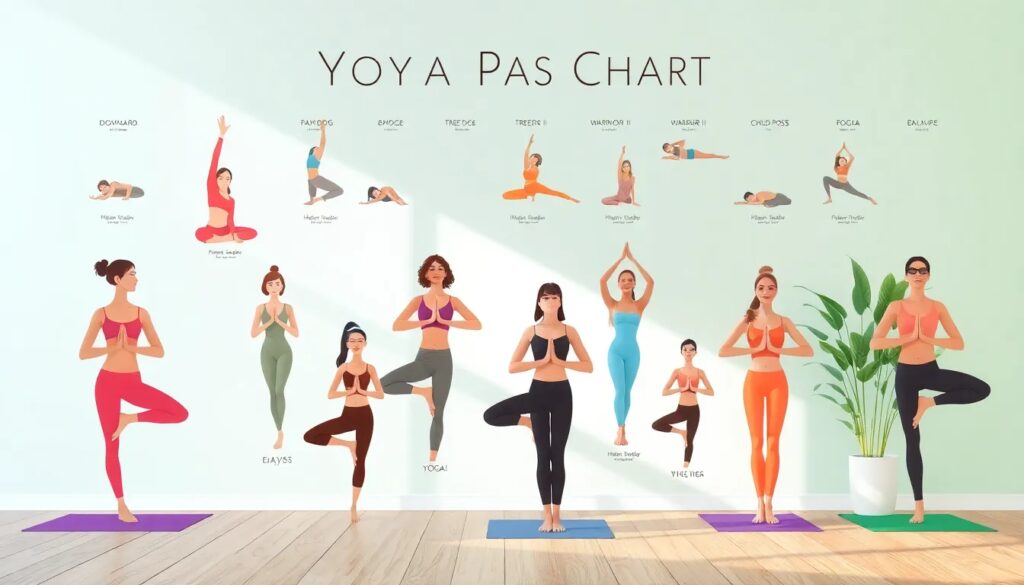
A yoga poses chart is a visual reference that shows yoga postures (asanas) — usually as illustrations or photos with English and Sanskrit names, grouped by category such as standing, seated, backbends, and inversions. Charts serve three practical jobs: helping you learn pose names, plan home sequences, and track which postures you have already worked on. They are not a substitute for alignment instruction, but used well they make a home practice far more organized. This guide covers the pose families you will see on any chart, a working list of common poses with their Sanskrit names and what each one does, the 26-posture Bikram series, and what separates a useful printable from a noisy one.
- What a yoga poses chart actually shows
- The main pose families on a chart
- Common yoga poses chart with names and benefits
- The 26 Bikram yoga poses chart
- How to use a yoga poses chart in your practice
- Types of yoga poses charts by use case
- What makes a printable yoga poses chart worth printing
- Where to find a good yoga poses chart
- Frequently asked questions
What a yoga poses chart actually shows
Most charts display each pose as a small figure with one or two names beneath it. Better charts add a difficulty marker, a category grouping, or a short breath cue. What nearly all charts leave out is the part that keeps practice safe: how to enter and exit a pose, detailed alignment notes, and modifications. Treat the chart as a map, not a teacher — pair it with detailed instructions or a class for anything new to you.
The most famous example of the format is the Dharma Mittra Master Chart of 908 Postures, compiled by Sri Dharma Mittra in 1984 from photographs of himself in each pose. It is the clearest visual reminder of how vast the asana catalog is — and that no practitioner needs anywhere near all of it to build a steady practice. For a guide that focuses on the names themselves, see our piece on yoga poses with names.
The main pose families on a chart
Whatever the chart, the postures fall into a small set of families. Knowing them turns a wall of figures into something you can sequence with:
| Category | Examples | Main purpose in practice |
|---|---|---|
| Standing | Mountain, Warrior I/II, Triangle | Strength, stability, foundation for flows |
| Balancing | Tree, Eagle, Half Moon | Focus, ankle and hip stability |
| Seated & forward folds | Staff, Seated Forward Fold, Head-to-Knee | Hamstring and back release, calming effect |
| Twists | Seated Spinal Twist, Revolved Triangle | Spinal mobility |
| Backbends | Cobra, Bridge, Camel | Front-body opening, posture counterbalance |
| Inversions & arm balances | Downward-Facing Dog, Headstand, Crow | Strength and control; the advanced end of most charts |
| Restorative | Child's Pose, Legs-up-the-Wall, Savasana | Rest, recovery, closing a practice |
For a deeper look at the seated and forward-fold end of the list, our guide to seated yoga poses walks through the shapes and the props that make them accessible.
Common yoga poses chart with names and benefits
Below is a working list of the 12 most common poses on any beginner or general chart, each with its English name, its Sanskrit name, and what the pose is generally used for. Sanskrit names are widely agreed across schools; the benefit notes describe the mechanical intent of the posture, not a clinical outcome. If much of this is new, our yoga poses for beginners guide covers the foundational shapes in more depth.
- Mountain (Tadasana) — the foundational standing posture; grounds the feet, lengthens the spine, sets alignment for every standing pose that follows.
- Downward-Facing Dog (Adho Mukha Svanasana) — an inverted V; opens the shoulders and hamstrings and is the rest pose of many Ashtanga-style flows. See our downward dog guide for alignment basics.
- Cobra (Bhujangasana) — a gentle backbend from prone; opens the chest and strengthens the spinal extensors.
- Bridge (Setu Bandha Sarvangasana) — a supported backbend; opens the chest and fronts of the hips. Our bridge pose walkthrough covers the setup and the common knees-apart cue.
- Child's Pose (Balasana) — a kneeling rest; releases the lower back and turns the practice inward. See the child's pose page for knee-friendly variations.
- Warrior I (Virabhadrasana I) — a strong standing pose with a back leg extended; builds leg strength and opens the front of the body.
- Warrior II (Virabhadrasana II) — a wide-stance standing pose; builds hip and shoulder endurance and is the most-posed figure in any warrior-themed chart.
- Triangle (Trikonasana) — a wide-stance side bend; lengthens both side bodies and stretches the hamstrings. See our triangle pose notes.
- Tree (Vrksasana) — a single-leg balance; trains ankle stability and focus. More on tree pose setup.
- Seated Forward Fold (Paschimottanasana) — a long, calm fold over the legs; releases the hamstrings and back body and is one of the main "cool-down" shapes on a chart.
- Corpse Pose (Savasana) — the closing rest; practiced at the end of nearly every session and the last figure on any complete chart.
- Crow (Kakasana) — an arm balance with the knees resting on the upper arms; an entry point for inversion-style strength. See our crow pose page for setup tips.
Of these, the seven most repeated on beginner charts are usually Mountain, Downward Dog, Cobra, Child's Pose, Tree, Warrior I, and Savasana — a useful shortlist if you are building a chart from scratch.
The 26 Bikram yoga poses chart
One specific chart shows up in search often: the 26-pose Bikram sequence. It is a fixed set of 26 postures (plus two breathing exercises) performed twice in a heated room, in a standardized order. Because the sequence does not change, charts for it are unusually consistent — every studio teaches the same 26, in the same order, which is why "yoga poses chart 26" is a recurring search.
For a pose-by-pose walkthrough of that series, our Bikram yoga poses guide lists each posture with the cue most teachers use.
How to use a yoga poses chart in your practice
- Pick a balanced handful, not a page. Choose 6–10 poses: a warm-up shape, two or three standing poses, one twist, one backbend, one forward fold, and a resting pose.
- Order them sensibly. Warm up first, peak effort in the middle, slower floor poses toward the end, rest last.
- Look up instructions for anything unfamiliar — the chart gives you the what, not the how. Pair it with a teacher or a detailed how-to for any new shape.
- Hold each pose for several slow breaths — about 3–5 breaths, longer for restorative shapes. Breath is the unit the chart does not measure for you.
- Mark progress. A printed chart doubles as a tracker: circle poses you practice regularly, star the ones you are building toward.
- Rotate monthly. Swapping a few poses keeps a home practice from going stale without redesigning it from scratch.
Types of yoga poses charts by use case
- Beginner charts keep to 10–30 foundational poses with clear names — the most useful kind for the first year of practice. They map directly to the family table earlier in this guide.
- Sequence charts map a fixed flow — the Ashtanga Primary Series and the Bikram 26 are the two most-asked examples. The Surya Namaskar (Sun Salutation) chart is a smaller fixed sequence of its own.
- Chair and seated charts adapt poses for desks and limited mobility — our guide to seated yoga poses and the chair yoga poses roundup cover that territory in depth.
- Kids charts use animal names and bright illustrations; we keep a free printable of yoga poses for kids for parents and teachers.
- Advanced charts (the 84-asana classical sets and the Dharma Mittra 908-pose chart) are inspiring reference pieces — browse them for curiosity, and build toward difficult poses gradually. Our look at the hardest yoga poses explains what makes the deep end deep.
What makes a printable yoga poses chart worth printing
- Both English and Sanskrit names, so studio cues and home practice connect.
- Clear, anatomically sensible figures — if the drawing is ambiguous, the chart will teach you the wrong shape.
- Category grouping or difficulty marking, which makes sequencing far easier than an alphabetical grid.
- A reputable source: charts from established schools, certified teachers, or recognized publishers are less likely to contain mislabeled poses than random image-search results.
General information, not medical advice. If you have an injury or health condition, get guidance from a qualified teacher or clinician before attempting unfamiliar poses.
Where to find a good yoga poses chart
The safest sources are established yoga schools, certified teachers, and recognized publishers rather than anonymous image results. Look for charts that label each figure in English and Sanskrit, group poses by family, and show unambiguous alignment. Yoga book publishers (we round up options in our yoga books guide) often include a fold-out chart in their back matter; teacher-training manuals and major school websites (such as Dharma Mittra's and the Yoga Journal pose library) are equally trustworthy. A non-slip mat to lay the chart on — or to practice from — is a small piece of kit most home practitioners already own:
As an Amazon Associate, we earn from qualifying purchases.


If you would rather have the chart itself on the wall, printed posters cover the same ground in a larger format:


Frequently asked questions
There is no fixed number. Classical Hatha texts describe 84 key asanas, while modern compilations run much larger — the Dharma Mittra Master Chart of 1984 documents 908 postures, and variations push the count higher still.
Yes, as a reference and planning tool. Beginners get the most from a small chart of foundational poses combined with detailed instructions or classes, since charts show what a pose looks like but not how to do it safely.
Pick 6 to 10 poses across families: a warm-up, two or three standing, one twist, one backbend, one forward fold, and a resting pose. Sequence from dynamic to calm, hold each for several slow breaths, and look up proper instructions for anything new.
The 26-pose Bikram sequence is a fixed set of postures (plus two breathing exercises) performed twice in a heated room. The order is standardized across studios, which is why charts for this series are especially common.
Look to established yoga schools, certified teachers, and recognized publishers rather than anonymous image results. Check that poses are labeled in English and Sanskrit and that the illustrations are unambiguous before printing.
Have a correction or a question about this article? Reach us via our contact page.
Last update 2026-09-10. Price and product availability may change.
Recommended: