Triangle Pose (Trikonasana): How to Do It, Alignment Cues, and Variations

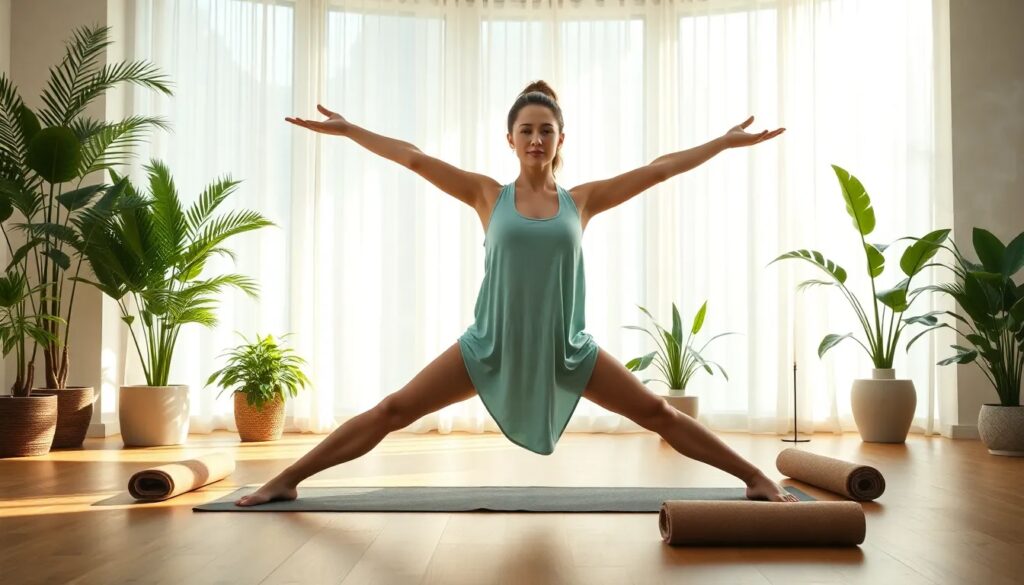
Triangle Pose (Utthita Trikonasana) is a standing yoga posture in which you straddle the mat with straight legs, hinge sideways over the front leg, rest the lower hand on your shin, a block, or the floor, and reach the top arm toward the ceiling, so the body forms a series of triangles. It stretches the hamstrings, inner thighs, and side body while strengthening the legs, and it appears in nearly every style of yoga, from hatha to vinyasa.
Below you will find precise step-by-step instructions, the alignment cues that actually matter, the most common mistakes, and variations for stiff, average, and very flexible bodies.
How to do Triangle Pose step by step
- Stand sideways on your mat and step the feet wide apart, roughly the length of one of your legs.
- Turn the right foot out 90 degrees so the toes point to the short edge of the mat. Turn the left toes in slightly. The right heel can align with the left heel or with the arch of the back foot, whichever feels more stable.
- Press evenly through both feet and lift the kneecaps to engage the thighs, keeping a soft micro-bend in the front knee rather than locking it.
- Inhale and extend the arms parallel to the floor at shoulder height.
- Exhale and reach the torso to the right, as if your hands were being pulled apart, then hinge at the right hip and lower the right hand to the shin, ankle, a block, or the floor.
- Extend the left arm straight up, stacking the shoulders roughly vertically. Look up at the top hand, straight ahead, or down at the floor if your neck prefers it.
- Stay for 3 to 6 slow breaths, keeping both sides of the waist long, then root through the feet, inhale, and rise. Repeat on the left side.
The alignment cues that actually matter
Triangle Pose attracts a lot of conflicting instruction, so it helps to separate essentials from preferences:
- Reach before you drop. The sideways length of the torso matters more than how low the bottom hand goes. A long spine on a block beats a collapsed spine on the floor.
- Keep both sides of the waist long. If the bottom ribs crumple, you have gone too deep.
- Do not lock the front knee. Hyperextension is the most common joint complaint in this pose; engage the thigh and keep a tiny bend.
- Stack within reason. The old instruction to flatten the body as if between two panes of glass works for open hips but forces others to collapse. Letting the chest rotate slightly toward the floor is acceptable if the spine stays long.
- Weight in both feet. Press the outer edge of the back foot down; the back leg is half the pose.
Common mistakes and how to fix them
| Mistake | Why it happens | Fix |
|---|---|---|
| Collapsing the chest toward the floor | Reaching too low for the hand position | Place the hand higher (shin or block) and rotate the chest open |
| Locked, hyperextended front knee | Relying on the joint instead of the muscles | Engage the quadriceps and keep a micro-bend |
| Back hip swinging behind the body | Tight hips forcing a fake depth | Shorten the stance slightly and re-stack the pelvis |
| Straining the neck looking up | Copying the full classical gaze too early | Look forward or down; the neck position is optional |
| All the weight in the front leg | Forgetting the back foot | Press the outer edge of the back foot firmly into the mat |
Variations for different bodies
- With a block: place a block outside the front shin at its tallest height. This is the standard option for most practitioners, not a downgrade.
- Back against a wall: practicing with the back body lightly touching a wall teaches the sideways plane of the pose and helps with balance.
- Shorter stance: reduces hamstring demand and makes the pelvis easier to control; useful for beginners and tight hamstrings.
- Revolved Triangle (Parivrtta Trikonasana): a much more demanding twisting version that requires hamstring length and balance; approach it only once the standard pose feels stable.
- Baddha Trikonasana (bound variation): once balance and hamstring length are steady, the arms can interlace behind the back instead of reaching up and down, adding a deeper shoulder and chest opening to the pose.
As an Amazon Associate, we earn from qualifying purchases.

- STABILITY plus BALANCE: Yoga blocks provide the stability and balance needed in your practice to help with optimal alignment, deeper poses and increased strength
- DURABLE SUPPORTIVE FOAM: These lightweight and supportive foam blocks are constructed of a durable foam with a nonslip surface and beveled edges for easy gripping. Premium blocks are 50 percent denser than standard EVA blocks
- MODIFY plus ALIGN: Use under your hands, feet or seat (meditation) to ensure the proper alignment needed in order to safely support and modify poses to suit your level of flexibility If you feel tight, don't risk injury and grab a block or two
- EXTEND plus DEEPEN STRETCHES: Blocks make for the ideal yoga prop and companion, as they are an important tool in your practice to help extend, support and deepen your stretches while also working to increase your range of motion
- CARE INFO: Spot clean with mild detergent towel or air dry (Dimensions: 9 Inches W x 6 Inches H x 4 Inches D / Weight: 4.6 Ounce) Sold as 2 Pack


- DIMENSIONS: Each yoga block measures 9 inches long, 6 inches wide, and 3 inches high, perfect for supporting various yoga poses and stretches
- SET INCLUDES: Package contains 2 high-density EVA foam blocks, providing reliable support for your yoga practice
- VERSATILE USE: Ideal for yoga, pilates, meditation, and stretching exercises, helping practitioners of all levels maintain proper alignment
- LIGHTWEIGHT DESIGN: Made from EVA foam material that is both sturdy and lightweight for easy transport to and from classes
- SUPPORT & STABILITY: Blocks provide the perfect height and firmness to assist with balance, flexibility, and proper posture during practice

- Yoga Blocks are essential tools for yoga practitioners of all levels to improve the difficulty and stretching strength of various parts of the body. They help adjust posture, assisting the body in achieving certain movements with more precision and ease
- Made from EVA rubber products, these yoga blocks are water-resistant, featuring a closed cell structure that makes non-water absorption and excellent moisture resistance
- This yoga bricks is designed for convenience, being lightweight and compact, making it suitable for carrying to various occasions such as lounges, outdoor activities, home yoga, and stretching exercises
- The surface of these yoga blocks is smooth and non-porous, repelling dirt and dust. Should any dirt accumulate, it can be easily removed with a damp towel, saving you the hassle of thorough cleaning
- They possess good shock resistance and cushioning performance, providing a stable and comfortable foundation for your yoga practice

- Yoga Block - The Gaiam yoga block is an essential yoga tool for aiding in poses and flexibility. Yoga blocks help to provide the stability and balance needed in your practice for optimal alignment, deeper poses, and increased strength.
- Portable and Durable - These lightweight and supportive foam blocks are constructed of a durable foam. They are light enough to carry to yoga classes or around the home yet strong enough for daily poses.
- Non-Slip - The beveled edges with the non-slip surface are designed for a more secure grip. Our yoga props are ideal for all sorts of poses as well as general floor stretches or incorporating with Pilates.
- Align and Center - Use under your hands, feet or seat to ensure the proper alignment needed in order to safely support and modify poses to suit your level of flexibility. Yoga blocks are great for extending poses while maintaining concentration.
- Specifications - For maintaining your yoga wedge block, we recommend spot cleaning with mild detergent and then towel or air dry. Dimensions are 9"W x 6"H x 4"D / weight: 4. 6oz.

- Set of 2 yoga blocks help promote better balance, proper alignment, and deeper poses
- Made of durable, high-density foam for reliable support and long-lasting performance
- Slip-resistant surface help ensure a secure hold; round edges for a comfortable, steady grip
- Lightweight and modular; use separately or stacked together in a variety of configurations
- Large enough to comfortably sit on; measure 4 by 9 by 6 inches each (LxWxH)

- DIMENSIONS: Each yoga block measures 9 inches long, 6 inches wide, and 3 inches high, perfect for supporting various yoga poses and stretches
- SET INCLUDES: Package contains 2 high-density EVA foam blocks, providing reliable support for your yoga practice
- VERSATILE USE: Ideal for yoga, pilates, meditation, and stretching exercises, helping practitioners of all levels maintain proper alignment
- LIGHTWEIGHT DESIGN: Made from EVA foam material that is both sturdy and lightweight for easy transport to and from classes
- SUPPORT & STABILITY: Blocks provide the perfect height and firmness to assist with balance, flexibility, and proper posture during practice

- Yoga Block - The Gaiam yoga block is an essential yoga tool for aiding in poses and flexibility. Yoga blocks help to provide the stability and balance needed in your practice for optimal alignment, deeper poses, and increased strength.
- Portable and Durable - These lightweight and supportive foam blocks are constructed of a durable foam. They are light enough to carry to yoga classes or around the home yet strong enough for daily poses.
- Non-Slip - The beveled edges with the non-slip surface are designed for a more secure grip. Our yoga props are ideal for all sorts of poses as well as general floor stretches or incorporating with Pilates.
- Align and Center - Use under your hands, feet or seat to ensure the proper alignment needed in order to safely support and modify poses to suit your level of flexibility. Yoga blocks are great for extending poses while maintaining concentration.
- Specifications - For maintaining your yoga wedge block, we recommend spot cleaning with mild detergent and then towel or air dry. Dimensions are 9"W x 6"H x 4"D / weight: 4. 6oz.

- Yoga Block - The Gaiam yoga block is an essential yoga tool for aiding in poses and flexibility. Yoga blocks help to provide the stability and balance needed in your practice for optimal alignment, deeper poses, and increased strength.
- Portable and Durable - These lightweight and supportive foam blocks are constructed of a durable foam. They are light enough to carry to yoga classes or around the home yet strong enough for daily poses.
- Non-Slip - The beveled edges with the non-slip surface are designed for a more secure grip. Our yoga props are ideal for all sorts of poses as well as general floor stretches or incorporating with Pilates.
- Align and Center - Use under your hands, feet or seat to ensure the proper alignment needed in order to safely support and modify poses to suit your level of flexibility. Yoga blocks are great for extending poses while maintaining concentration.
- Specifications - For maintaining your yoga wedge block, we recommend spot cleaning with mild detergent and then towel or air dry. Dimensions are 9"W x 6"H x 4"D / weight: 4. 6oz.

- 🌿【comfortable support】: Discover enhanced comfort during your yoga practice with Trideer Yoga Block. Crafted from premium foam, these versatile accessories provide the perfect blend of softness and stability, ensuring optimal support for your body.
- 🌿【Injury Prevention】: Yoga blocks are designed to reduce the risk of strain or injury by offering a reliable foundation for various poses and stretches. The foam material gently cushions your body, allowing you to maintain proper alignment and stability throughout your practice.
- 🌿【Versatile Workout Aid】: Whether you're a beginner or an experienced yogi, our foam are an essential tool to elevate your practice. They can be used to deepen stretches, improve flexibility, and increase strength. These lightweight and portable blocks (9"x6"x3")make it easy to incorporate them into any workout routine, both at home or in the studio.
- 🌿【Premium Quality】: Trideer takes pride in delivering high-quality products, and yoga blocks are no exception. Made from durable foam, these blocks are built to withstand regular use and maintain their shape over time. The non-slip surface ensures a secure grip, providing stability and peace of mind during your practice.

- Planet-friendly & Durable -- The KEEP Yoga Blocks are made from high-density EVA foam, providing stable support and high load-bearing capacity, offering the strength needed to support various poses and exercises.They are recyclable and non-toxic, free of chlorides, heavy metals, phenols and latex
- Slip-Resistance Surface -- The surface of the yoga blocks adopt closed-cell treatment, a non-slip, textured surface which can effectively prevent moisture, allows you to maintain control and stability throughout your practice
- Lightweight yet Stability -- After being processed by microporous foaming process, the weight of a single block is only about 0.44lb and children can easily pick it up and grasp it. Yet the design of six sides and 8 angles make them sturdy eenough
- Resist Deformation -- with a precisely scientific cutting, ensuring they are both supportive and durable. This optimal hardness level means the blocks resist deformation and provide consistent support throughout your practice and help you achieve better alignment and balance
- Deepen Yoga Poses -- Yoga blocks are excellent aids for enhancing your yoga practice, They help improve flexibility and facilitate deep stretching. Perfect for extending and supporting your stretches, assisting in challenging poses, and increasing your range of motion
Who should be cautious with Triangle Pose
Triangle Pose is generally safe for most healthy practitioners, but a few situations call for extra caution. An acute back, hip, or knee injury can be aggravated by the hinge and rotation the pose involves. Low blood pressure or dizziness on standing can make the shift into the tilted position uncomfortable, and anyone with balance issues affecting daily movement should practice near a wall or with support close by. None of this rules the pose out on its own — the block and wall variations above make it gentler — but these are reasons to go slowly and check with a healthcare professional if in doubt.
Benefits and how Triangle fits into a sequence
Triangle Pose stretches the hamstrings, adductors, and side waist, builds standing-leg strength, and trains the lateral plane of movement that daily life rarely visits. Claims that it stimulates specific organs are traditional rather than proven, so treat them as such.
In class, Triangle usually appears in the standing sequence after warm-ups such as Downward Facing Dog and lunges, and it pairs naturally with Warrior II and Extended Side Angle. In vinyasa-style classes it is often linked dynamically with breath inside a standing yoga flow. Afterward, hip-focused poses such as Pigeon Pose or gentle backbends like Bridge Pose balance the work nicely.


Frequently asked questions
No. The floor is one option, not the goal. A long, open torso with the hand on a block or shin is better practice than a collapsed torso with the hand on the floor. Hand height should follow spine length, not the other way around.
Three to six slow breaths per side is typical in a flowing class; in hatha or alignment-focused classes you might stay up to a minute. Come out earlier if the legs shake heavily or the lower side of the waist starts to collapse.
The usual cause is a locked, hyperextended knee carrying the load passively. Engage the front thigh, keep a small bend in the knee, and shorten your stance. If pain persists, stop and have the joint assessed by a professional.
Both are standing side-bending poses, but in Triangle the front leg stays straight, while Extended Side Angle bends the front knee to about 90 degrees. The bent knee makes Side Angle easier on tight hamstrings, while Triangle demands more hamstring length and balance.
People with acute back, hip, or knee injuries, low blood pressure, or balance issues affecting daily movement should approach Triangle Pose with caution or skip it, and check with a healthcare professional first. The wall and block variations described above make it gentler, but they do not remove every risk.
This article is general information, not medical advice. If you have a back, hip, or knee injury, low blood pressure, or another condition that affects balance, check with a qualified health professional before practicing this pose.
Have a correction? Contact us.
Last update 2026-09-10. Price and product availability may change.
Recommended: