What Is the Name for the Yoga of Meditation? A Practical Guide

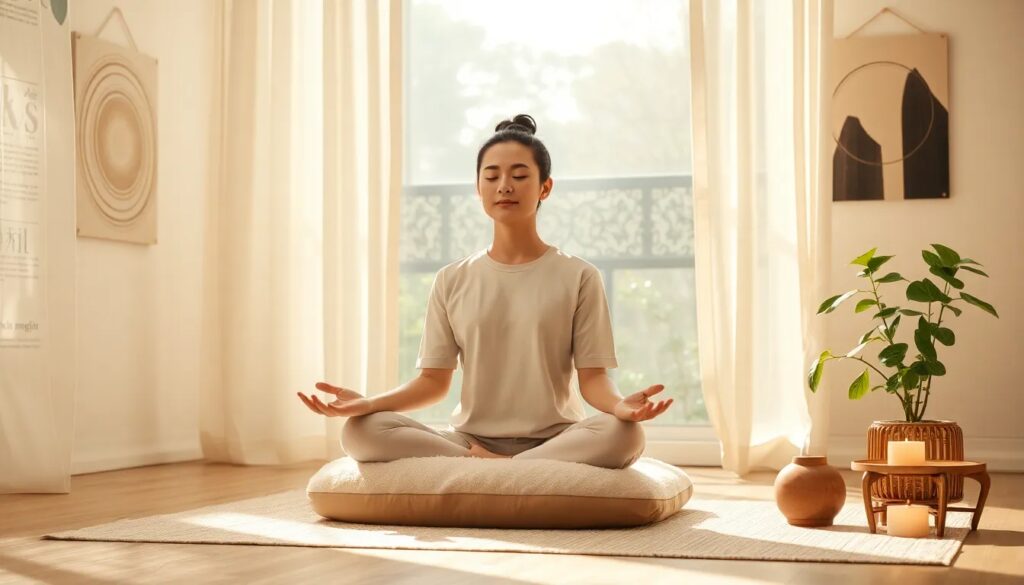
The yoga of meditation is called Dhyana Yoga, from the Sanskrit word dhyana, meaning meditation or meditative absorption. In the classical system it sits within Raja Yoga — the royal path codified in Patanjali's Yoga Sutras — where dhyana is the seventh of eight limbs, the stage of sustained, unbroken concentration that precedes samadhi. If you want a single name: dhyana is the meditation itself, and Raja Yoga is the school of yoga built around it.
- What does dhyana actually mean?
- Dharana, dhyana and samadhi: how the three stages differ
- What is Raja Yoga, the royal path?
- Dhyana Yoga and the other classical paths
- How dhyana traveled: from Sanskrit to Chan and Zen
- Where does Hatha Yoga fit in?
- How to start a simple dhyana practice
- Related meditation practices to explore
What does dhyana actually mean?
The word dhyana is usually translated as meditation, but a more accurate rendering is meditative absorption: a state in which the mind rests on its object without drifting, judging, or grasping. In everyday English, meditation often means "sitting quietly and trying not to think." Classical dhyana is more specific. It is defined by the quality of attention, not by posture, length of session, or whether the eyes are open. You can practice dhyana on the breath, on a mantra, on a visual object, on a question, or on a sensation in the body. The object matters less than the steadiness of the attention itself.
As a technical term, dhyana is formed from the Sanskrit verbal root dhyai, meaning to think of, contemplate or meditate upon — the word names an activity of the mind, not a way of holding the body. It is worth keeping it distinct from dharana, which is built on a different root, dhri, meaning to hold, bear or sustain: dharana is the effort of holding attention in place, while dhyana is what remains when that effort is no longer needed. The word itself traveled a long way when meditation teachings moved with Buddhism out of India and into China, Korea, Japan, and Vietnam.
Dharana, dhyana and samadhi: how the three stages differ
In Patanjali's framework, meditation is not one act but a progression of three increasingly subtle stages, sometimes practiced together as samyama:
- Dharana (concentration): fixing attention on a single object — the breath, a mantra, a candle flame. Dharana still involves effort: the mind returns to the object again and again.
- Dhyana (meditation): when that concentration becomes continuous and effortless, an unbroken flow of attention toward the object. The meditator is no longer "holding" attention in place; attention simply rests there.
- Samadhi (absorption): the state in which the sense of a separate observer dissolves and only the object of meditation remains. The meditator and the object of meditation are no longer two.
These are the sixth, seventh, and eighth limbs of classical yoga. Most practitioners who sit regularly spend their time oscillating between dharana and dhyana, with brief moments of samadhi arising naturally rather than being chased. The three are usually described as a single continuum, not three separate techniques.
What is Raja Yoga, the royal path?
Raja Yoga — literally royal yoga — is the name traditionally given to the meditative path described in the Yoga Sutras of Patanjali, compiled roughly two thousand years ago. Its eight limbs (ashtanga, not to be confused with the modern posture style of the same name) form a complete training:
- Yama — ethical restraints toward others.
- Niyama — personal observances and self-discipline.
- Asana — steady, comfortable posture.
- Pranayama — regulation of the breath.
- Pratyahara — withdrawal of the senses from their objects.
- Dharana — concentration.
- Dhyana — meditation.
- Samadhi — absorption.
Notice the proportions: only one limb covers physical postures, while three are devoted to meditation. In the classical view, the earlier limbs exist to prepare the practitioner for the last three, and the last three are the actual heart of the practice. For that reason Raja Yoga is often called the yoga of meditation in shorthand. For a fuller treatment of the system, see our dedicated guide to Raja Yoga.
Dhyana Yoga and the other classical paths
Hindu tradition, drawing especially on the Bhagavad Gita, describes several complementary yogas suited to different temperaments. Meditation is central to one of them; the others use different tools to reach related goals.
| Path | Meaning | Primary practice | Suits people who... |
|---|---|---|---|
| Raja / Dhyana Yoga | Yoga of meditation | Concentration and meditative absorption | Are introspective and disciplined |
| Jnana Yoga | Yoga of knowledge | Self-inquiry and study of scripture | Are analytical and philosophical |
| Bhakti Yoga | Yoga of devotion | Chanting, prayer, worship, surrender | Are emotionally and devotionally inclined |
| Karma Yoga | Yoga of action | Selfless service without attachment to results | Are active and service-oriented |
These paths are not exclusive. Most traditions treat them as mutually reinforcing, and the Bhagavad Gita devotes its sixth chapter — often titled Dhyana Yoga — specifically to the practice of meditation, while weaving in elements of all four.
How dhyana traveled: from Sanskrit to Chan and Zen
Dhyana is one of the most-traveled words in the history of meditation. As Buddhist teachings moved from India into China between the first and sixth centuries CE, dhyana was transliterated into Chinese as chan (禪). When those same teachings later reached Japan, chan was read in Japanese as zen. The Korean seon and the Vietnamese thiền are local readings of the same Sanskrit root. Zen, in other words, literally means meditation; the name of the school is a direct echo of the seventh limb of yoga.
This shared root is also why Zen, Chan, and other East Asian meditation schools are sometimes described as a "yoga of meditation" in their own right. Their practice, lineage, and literature grew out of the same dhyana tradition that Patanjali systematized, even though their later forms developed independently and absorbed a great deal of Mahayana Buddhist philosophy along the way.
Where does Hatha Yoga fit in?
Most of what is taught in Western studios — postures, sun salutations, alignment cues — descends from Hatha Yoga, a later tradition that uses the body and breath to prepare the practitioner for meditation. In the classical view, asana exists largely so you can sit comfortably and steadily for dhyana. Breath practices play the bridging role: pranayama calms the nervous system and steadies attention, which is why most meditation traditions begin with the breath before introducing any other object of focus.
The seated postures most often used for dhyana have their own Sanskrit names — Sukhasana (easy cross-legged seat), Padmasana (full lotus), Ardha Padmasana (half lotus), Siddhasana and Muktasana. The shape matters less than the ability to hold it without fidgeting, which is exactly why Hatha's postural training was developed in the first place.
How to start a simple dhyana practice
- Sit steadily. Choose a position you can hold without fidgeting — cross-legged on a cushion or upright in a chair. Comfort and a tall spine matter more than any particular shape.
- Settle the breath. Take two or three minutes of slow, even breathing, or a simple pranayama such as extending the exhale.
- Choose one object. The sensation of the breath at the nostrils, a silent mantra, or a candle flame. One object, kept for the whole session.
- Practice dharana. Rest attention on the object. When the mind wanders — it will — notice without judgment and return. Each return is the training.
- Let dhyana arise. With repetition, the returns become less frequent and attention begins to flow continuously. This cannot be forced; it emerges from consistency.
- Keep it short and regular. Ten minutes daily builds more than an hour once a week.
If sitting still feels inaccessible at first, related practices can serve as gateways. Kundalini Yoga combines movement, breath, and mantra with meditation, which makes the transition into stillness easier for some people. Yoga Nidra is a guided, lying-down practice that trains deep relaxation and interior awareness without requiring a seated posture, and is often used as a first step toward a formal dhyana practice.
Dhyana Yoga. Dhyana is the Sanskrit word for meditation or meditative absorption, and it is the seventh of the eight limbs in Patanjali's classical yoga system. The broader school built around meditation is called Raja Yoga.
Dharana is concentration, the effort of holding attention on one object. Dhyana is meditation, when that attention flows continuously without interruption. Samadhi is absorption, when the sense of a separate observer dissolves. They are the sixth, seventh, and eighth limbs of classical yoga.
Not exactly. Raja Yoga is the complete eight-limbed path described in the Yoga Sutras, which includes ethics, posture, and breathwork as preparation. Meditation (dhyana) is its central and defining practice, which is why Raja Yoga is often called the yoga of meditation.
Both derive from the Sanskrit word dhyana. As meditation teachings traveled with Buddhism, dhyana became chan in Chinese and then zen in Japanese, so Zen literally means meditation.
Have a correction? Contact us.
Recommended: