What Is Yoga Nidra?

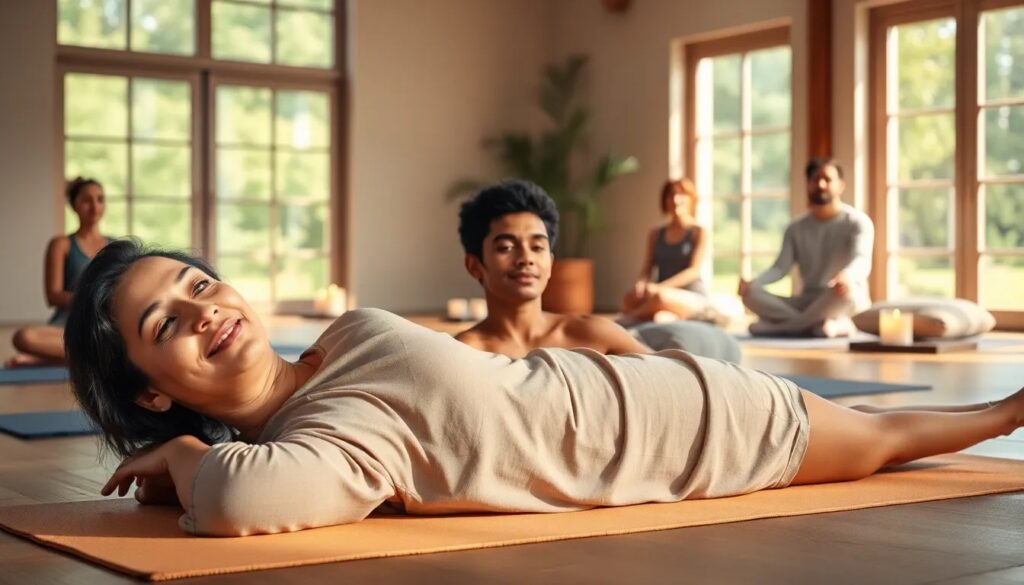
What is yoga nidra? It is a guided meditation you do lying on your back, usually in savasana, while a teacher's voice walks your attention through the body, the breath, and simple imagery. Sessions typically run 20 to 45 minutes, and the aim is a state on the border between waking and sleep — deeply rested, but still lightly aware. The Sanskrit name breaks down to yoga (union) and nidra (sleep), so it is often translated as "yogic sleep."
Where yoga nidra comes from
The idea of conscious rest appears in older yogic and tantric texts, but the structured practice taught today is largely the work of Swami Satyananda Saraswati and the Bihar School of Yoga in the mid-20th century. Satyananda systematized the format into a fixed sequence of stages that most modern recordings still follow. Two later branches matter for English-speaking students: iRest, developed by psychologist Richard Miller as a clinical adaptation used in hospitals, veterans' programs, and trauma-informed settings, and NSDR (non-sleep deep rest), a more recent secular label popularized in neuroscience circles to describe essentially the same protocols without the traditional Sanskrit framing.
What happens in a yoga nidra session
Most guided sessions move through a recognizable sequence, classically eight stages:
- Preparation (settling) — you lie in savasana, supported with props as needed, and let the body come to stillness.
- Sankalpa (intention) — a short, positive resolution stated in the present tense, set mentally at the start and revisited at the end.
- Rotation of consciousness (body scan) — the guide names body parts in a fixed order and you move attention to each one without moving the body.
- Breath awareness — often counting breaths backwards to deepen the relaxation.
- Opposites — paired sensations such as heavy/light or warm/cool, to keep the mind engaged without effort.
- Visualization — guided imagery, often symbolic, designed to access deeper layers of awareness.
- Silent awareness — a stretch of unstructured rest without instructions.
- Return — the sankalpa is revisited and the guide brings you gently back to ordinary wakefulness.
Falling asleep during practice is common, especially at first — it is not a failure, just a sign the nervous system is taking the rest it needs. With repetition, most students learn to stay in the deeply relaxed but aware state that gives the practice its name. If you want a transcript to follow along at home, our guide to yoga nidra scripts walks through what a full session sounds like.
Yoga nidra vs. meditation vs. a nap
| Yoga nidra | Seated meditation | Nap | |
|---|---|---|---|
| Position | Lying down (savasana) | Usually seated, upright | Lying down |
| Guidance | Fully guided, structured stages | Often unguided or lightly guided | None |
| Awareness | Maintained at the edge of sleep | Maintained while alert | Lost |
| Effort required | Minimal — you follow a voice | Moderate — you hold attention yourself | None |
| Typical length | 20–45 min | 10–30 min | 20–90 min |
| Best for | Deep rest, sleep, easing into stillness | Training attention and clarity | Sleeping when sleep-deprived |
If sitting meditation has always felt like a struggle, yoga nidra is the lower-friction entry point: the continuous guidance does the attention-holding for you. For an extended look at the meditative side of the practice, see yoga nidra as a daytime meditation. It also pairs naturally with posture-based rest — the supported shapes of restorative yoga use many of the same props and the same intent.
What the research actually shows
Yoga nidra has a growing but still modest evidence base. Small clinical studies and reviews point to plausible benefits for perceived stress, anxiety symptoms, and subjective sleep quality, plausibly via a shift toward parasympathetic (rest-and-digest) nervous system activity. Adapted protocols such as iRest have shown encouraging results for PTSD symptoms and chronic pain in specific populations, including veterans.
Honest caveats: many of these studies are small, lack rigorous controls, or rely on self-reported outcomes. The popular claim that one hour of yoga nidra "equals four hours of sleep" circulates widely online and has no solid scientific basis. Yoga nidra is a deeply restful state and may improve how well you sleep, but it does not replace the brain processes of actual sleep. Treat it as a low-cost, low-risk relaxation tool that complements professional care for sleep or mental-health conditions rather than replacing it.
Many people use the practice specifically to wind down at night; for the sleep angle in depth, see our guide to yoga nidra for sleep.
Yoga nidra and NSDR: what's the difference
NSDR (non-sleep deep rest) is a modern, secular label for guided deep-relaxation protocols — and yoga nidra is the best-known practice within it. The protocols are essentially the same: lie down, follow a guided body scan and breath, and rest in light awareness. NSDR scripts typically drop the traditional framing (sankalpa, the eight classical stages, the Sanskrit vocabulary) and present the practice as a brain-state exercise rather than a yogic one. The recent surge in popularity is largely thanks to neuroscientist Andrew Huberman, who has spoken about NSDR on his podcast as a way to deliberately downshift the nervous system.
How to start practicing tonight
- Find a guided recording. Free sessions of every length are available on YouTube and on apps such as Insight Timer. Start with a 20-minute track.
- Set up for stillness. Lie on a mat or a bed, cover yourself with a blanket (body temperature drops as you relax), and support the knees with a cushion or bolster. The set-up mirrors restorative yoga, so the same props work for both.
- Pick a consistent time. Right before bed is the most popular slot; mid-afternoon works well as a reset. Avoid right after a large meal.
- Set a sankalpa if the recording asks. A short, present-tense phrase ("I am at ease") is enough. It is the one moment of "doing" in the whole practice.
- Let go of doing it right. Wandering attention and dozing off are part of the learning curve, not a problem to fix. The same practice will look different from session to session.
If lying flat on the floor is uncomfortable, the practice adapts easily — it can be done seated in a chair, and audio-only formats work for people who cannot get down to the mat.
Who should be cautious
Yoga nidra is physically about as low-risk as a practice can be. The main cautions are psychological. People with trauma histories, PTSD, or severe depression occasionally find that deep relaxation and guided imagery surface difficult material. If that applies to you, work with a trauma-informed teacher or a clinician-developed protocol such as iRest rather than random recordings, and stop any session that feels distressing. For practitioners who want to learn to guide the practice themselves, our overview of yoga nidra certification covers what to look for in a training.
This article is general information, not medical or mental-health advice. Yoga nidra can complement professional care, but it does not replace it. Students with trauma histories, persistent insomnia, or psychiatric conditions should work with qualified clinicians alongside any relaxation practice.
Frequently asked questions
Yes. Falling asleep is common, especially at first, and the body still gets rest from the session. With practice most students learn to hover in the deeply relaxed but aware state the practice is designed for.
Anywhere from 10 to 45 minutes. Twenty minutes is a good starting length; longer sessions simply spend more time in each stage. Consistency over several weeks matters more than duration.
No. It is deeply restful and may improve how well you sleep, but the popular claim that one session equals several hours of sleep has no solid scientific basis. Treat it as a complement to sleep, not a substitute.
None. There are no poses and no physical demands beyond lying still. If you can lie down and listen to a guided recording, you can practice yoga nidra.
NSDR (non-sleep deep rest) is a modern, secular label for guided deep-relaxation protocols, and yoga nidra is the best-known practice within it. NSDR scripts usually drop the traditional framing such as the sankalpa; the underlying protocol is essentially the same.
Have a correction or a question about this article? Reach us via our contact page.
Recommended: