What Is Gentle Flow Yoga? A Slow Vinyasa Practice for Every Body

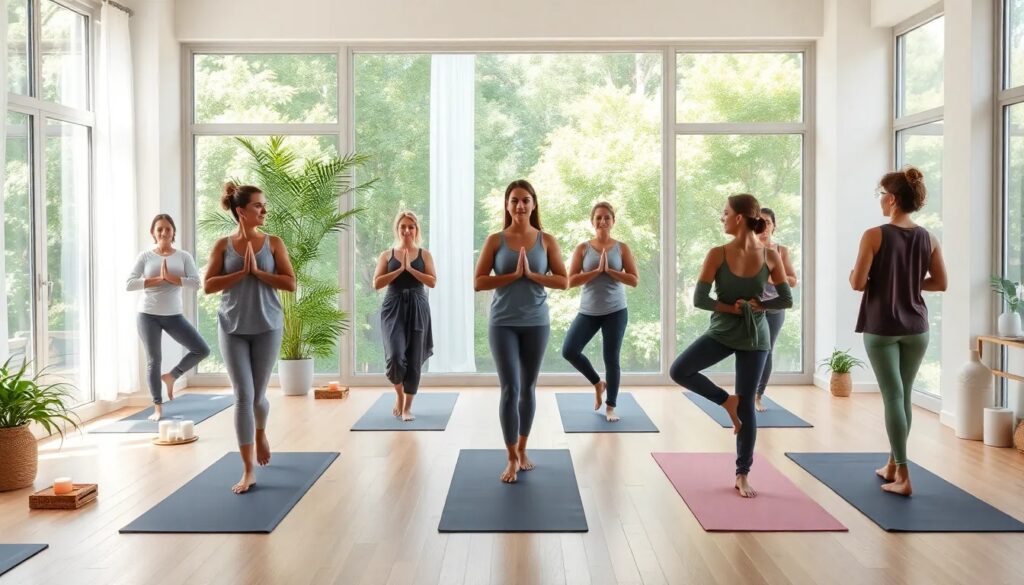
Gentle flow yoga is a slow-paced vinyasa practice that links simple, joint-friendly postures to the breath at a conversational tempo. Poses shift one breath at a time, sequences repeat so the body can learn the patterns, and the teacher offers wall, chair, or block support throughout. The result is a class that feels like movement meditation: enough structure to stay engaged, enough ease to stay present.
It belongs to the vinyasa family (breath-to-movement), but it is the vinyasa family at a slower clock. For a closer look at the parent style, see our guide to vinyasa. For a wider view that includes restorative and chair yoga, see gentle yoga.
How gentle flow differs from regular vinyasa
In a standard vinyasa flow class, you link movement to each inhale or exhale and the sequence keeps advancing — miss a cue and you are already on the next pose. Gentle flow slows the transitions so that each breath cue gives you real time to arrive in the shape. Planks are usually held for a breath or two rather than used as pass-through postures. Child's Pose is offered genuinely as part of the sequence, not as a quick reset between Chaturangas. The cumulative effect is that your nervous system rarely tips into a low-grade "keep up" response.
This distinction matters in practice. Gentle flow is not just beginner vinyasa with easier poses. It is a deliberate deceleration of the flow model, and that pacing changes the experience. If you want a related but distinct style that also slows vinyasa down, see slow flow yoga.
Gentle flow vs. restorative and yin yoga
| Feature | Gentle Flow | Restorative | Yin |
|---|---|---|---|
| Movement | Slow continuous flow | Fully passive; no flow | Passive; long static holds |
| Poses per class | 10–20 | 4–7 | 5–10 |
| Hold duration | 3–5 breaths | 5–10+ minutes per pose | 3–5 minutes per pose |
| Props | Optional; blocks and straps | Extensive (bolsters, blankets) | Moderate (blocks, blankets) |
| Target tissue | Muscles and joints | Nervous system reset | Connective tissue (fascia) |
| Energy after class | Calm but grounded | Deeply settled | Released, sometimes emotional |
Gentle flow is the only one of the three that involves actual movement. That quality makes it useful when you want more than passive rest but less than a workout. You leave a restorative class feeling like you slept; you leave a gentle flow class feeling like you moved thoughtfully. For a deeper look at the still, supported end of the spectrum, see restorative yoga; for the long-hold, fascia-focused end, see yin yoga.
What a gentle flow class looks like
Most gentle flow classes run 45 to 75 minutes. A typical structure:
- Supine opening (5–10 min). Starting on the back with knees-to-chest, gentle spinal twists, or Supta Baddha Konasana (reclined bound angle). No pressure to do anything ambitious while the body is still cold.
- Tabletop and kneeling work (10–15 min). Cat-Cow, Bird-Dog, low lunges, and gentle hip circles. This builds warmth without demanding balance or upper-body strength.
- Standing sequence (15–20 min). Mountain Pose, Warrior I and II, Triangle, and Tree are common. Movements are slow enough that teachers can cue alignment details. Wall or chair support is routinely offered.
- Seated and floor closing (10–15 min). Seated Forward Fold, a reclined twist, and Legs-Up-The-Wall or supported Bridge before Savasana.
- Savasana (5–10 min). Always included; sometimes extended.
For a ready-made sequence to follow at home, see our gentle yoga sequence.
Who gentle flow yoga is best suited for
Gentle flow is a strong match for people who are new to yoga and want to build the movement vocabulary before attempting a standard flow class. The slower pace gives beginners time to learn pose names, follow alignment cues, and breathe without trying to keep up with an advancing sequence, which is why it is often recommended over standard vinyasa for absolute beginners.
It also suits people returning after injury. The slow transitions give you time to notice when something feels wrong and ease out of the pose before it becomes worse. People managing chronic pain, anxiety, or stress-related sleep issues often choose gentle flow for the same reason: the pacing and the extended breath cues tend to feel grounding rather than stimulating.
Older adults, including those with no prior yoga experience, often find gentle flow more accessible than chair-only sequences because it still includes standing postures and a normal range of motion, with the option to keep one knee down in lunges or use a wall for balance. Pregnant students are commonly guided toward gentle flow by prenatal teachers for the same reason, though individual guidance from a qualified prenatal instructor matters.
Experienced practitioners use gentle flow as active recovery on days after more demanding sessions, or as a deliberate reset during stressful periods. The question is not whether you are advanced enough for the room; it is whether the pace fits what your body and mind need today.
Common poses in a gentle flow sequence
The poses themselves are not unique to gentle flow; what distinguishes the style is the pacing and intention. That said, certain postures appear consistently across most classes. For a fuller visual catalogue, see our guide to gentle yoga poses.
- Cat-Cow (Marjaryasana-Bitilasana): A foundational breath-to-movement pairing that most teachers use to warm the spine and establish the flow rhythm.
- Low Lunge (Anjaneyasana): An accessible hip-flexor opener that scales well. The back knee can stay on the mat throughout, which makes it friendly for tight hips and for seniors.
- Warrior II (Virabhadrasana II): Held longer than in a standard vinyasa class, giving the teacher time to cue details about hip alignment and arm energy.
- Supine Twist (Supta Matsyendrasana): A closing rotation that releases the thoracic spine and is comfortable for almost everyone.
- Legs-Up-The-Wall (Viparita Karani): A semi-inversion that calms the nervous system and relieves tired legs; common as a transition into Savasana.
As an Amazon Associate, we earn from qualifying purchases.


How to choose a gentle flow class
A few practical filters make it easier to find a class that actually feels like gentle flow rather than a vinyasa class that just uses the word "gentle" in the title.
- Check the class description, not just the name. "Gentle flow" and "slow flow" often overlap, but "gentle" usually signals modifications and props first; "slow" usually signals longer holds in a vinyasa sequence. Either is fine — pick based on what your body needs today.
- Look for explicit prop use. Studios that mention blocks, straps, bolsters, and chair support in the class description are usually more committed to accessibility than studios that just label the class "gentle".
- Ask the teacher two questions before class. "What intensity should I expect?" and "Are modifications offered for every pose?" If the answers feel vague, the class may be marketed as gentle but taught as a level-1 vinyasa.
- Online vs. in-person. Online classes give you pause-and-replay access, which is helpful when you are new to a sequence. In-person classes give you hands-on adjustments and a teacher who can see your alignment. Many students use a mix.
- What to bring. A yoga mat, a water bottle, and (if you have them) a block and a strap. Studios usually provide props; for home practice, a sturdy chair and a folded blanket are a useful substitute for a bolster.

- YOGA BLOCK and YOGA STRAP COMBO: Makes for a great yoga prop and accessories starter kit, providing the support you need to get started
- STABILITY and BALANCE: Yoga blocks and yoga straps provide the stability and balance needed in your practice to help with optimal alignment, deeper poses and increased strength
- EXTEND with DEEPEN STRETCHES: Blocks and straps enable you to extend, support and deepen your stretches while also working to increase range of motion; Easy release D ring metal buckle holds 6 feet strap securely in place allowing your shoulders to relax
- MODIFY and ALIGN: Use under your hands, feet or seat (meditation) to ensure the proper alignment needed in order to safely support and modify poses to suit your level of flexibility; If you feel tight, don't risk injury and grab a block and a strap
- CARE INFO: Spot clean with mild detergent; towel or air dry (Block Dimensions: 9 inches W x 6 inches H x 4 inches D / Weight: 4.6 ounces; Strap Dimensions: 6 feet)

Gentle flow and mental wellbeing
Many practitioners choose gentle flow for stress and anxiety because the slow pace, extended breath cues, and supported postures tend to feel calming. Movement combined with deliberate slowing is a common pairing in stress-management practice, and the class usually leaves you calm but grounded rather than depleted.
Gentle flow is a supportive practice, not a medical treatment. If anxiety, depression, or chronic stress are significantly affecting your daily life, speak with a qualified clinician. For most students, gentle flow works best as one regular input alongside sleep, movement, and professional support when needed.
Frequently asked questions
Gentle flow yoga involves slow, continuous movement linking breath to pose transitions, typically 10 to 20 poses per class held for a few breaths each. Restorative yoga is fully passive: you lie supported by bolsters and blankets in 4 to 7 poses for 5 to 10+ minutes each with no active movement. Gentle flow leaves you calm and grounded; restorative leaves you deeply settled.
Yes. The slower pace gives beginners time to learn pose names, follow alignment cues, and breathe without trying to keep up with an advancing sequence. Most gentle flow teachers also offer modifications throughout the class.
Gentle flow involves slow movement throughout the class. Yin involves holding a small number of passive poses, commonly 5 to 10, for about 3 to 5 minutes each, with no flowing transitions. Yin targets connective tissue; gentle flow targets muscles and joints through mindful movement.
Many practitioners choose gentle flow for stress and anxiety because the slow pace, extended breath cues, and supported postures tend to feel calming. It is a supportive practice, not a medical treatment; if anxiety is significantly affecting your life, speak with a qualified clinician.
Yes. The slower transitions, option to keep one knee down in lunges, and routine use of blocks and chairs make gentle flow more accessible than standard vinyasa for many older adults, including those with no prior yoga experience.
Have a correction or a question about this article? Reach us via our contact page.
Last update 2026-09-10. Price and product availability may change.
Recommended: