Acro Yoga Poses: The Complete Beginner-to-Advanced Catalog

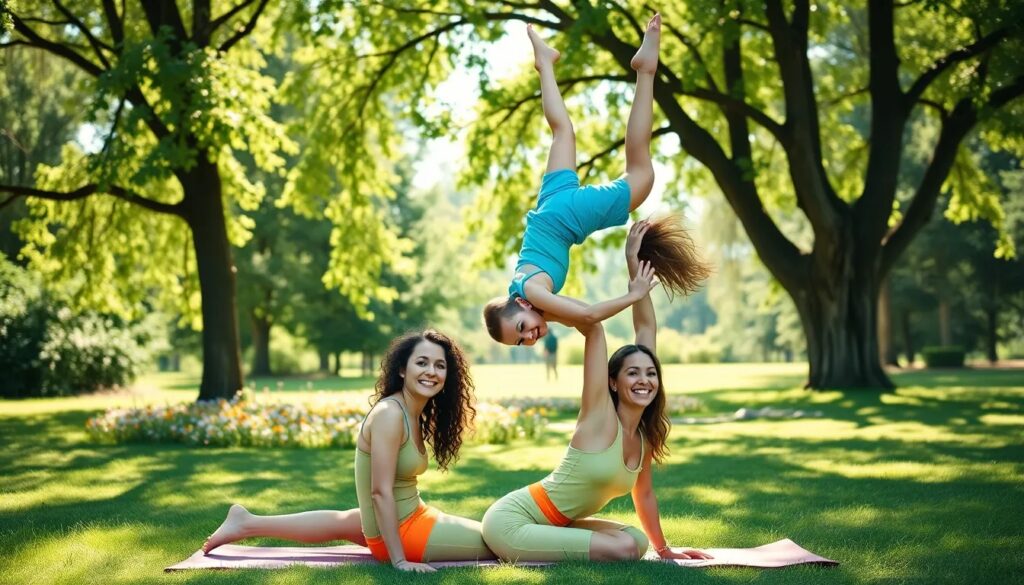
Acro yoga poses are partner postures that blend yoga shapes with basic acrobatics: one person (the base) supports another (the flyer) on their feet or hands, while a third person (the spotter) stands by to prevent falls. Most beginner poses are "L-base" positions — the base lies on their back with legs vertical — and foundational ones like Front Bird and Throne can be learned in a single session with a spotter present.
This page is the full catalog, sorted from beginner to advanced, with the specific skill each pose demands. For the three roles, the traditions behind acro yoga, and how to get started safely, see our full acro yoga guide — this page focuses on the poses themselves.
- The three roles, in brief
- Beginner Acro Yoga Poses (L-Base Foundations)
- Intermediate Acro Yoga Poses
- Advanced Acro Yoga Poses
- Acro Yoga Poses by Difficulty
- Acro Yoga Poses for 2, 3, and Kids
- How to Practice Acro Yoga Safely
- Do Partners Need to Be the Same Size?
- Building Toward Advanced Poses
- Frequently Asked Questions
The three roles, in brief
Every pose here rests on the same division of labor: the base supports the flyer's weight through stacked bones rather than muscle, the flyer keeps their body tense and unified so the base has something stable to balance, and the spotter stays close and ready to guide the flyer down if balance breaks. See our acro yoga guide for the full breakdown of each role and the three traditions — yoga, acrobatics, and Thai-massage-style therapeutic flying — that shape how acro yoga is practiced.
Beginner Acro Yoga Poses (L-Base Foundations)
Front Bird (Front Plank)
The first pose almost everyone learns. The base lies down and places their feet on the flyer's hip bones, hands clasped with the flyer. The flyer leans forward with a straight body, and the base bends and then straightens the legs to lift the flyer parallel to the floor. Once stable, partners can release hands so the flyer extends arms like wings.
Throne
The flyer ends up seated on the base's feet as if on a chair. It is one of the most stable shapes in acro yoga because the flyer's weight sits directly over the base's stacked legs — a good pose for building confidence and practicing hand-to-hand communication.
Folded Leaf
A therapeutic pose: the base's feet support the flyer's hip creases while the flyer folds forward completely, arms and head hanging relaxed. It gently tractions the flyer's spine and is typically used to rest between active poses.
Back Bird
Like Front Bird but with the flyer facing up, the base's feet placed along the flyer's upper back and hips. The flyer arches gently over the base's feet in a supported backbend. Build this one only after Front Bird feels solid, and always with a spotter.
Intermediate Acro Yoga Poses
High Flying Whale
A therapeutic pose: the base places their feet along the flyer's upper back and shoulder blades instead of the hips, then lifts and gently arches the flyer into a supported backbend with room to sway side to side. It asks more precise foot placement than the beginner L-base poses, since the contact points sit higher and closer to the spine, but the flyer stays passive throughout — it's a stretch, not a hold.
Star (Assisted Entry)
The flyer balances upside down, hands in the base's hands, feet reaching toward the sky in an inverted straddle or pike shape. Most practitioners first learn Star with a spotter physically guiding the flyer's legs into position rather than kicking up freely — the base needs a steady hand-to-hand grip and the flyer needs enough inversion comfort to stay calm upside down. Expect several sessions of assisted entries before attempting it solo.
Advanced Acro Yoga Poses
Reverse Star
The same inverted shape as Star, but the flyer enters facing away from the base, without the visual feedback of seeing the base's hands. That blind entry is what pushes Reverse Star into advanced territory — it demands a base and flyer who already trust each other's timing completely, and it should only be attempted with a spotter experienced in inverted acro work.
Hand-to-Hand
The flyer holds a full handstand line balanced entirely on the base's hands, with no feet or hip support underneath. It combines a strong solo handstand (the flyer's skill) with a precise, weight-shifting grip (the base's skill), which is why it's usually one of the last poses acro partners add. Like Reverse Star, this is not a pose to attempt from an article — work up to it with trained spotters and an instructor who can correct hand placement in real time.
Acro Yoga Poses by Difficulty
| Pose | Level | Type | Key skill required |
|---|---|---|---|
| Front Bird | Beginner | Acrobatic | Flyer body tension |
| Throne | Beginner | Acrobatic | Base leg stacking |
| Folded Leaf | Beginner | Therapeutic | Flyer relaxation |
| Back Bird | Beginner–intermediate | Therapeutic | Spotted backbend control |
| High Flying Whale | Intermediate | Therapeutic | Base foot placement on upper back |
| Star | Intermediate–advanced | Acrobatic | Inverted balance, hand-to-hand grip |
| Reverse Star | Advanced | Acrobatic | Blind entry, strong spotting |
| Hand-to-Hand | Advanced | Acrobatic | Handstand line, trained spotters |
Inverted poses like Star ask the flyer to balance upside down on the base's feet or hands. If you're new to being inverted, building comfort with solo yoga inversions first makes the transition much smoother.
Acro Yoga Poses for 2, 3, and Kids
Every pose in this guide is already "for 2" — base and flyer are the two roles every pose is built around. Adding a third person usually means a dedicated spotter who stays hands-on rather than just watching, which is standard practice for any inverted or advanced pose above; some groups also build simple pyramids, stacking a second base or flyer onto an already-stable pose rather than turning acro yoga into a true three-person shape. If you want partner work without the acrobatic lift, simpler 2 person yoga poses are a friendlier entry point, and larger groups can scale up to 4 person yoga poses for events and retreats.
Acro yoga with kids sticks to the same beginner poses on this page — Front Bird and Throne are the two most commonly used — kept low, heavily spotted, and led by an adult who stops the moment the child wants down. See our yoga for kids guide for more partner-friendly options at that level.
How to Practice Acro Yoga Safely
- Always use a spotter for new poses. Unspotted attempts at new poses are where most falls happen — never skip the spotter for a pose you haven't nailed with one.
- Communicate before, during, and after. Agree on simple cues — "up," "down," "out" — and honor them instantly. "Down" always means down, no negotiation.
- Warm up first. Wrists, hamstrings, and core do most of the work. A short flow such as a few rounds of sun salutations (see our guide to vinyasa yoga) prepares both partners.
- Practice on a soft, level surface — grass, mats, or a sprung floor. Never on concrete, and never near furniture.
As an Amazon Associate, we earn from qualifying purchases.

- 【Relieve Pressure & Protect Joint】: Our Yoga knee pad is made from thickened foam material, and the central sag design helping relieve pressure on the joints and muscles while performing different yoga poses to preventing your knees, elbows, wrist, hip, ankle or hand from injure.
- 【 High quality materials 】: Made of environmentally friendly TPE material, it can be easily cleaned with a damp cloth after practice. Paired with yoga mats, the exercise effect is excellent.
- 【Excellent Design】: Soft foam cushions the impact force brought by yoga, therefore you can exercise comfortable in hard floor while doing yoga poses. With non-slip textured surface, making you grip yoga mat or floor better to ensure excellent stability and balance during complicated yoga poses.
- 【Widely applicable】: 0.78inch thickness knee support pad can provide superior performance of instant rebounds, making this pad durable for use. You can use it during your exercise for kneeling, stretching, meditation and also as a knee pad during gardening, bathing your kids, or as a seat pad. Perfect for Yoga, fitness, workout, plank, pilates.
- 【Easy To Clean & Portable】: You can moisten the cloth to wipe the foam pad, quickly dry up for next use. Just only 0.35pounds/160g, you can put them to your yoga bag and take them to any gym to do yoge training or other exercise with any other sports equipment. Customer satisfaction is our No.1 priority. Come with a 1-year warranty and 100% Satisfaction Guarantee to make your purchase worry free.
Do Partners Need to Be the Same Size?
No. Because a well-aligned base supports weight through stacked bones rather than muscle, flyers can be heavier than their base — mixed-size and mixed-strength pairs are normal in acro classes. What matters more is communication and the flyer's body tension. See the section above for partner and group options at every size.
Building Toward Advanced Poses
Advanced acro — Reverse Star, Hand-to-Hand, washing-machine flows (continuous rotating sequences) — rewards patience. The standard progression is: master the static beginner poses, learn clean entries and exits, add simple transitions between two poses you both know, and only then attempt new inverted shapes with experienced spotters. Strength work helps too; many of the balance demands overlap with the solo skills covered in our guide to the hardest yoga poses.


Health note: acro yoga involves lifting and balancing another person and carries a real risk of falls. This article is general information, not medical or safety instruction. Learn with a qualified teacher, and avoid flying or basing if you are pregnant or have wrist, shoulder, neck, or back injuries unless a professional has cleared you.
This guide is part of our full range of yoga styles and lineages.
Frequently Asked Questions
Front Bird, Throne, Folded Leaf, and Back Bird are the four L-base poses almost everyone learns first.
Yes. Foundational L-base poses like Front Bird and Throne are taught in beginner classes and require no prior acrobatic experience — just a willing partner, a spotter, and a soft surface.
Acrobatic poses like Bird and Star require active strength and balance from the flyer. Therapeutic poses like Folded Leaf let the flyer relax completely while the base provides a passive stretch, an approach influenced by Thai massage.
Simple, well-spotted poses like Front Bird and Throne are often practiced playfully between a parent and child. Keep poses low, use a soft surface, never force a position, and stop the moment the child wants down.
Yes — it draws on yoga postures and breath awareness, blended with partner acrobatics and Thai-massage-style therapeutic flying.
Have a correction or a question about this article? Reach us via our contact page.
Last update 2026-09-10. Price and product availability may change.
Recommended: