What Is Mysore Yoga? The Self-Paced Ashtanga Method, Explained

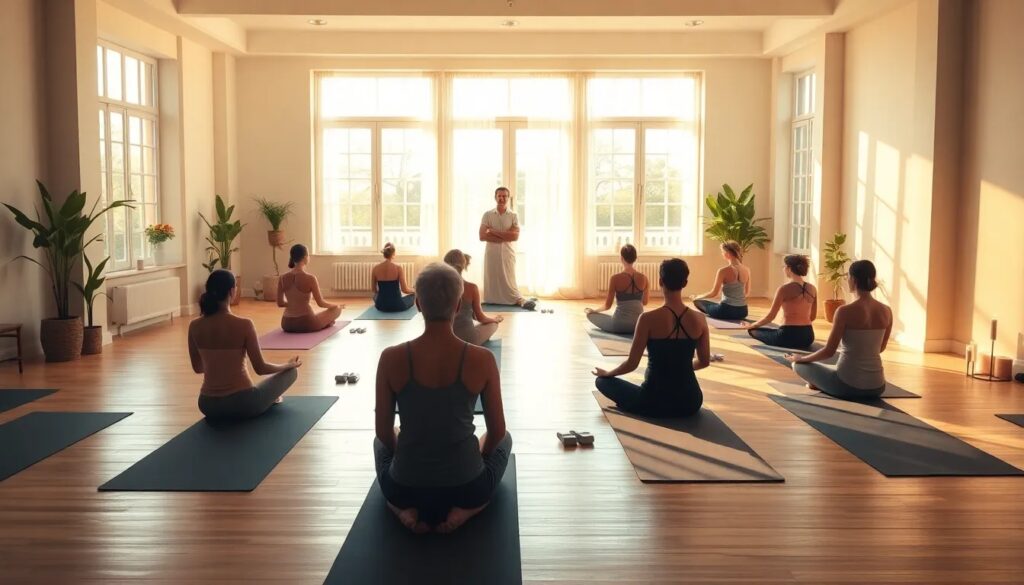
Mysore yoga is not a different style of yoga. It is the traditional, self-paced way of learning Ashtanga yoga, named after the South Indian city of Mysore (officially Mysuru) where the method was popularized. In a Mysore class there is no group instruction: each student moves through the memorized Ashtanga sequence at their own breath and pace, while the teacher walks the room giving individual adjustments and teaching new postures one at a time, only when the student is ready. The room is mostly silent except for breathing — a beginner on their third pose practices beside someone an hour into the series.
This guide covers how Mysore differs from a led class, what your first session actually looks like, the sequence behind it, who brought the method to the West, and how to start even with zero experience.
Mysore style vs led Ashtanga class
The postures are identical; the teaching method is the opposite. Most Ashtanga programs offer both formats, and they complement each other — beginners often alternate between a Mysore practice for new material and a weekly led class to learn the rhythm.
| Mysore style | Led class | |
|---|---|---|
| Pacing | Your own breath count | Teacher counts for the whole room |
| Instruction | One-on-one, within a group setting | Group cues, little individual attention |
| Sequence knowledge | You memorize it progressively | You follow along |
| Practice length | Varies per student — short for beginners, longer for advanced | Fixed, usually 75–90 minutes |
| Start time | Open window; arrive when you like within it | Fixed start |
| Best for | Building an independent practice | Learning the count and rhythm |
What to expect at your first Mysore class
Counterintuitively, Mysore is one of the most beginner-friendly formats in yoga — because nothing is assumed. A typical first visit looks like this:
- You arrive during the open window (very early morning — many shalas open before 6 a.m.) and the teacher greets you individually.
- You learn the Sun Salutations first. Surya Namaskara A and B open every Ashtanga practice; our step-by-step Sun Salutation guide covers the same movements.
- The teacher adds a few standing poses, then teaches you the closing postures and sends you home — often after only a short practice.
- Over weeks, postures are added one at a time, each only when the previous one is reasonably stable. Your practice grows at the rate your body earns it.
This incremental method is the real distinction of Mysore: it builds a self-sufficient practice you can do anywhere, with or without a teacher present. A first-timer usually leaves well before the room empties, and that is the system working as intended.
The sequence behind the method
Mysore practice follows the fixed Ashtanga series. Nearly all practitioners work within the first one, the Primary Series (Yoga Chikitsa) — Sun Salutations, a standing sequence, a long seated section, and closing inversions — which we break down fully in our guide to the Ashtanga Primary Series. The Intermediate and Advanced series exist, but they are the work of years, and there is no obligation to ever go beyond Primary. Because the sequence never changes, the practice becomes meditative: no decisions, just breath, posture, and gaze.
A short history
The method descends from Tirumalai Krishnamacharya, who taught yoga in Mysore from the late 1920s and into the 1930s, where his student K. Pattabhi Jois studied with him. Jois went on to systematize the sequences and, in 1948, established a small school at his home in Mysore — the Ashtanga Yoga Research Institute — which later became the K. Pattabhi Jois Ashtanga Yoga Institute (KPJAYI) (K. Pattabhi Jois). He taught there for decades until his death on 18 May 2009, and the teaching style continued under his family, with schools still operating in Mysuru. Western students who traveled to study with him brought the method — and the name «Mysore» — back to studios worldwide. Today a «Mysore program» on a studio schedule simply signals self-paced Ashtanga with individual instruction. For the broader relationship between the method and the flowing styles derived from it, see what is Ashtanga vinyasa yoga.
How to start Mysore practice
- Find a dedicated Mysore program, not just occasional led classes — consistency of teacher matters in this method.
- Tell the teacher you are new. Beginners are expected; arriving with no Ashtanga experience is normal.
- Commit to two or three mornings a week at first. Traditional programs practice six days weekly, but that is a destination, not an entry requirement.
- Expect short practices early on. Leaving after half an hour is the system working, not failing.
- Be patient with memorization. Most students hold the standing sequence in memory within two or three weeks.
- Look locally first. A simple search for «Mysore program» plus your city will surface dedicated shalas; many also list their Mysore hours on the studio's schedule page.
- Consider an immersion later. Once a practice is established, many students deepen it at a dedicated Ashtanga retreat.
Benefits of Mysore practice
Because students work at their own pace, Mysore offers benefits that a one-room-fits-all class usually cannot. Beginners get direct individual attention on day one rather than after a semester; advanced students spend the full practice in their own rhythm rather than waiting for the teacher's count. The daily repetition builds the same sequence into muscle memory, so the practice becomes portable — the same sequence on a retreat, at a friend's shala, or at home on a quiet morning. And the silent, self-paced room tends to produce a quieter mind: the structure of the sequence leaves no decisions to make, which many students describe as the most meditative part of their week.
Mysore poses you'll learn first
A new student does not start with the full Primary Series. The first weeks typically cover Surya Namaskara A, then Surya Namaskara B, then a small set of foundational standing postures, and finally the closing sequence. More postures are added one at a time, in roughly the order they appear in the Primary Series, but the specific selection is up to the teacher. A useful general rule: expect to learn the opening sequence and a handful of standing poses before any seated work is introduced, and do not be surprised if a single new posture takes a week to settle in.
Is Mysore the same as Ashtanga?
It is the same practice, just a different way of teaching it. Ashtanga is the method — a fixed sequence of postures linked to a specific breath. Mysore is the traditional classroom format in which that method is taught: self-paced, with individual instruction. A led Ashtanga class teaches the same sequence, but everyone moves together to the teacher's count. Most students benefit from doing both: led classes to learn the rhythm, Mysore to build an independent practice.
Mysore yoga is the traditional, self-paced way of learning Ashtanga yoga, named after the city of Mysore (Mysuru) in southern India. Students move through the memorized Ashtanga sequence at their own breath while the teacher gives individual adjustments and adds new postures one at a time.
Yes — often better than a led class. Beginners receive direct one-on-one instruction, start with only Sun Salutations and a few poses, and build up gradually. A first Mysore practice is usually short, which is the system working as intended.
Mysore is the traditional teaching format of Ashtanga yoga, not a different style. In a Mysore class students move at their own pace with individual guidance; in a led Ashtanga class the teacher counts the same sequence aloud for the whole group.
No. The teacher teaches you the sequence piece by piece, starting with the Sun Salutations on day one. Memorization happens naturally through repetition over the first weeks of practice.
Tradition prescribes six mornings a week with rest on Saturdays and moon days, but most teachers welcome students who can manage two or three sessions weekly at the start. Frequency can grow with the practice; consistency matters more than volume in the beginning.
This article is for general information only and is not medical advice. Ashtanga is a physically demanding practice — if you have an injury or a health condition, tell your teacher and check with a qualified professional before starting.
Have a correction? Contact us.
Recommended: