SUP Yoga: What It Is, How a Class Works, and How to Start

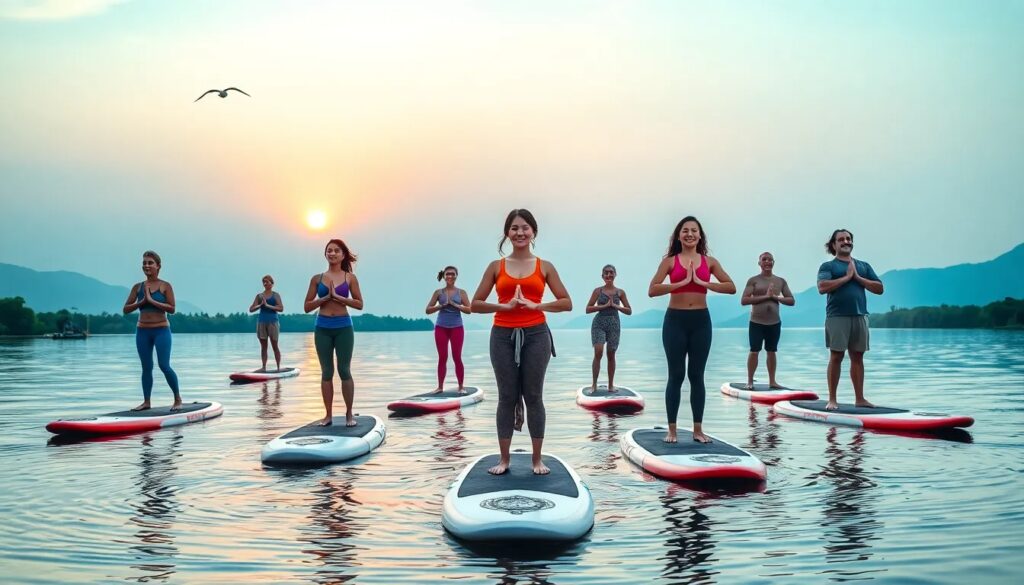
SUP yoga is yoga practiced on a stand-up paddleboard (SUP) floating on calm water, usually with the board anchored so it does not drift mid-class. The unstable surface forces constant micro-adjustments, so familiar poses become genuine balance and core work — and falling in is simply part of the experience. Classes typically run about an hour: a short paddle out, an anchored sequence of floor-based and standing poses, and a savasana that very few studios can match — lying on water, drifting slightly with the current.
It is not the same as paddle surfing. Stand-up paddleboarding for yoga uses a wide, stable, board-shaped craft (often 10 to 12 feet long) with a full-length deck pad; paddle surfing rides shorter surf-style boards on waves. Most SUP yoga happens on flat water — protected bays, lakes, slow lagoons — never on surf.
You do not need to be an advanced yogi or an experienced paddler to try it, but a few basics make the difference between a great first class and a frustrating swim. Here is what to know.
How a SUP Yoga Class Works
- Briefing on land: board handling, paddling basics, how the anchor works, and what to do when (not if) you fall.
- Paddle out: usually a short distance to a calm, designated area — a protected bay, lake, or slow lagoon.
- Anchor down: each board is anchored or tethered so the group stays together and nobody drifts off mid-warrior.
- Practice: a sequence built from kneeling and seated poses upward, slower than a land class because every transition is a balance event.
- Paddle back: often the most relaxed part — your nervous system has recalibrated to the water by then.
What SUP Yoga Trains That a Studio Class Does Not
- Deep stabilizer work. The board amplifies every wobble, recruiting core, ankle, and hip stabilizers continuously — even in poses that feel easy on land.
- Honest alignment feedback. On a mat you can muscle through a misaligned pose; on water the board tips and tells you immediately.
- Forced presence. Mind-wandering has a consequence (a splash), which makes the mindfulness component less abstract than in a studio. Coordinating movement with the breath, much as you would in a focused breathing practice, becomes natural rather than forced.
- Slower, humbler practice. Most people regress several pose levels on water. That reset is part of the value — it rebuilds attention to basics.
It is worth saying plainly: no large body of research isolates SUP yoga's benefits specifically. The reasonable claim is that it combines the established benefits of yoga with balance training and time outdoors — which is plenty.
SUP Yoga vs Studio Yoga vs Water Yoga
| Aspect | SUP yoga | Studio yoga | Water (aqua) yoga |
|---|---|---|---|
| Surface | Unstable board; every pose is balance work | Stable mat | Pool water; buoyancy assists movement |
| Joint load | Low impact, but balance demand is high | Low to moderate, depends on style | Very low — water carries part of body weight |
| Pace | Slower, fewer poses, longer setups | Full range, faster transitions | Slow, ranges of motion are gentle |
| Season and setting | Warm months, calm open water only | Year-round, indoors | Year-round, indoor heated pool typically |
| Falling | Expected and harmless (into water) | Rare | Rare |
| Best for | Balance, core, novelty, being outdoors | Depth, precision, consistency | Joint-friendly movement, seniors, rehab |
Treat them as complements. A regular practice like vinyasa flow or a steady hatha class on land builds the strength and body awareness that make the board manageable. For the opposite end of the water-yoga spectrum — gentle, joint-friendly, in a pool — see our guide to water (aqua) yoga.
A Realistic First-Time Pose Progression
Work up this ladder over your first sessions — do not start at the top:
- Seated and kneeling poses (easy pose, cat-cow, child's pose) — center of gravity low, almost impossible to fall.
- Tabletop and bird-dog — first taste of the wobble.
- Downward dog — hands and feet wide on the board's centerline.
- Low lunge and modified warrior poses — keep a wide stance over the board's handle (its balance midpoint).
- Standing poses and tree pose — the graduation exam. Expect to swim a few times first.
Safety: The Non-Negotiables
- Know how to swim. This is not optional for open-water classes.
- Wear or carry a flotation device. Many jurisdictions legally require a PFD on a paddleboard outside designated swim zones; a board leash is also standard except in moving water, where leash rules differ.
- Calm, supervised water only. Flat lakes, protected bays, slow lagoons. No currents, boat traffic, or offshore wind — wind matters more than it looks.
- Go with an instructor first. A certified SUP yoga teacher chooses safe locations, anchors correctly, and watches the group.
- Sun protection: water reflects UV; waterproof sunscreen and a hat earn their place.
This article is general information, not medical advice. If you are pregnant, recovering from an injury, or have a condition affecting balance or cardiovascular health, talk to your doctor before trying SUP yoga — and tell the instructor before class.
Gear: What Matters and What Does Not
- The board: yoga-specific SUPs are wider (roughly 32–36 inches), longer, and have a full-length deck pad. Rental fleets at SUP yoga classes are usually exactly this, so do not buy before you have tried it.
- A leash: a coiled SUP leash keeps the board attached to your ankle if you fall, so it does not drift away or hit another paddler. A short, well-fitted one is standard safety equipment — the same logic as a surfboard leash.
- An anchor: small folding anchor or a tether to a fixed line — supplied by any organized class.
- Clothing: quick-dry athletic wear or swimwear you can move in; in cooler water a rash guard or thin wetsuit. Cotton stays cold and heavy — the same fabric logic as choosing clothes for hot yoga, applied to water.
- Footwear: none. Bare feet grip the deck pad best — yoga's barefoot rule applies doubly on a board.
- What you do not need: a yoga mat (the deck pad replaces it — your outdoor mat stays home), expensive accessories, or prior paddling credentials.
As an Amazon Associate, we earn from qualifying purchases.

- 10 ft for Most Fit: It's suggested to choose a paddleboard leash equal in length to or slightly longer than your board. Our coiled SUP leashes are available in 8 colors and in carefully chosen 10 feet in length, thus suitable for most longboard surfboards, iSUP and paddleboards.
- Durable and No-Tangle: This surfboard leash uses a 5mm TPU cord for optimum strength and durability. The featured anti-corrosive steel swivels can keep the leash spinning smoothly to avoid getting tangled. It's an all-round leash, designed for small to medium waves.
- Comfortable and Anti-Slip: Soft neoprene 2.4" ankle cuff provides extra comfort to wear and prevents chafing and blistering. The double wrap-around velcro cuff is adjustable to make sure the cuff stay tight on your ankle and adds extra strength and security to your connection.
- Safe and Protective: The paddded ankle cuff has a quick release pull tab so that you can detach yourself from the board with ease.Tight and even stitching that ensures maximum strength and reliability withstand harsh marine environments and high-impact use.
- Why Shop ABAHUB: This surfboard leash is built with premium materials at an affordable price and we stand by the quality of our products.
Where to Find SUP Yoga Classes
Search for SUP yoga plus your nearest lake, bay, or river town; paddle shops and waterfront fitness studios run seasonal programs in most regions with calm water, and yoga festivals near water frequently offer taster sessions. Expect seasonal availability — in most climates this is a late-spring-to-early-fall activity.
Frequently Asked Questions
Yes. Falling into the water is a normal part of learning, so swimming ability is a basic safety requirement. Classes also typically require or provide a personal flotation device, and instructors keep the group in calm, shallow, supervised areas.
The same poses are significantly harder on a board because the surface moves under you. Most practitioners can manage several levels fewer than their land practice at first. The flip side is that the difficulty comes from balance rather than strength or flexibility, so beginners and experienced yogis often end up closer in ability than expected.
A wide, stable board — usually around 32 to 36 inches across — with a full-length traction pad for grip. Many are inflatable, which gives a slightly softer, more forgiving practice surface. Organized classes provide suitable boards, so there is no need to buy one to start.
Boards are anchored or tethered during the yoga portion, which stops them drifting but does not stop them moving — the gentle rocking remains, and that instability is precisely what makes the practice valuable for balance and core strength.
Quick-dry athletic wear or a swimsuit you can move in freely, plus a hat and waterproof sunscreen for sun protection. In cooler water a rash guard or thin wetsuit helps. Avoid cotton — it stays cold and heavy once wet. You go barefoot on the board; grip comes from the deck pad.
Have a correction? Contact us
Last update 2026-09-10. Price and product availability may change.
Recommended: