200 Hour Yoga Teacher Training: The Complete Guide Before You Enroll

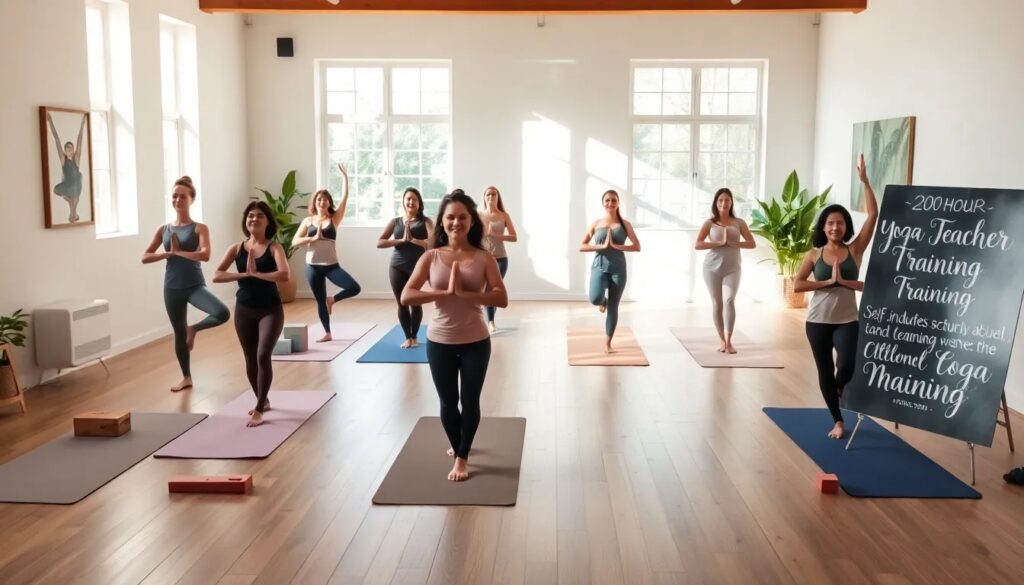
A 200 hour yoga teacher training (often written 200HR YTT) is the standard entry-level credential for teaching yoga. Completing a program registered with Yoga Alliance as an RYS 200 lets you apply for the RYT 200 designation — the qualification most studios and gyms ask for when hiring new teachers. The 200 contact hours cover physical practice and technique, anatomy, yoga philosophy and history, teaching methodology, and supervised practice teaching, and they can be delivered as a residential intensive, a part-time course over several months, an online program, or a hybrid that mixes both.
This guide walks through what you will actually learn, how the main formats compare, what RYT 200 does and does not give you, how to choose a program well, and whether one is even worth it for you. For a broader view of every credential a teacher can pursue, see our main yoga teacher training explainer.
- What a 200 hour yoga teacher training actually is
- What the curriculum covers
- Formats compared: intensive, part-time, online, hybrid
- What RYT 200 means (and what it does not)
- How to choose a 200 hour program: 8-point checklist
- Is a 200 hour training worth it?
- How to prepare before day one
- What comes after 200 hours
- Frequently asked questions
What a 200 hour yoga teacher training actually is
The 200 hour figure is a minimum: 200 contact hours of training with a Registered Yoga School (RYS 200). It is the foundation of the modern teaching pathway — the first rung of a ladder that can lead to RYT 500, specialty certifications, and experienced-teacher (E-RYT) status further down the line. Most new yoga teachers begin here because it is what the industry asks for, not because any law requires it: no jurisdiction in the US licenses yoga teachers, but studios, gyms, and most liability insurers treat RYT 200 as the realistic entry ticket.
If you are still deciding whether a credential is even the right goal for you, the question why you want it usually matters more than the curriculum itself — we come back to that in the section on whether the training is worth it.
What the curriculum covers
Registered schools distribute the 200 hours across the same four broad categories, even when they emphasize different styles. A typical breakdown looks like this.
- Techniques, training and practice (the largest block): asana technique and alignment, pranayama (breathwork), and meditation — both practicing them and analyzing how to teach them.
- Anatomy and physiology: functional anatomy applied to yoga — what is happening in the hamstrings, spine, shoulders, and knees, and how to keep students safe.
- Yoga humanities: philosophy (most programs anchor in Patanjali's Yoga Sutras and the eight limbs), history of yoga, and ethics for teachers.
- Professional essentials: teaching methodology — sequencing, cueing, demonstration, observation, hands-on adjustments where appropriate, and the business basics of running a class — plus the practicum: supervised practice teaching with real or simulated students, and peer feedback. This is the single biggest quality differentiator between programs and the one to weigh heaviest when choosing a school.
Most 200-hour programs teach a Vinyasa or Hatha base, since those dominate studio schedules. If you are unclear on the difference, start with our explainer on what Vinyasa yoga is. Style-specific trainings also exist — see our guide to Ashtanga yoga teacher training for the most structured example.
Formats compared: intensive, part-time, online, hybrid
How the same 200 hours get scheduled changes the experience more than any other variable. The four formats below are the ones you will see most often; trade-offs depend on your life, your budget, and how much in-person feedback you want.
| Format | Typical duration | Best for | Trade-offs |
|---|---|---|---|
| Residential intensive | 3–5 weeks full-time, often away from home | Full immersion, fast completion, traveling as part of the experience | Requires time off work; intense daily pace; little time to digest between sessions |
| Part-time / weekends | 3–6 months, one or two long days a week | Keeping your job; learning gradually; building a local cohort | Long overall commitment; momentum can flag by month three |
| Online | Self-paced up to about a year | Remote locations, family or work constraints, tight schedules | Less hands-on adjustment feedback; practice teaching happens on video |
| Hybrid | Several months with one or two in-person weekends | Flexibility of online plus real in-person contact hours | More moving parts to coordinate; the in-person dates drive the calendar |
Cost varies widely by country, by school reputation, and by what is included (lodging, meals, manuals, retreat fees). Treat any specific price you see as belonging to that one program in that one season rather than as a benchmark for the whole market — always read the contract and ask what is and is not covered. For a deeper look at the format most people ask about, see our guide to 200 hour yoga teacher training online and our broader overview of online yoga teacher training.
What RYT 200 means (and what it does not)
RYT 200 (Registered Yoga Teacher) is a designation maintained by Yoga Alliance, a US-based nonprofit registry. To use it, you complete a 200-hour program at a Registered Yoga School (RYS 200) and then register with the organization, which involves an application and annual fees. Higher tiers — RYT 500, E-RYT 200, E-RYT 500 — come later, after additional training and documented teaching hours.
It is worth being precise about what the designation is not. It is not a government license, since no US state requires one to teach yoga. It is not a guarantee of a teaching job or a certain income — studios still decide whom to hire, and most new teachers build their schedule gradually. And it is not a mark of personal quality: the credential says you completed a registered program, not that you are a finished teacher. Good teachers treat the 200-hour as a learner's permit: it qualifies you to begin, and the real education happens in the first few hundred classes you teach.
How to choose a 200 hour program: 8-point checklist
- Verify the school in the directory rather than trusting a logo on the website. A school claiming RYS 200 status should appear in the registry's public list with the styles and dates it is currently authorized to teach.
- Research the lead trainers. Years of teaching experience, their own training lineage, and whether they actually lead most sessions or hand them off to junior staff.
- Ask for the full curriculum and daily schedule. Vague answers are a red flag — a 200-hour program has 200 hours of content, and you should be able to see where they go.
- Check the practicum hours. The single biggest quality differentiator is how much supervised practice teaching with feedback you get. A program heavy on lectures and light on practice teaching will leave you underprepared for real classes.
- Take classes with the trainers first if the school is local. Their teaching is what you are paying for; if it does not land for you as a student, it will not land for you as a trainee.
- Talk to recent graduates, ideally ones the school did not hand-pick. Alumni communities on social media are usually more candid than the testimonials on the school's own site.
- Read the contract: deposit and refund policy, what happens if you miss sessions, and any extra costs (books, registration, retreat fees, prop kits). Get promises in writing.
- Match the style to your goals. A strongly branded method is great if you love it, and limiting if you discover mid-course that you do not. A broad Vinyasa or Hatha base tends to be the most flexible starting point.
Is a 200 hour training worth it?
Honest answer: it depends on your goal.
If you want to teach: it is the required entry ticket, and there is no realistic way around it. Be realistic about the early economics, though: new teachers typically start with a few classes a week at modest per-class rates, and most build up gradually or combine teaching with other work. The credential opens the door; the schedule is something you build yourself over the first year or two.
If you want to deepen your practice without teaching: many trainees never intend to teach, and a YTT genuinely delivers depth — anatomy, philosophy, and a transformed personal practice. It is, however, an expensive way to get that depth. An immersive yoga and meditation retreat or a series of workshops may give you a large share of the experience for a fraction of the cost. Do the training when you specifically want the teacher's lens: understanding why classes are built the way they are, and how to build them for other people.
How to prepare before day one
- Build practice consistency — most schools recommend (some require) six months to a year of regular practice first. This is not about flexibility; it is about knowing the basic shapes so you can analyze them.
- Try multiple teachers and styles so you choose your training from experience rather than from marketing. The biggest predictor of a good training is a good fit between you and the lead teachers' style.
- Read ahead: most programs assign the Yoga Sutras and an anatomy text. Starting the reading before the program begins reduces the firehose effect in the first week.
- Sort logistics: basic props for home study (a mat, two yoga blocks, a strap), and clear your calendar realistically — a part-time YTT plus a full-time job is demanding. For a more detailed pre-training checklist, see our guide on how to prepare for yoga teacher training.
What comes after 200 hours
Graduates typically start by teaching community classes, subbing for established teachers, or teaching friends while they find their voice. Continuing education options include the 300-hour advanced training (leading toward RYT 500) and shorter specialty certifications — prenatal, yin, kids yoga, or deep-relaxation methods like yoga nidra teacher training. None of these are required, and many teachers wait a year or two of real teaching before stacking more credentials, so the first 200 hours can actually settle in.
Teacher training involves daily physical practice. If you have injuries or health conditions, discuss the program's demands with your healthcare provider and tell your trainers in advance.
Frequently asked questions
As a full-time residential intensive, about three to five weeks. In part-time weekend formats, usually three to six months. Self-paced online programs can take anywhere from a few weeks to about a year, depending on your schedule. For a deeper look at the duration question, see our guide on how long a 200 hour training actually takes.
Legally yes, since yoga teaching is unregulated in most places. Practically, most studios and gyms ask for RYT 200 or equivalent when hiring, and liability insurers usually ask for proof of training, so the certification is the realistic entry path into paid teaching.
More demanding than a typical yoga class, but not impossible for a committed student. The workload combines daily physical practice with anatomy study, philosophy reading, peer teaching, and written assignments, on top of the hours in the room. Most students find the pace manageable if they arrive with a consistent personal practice and clear their calendar in advance.
It can be, if the school is registered (RYS 200) and the program meets the same curriculum standards as an in-person training. The trade-off is usually less hands-on feedback and practice teaching on video rather than in person. Verify the school's status in the public registry before enrolling, and read recent graduate reviews outside the school's own website.
Have a correction? Contact us.
Recommended: