Dancer Pose Yoga: Step-by-Step Guide to Natarajasana

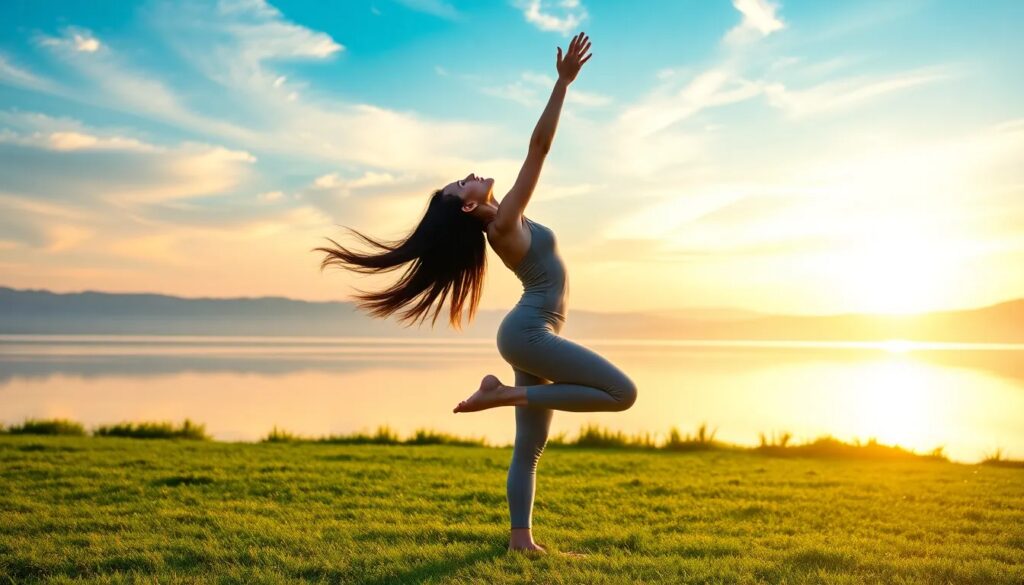
Dancer Pose — Natarajasana in Sanskrit — is a standing balance in which you stand on one leg, catch the lifted foot behind you, and press it back and up into your hand while reaching the opposite arm forward. It combines three demands at once: single-leg balance, a backbend, and a deep stretch through the quadriceps, hip flexors, chest, and shoulders. That combination is exactly why it looks graceful and feels hard — and why setup details matter more here than in most standing poses.
The name comes from Sanskrit: nata (dancer), raja (king), and asana (pose) — a reference to Shiva Nataraja, the Lord of the Dance in Hindu tradition, whose cosmic dance symbolizes the cycle of destruction and creation. In practice terms, the pose teaches a balance between effort and steadiness that carries into the rest of your standing work.
- How to do Dancer Pose step by step
- Common mistakes (and the fixes)
- Modifications and variations by level
- Benefits of practicing Dancer Pose
- Dancer Pose vs Bow Pose (and how they differ)
- Preparatory poses that make Dancer accessible
- Safety and contraindications for Dancer Pose
- Frequently asked questions
How to do Dancer Pose step by step
Before you lift the back leg, fix your gaze (drishti) on a single still point slightly below eye level. A wandering eye is the fastest way to lose balance, and the kick-back action below only works once the gaze is anchored.
- Start in Mountain Pose (Tadasana). Ground evenly through your right foot and fix your gaze (drishti) on a point that does not move, slightly below eye level.
- Bend your left knee and bring the heel toward your left buttock.
- Catch the inside of the left foot or ankle with your left hand, palm facing out (thumb pointing toward the toes). The inside grip lets the shoulder rotate externally and keeps the knee tracking straight back.
- Reach your right arm straight up. Lengthen through the crown of your head and draw the lower belly gently in.
- Press the foot into the hand — this kick-back action, not pulling with the arm, is what lifts the leg and creates the backbend.
- Hinge forward from the hips only as much as the kick lifts the back leg, keeping your chest broad. The forward reach of the front arm counterbalances the lifted leg.
- Keep the standing leg strong — a microbend in the knee is fine; locking it out is not.
- Hold for 3 to 5 slow breaths, then rise back to standing with control and repeat on the other side.
Common mistakes (and the fixes)
Is Dancer Pose difficult? It is intermediate-to-advanced, but the difficulty usually comes from one of a handful of recurring mistakes. Most of them collapse the shape or load the wrong joint; a small adjustment often changes everything.
- Splaying the lifted knee out to the side. Keep the knee pointing down and back, in line with the hip — it protects the knee and keeps the stretch in the quad where it belongs.
- Pulling the foot with the arm instead of kicking into the hand. The press of foot into hand is the engine of the pose; passive pulling collapses the chest and strains the shoulder.
- Dumping into the lower back. Lift the lower belly and think of lengthening the tailbone before bending. The backbend should distribute along the whole spine, not hinge at one lumbar point.
- Collapsing the chest toward the floor. Hinge only as far as you can keep the sternum lifted; depth comes from the kick, not from diving forward.
- Wandering gaze. Balance lives in the eyes — pick one still point and keep it.
- Holding the breath. Strained breathing is the most reliable sign you have gone past your edge today.
Modifications and variations by level
| Level | Variation | How it works |
|---|---|---|
| Beginner | Wall support | Fingertips of the front hand on a wall remove the balance demand so you can learn the shape |
| Beginner | Strap around the foot | A yoga strap looped over the back foot extends your reach if grabbing the ankle is not available yet |
| Beginner | Low Dancer | Keep the kick small and the torso nearly upright — same actions, smaller range |
| Intermediate | Full expression | Deeper hinge with strong kick-back, chest lifted, holding 5+ breaths |
| Advanced | Overhead grip (King Dancer) | Both hands reach overhead to catch the foot, elbows pointing up — requires significant shoulder mobility and a deep, even backbend; learn it with a teacher |
A strap is also a useful prop for half Dancer — the version where you keep the torso mostly upright and just play with the kick and the grip before adding the forward hinge. Loop the strap over the ball of the back foot and hold one end in each hand; you can take up the slack gradually without straining the shoulder.
As an Amazon Associate, we earn from qualifying purchases.

- Home PT Strap for Independence (3 Recovery Stages) – A physical therapy stretching strap designed for gentle knee/hip/leg mobility at home. Use it across recovery: Stage 1 bedside assist (when movement is limited), Stage 2 PT stretching/ROM, Stage 3 daily warm-up to maintain mobility—so you can stay independent
- Non-Elastic, Steady Holds (No Rebound / No Surprise Stretch) – The strap does not stretch, so there’s no bounce and no sudden “give.” You can pull to the angle you need and it stays there, helping you move slowly and safely—especially after knee replacement or hip replacement recovery.
- Loops = Easier Grip + Adjust Depth + Track Progress – Multiple loops provide clear hand/foot holds with less grip strength than towels or ropes. Switch loops anytime to adjust stretch depth, repeat the same position each session, and track ROM progress for hamstrings, calves, hips/hip flexors, and lower back—without forcing.
- Leg Lifter Strap / Mobility Aid for Bed & Car – Can also be used as a leg lifter to help lift your leg into bed or car, supporting daily movement tasks when flexibility is limited (use gently within comfort). gently within comfort).
- PT-Style Daily Stretching for Legs, Back & Feet (Comfort Tip) – Built for slow, controlled home stretching and mobility work for legs, hips, lower back, ankles, and feet (calf/Achilles tightness included)—not an elastic resistance band. For comfort during longer holds, socks or light gloves may help. during longer holds, socks or light gloves can help if you have sensitive hands/skin. gloves can help if you have sensitive hands/skin.
Benefits of practicing Dancer Pose
- Balance and proprioception — single-leg standing work trains stability, useful well beyond the mat.
- Strengthens the standing leg (ankle, calf, thigh, glute) and the back-body muscles that hold the lift.
- Stretches the quadriceps, hip flexors, chest, and shoulders — the exact areas shortened by sitting.
- Focus — the pose simply does not work with a distracted mind, which makes it a moving concentration exercise.
Dancer Pose vs Bow Pose (and how they differ)
Both are backbends, and both name an animal or archetype, which is why they get confused. The difference is in the body contact with the floor and the direction of the lift. In Dancer Pose you are standing, balancing on one leg, with the back foot lifted toward the ceiling and the chest opening upward; the backbend is shared between the lifted leg, the chest, and the standing-leg counterbalance. In Bow Pose (Dhanurasana) you lie on your belly, both hands grab both ankles, and the lift comes from the kick of both legs at once, with the chest and thighs rising together off the floor. Dancer is a balance and a backbend; Bow is a prone backbend with no balance demand. They train overlapping but distinct things, and neither replaces the other.
Preparatory poses that make Dancer accessible
If Dancer feels far away, the limitation is usually quad/hip-flexor length, shoulder mobility, or balance. Work these first:
- Low Lunge (Anjaneyasana) — opens the hip flexors of the back leg.
- Bridge Pose (Setu Bandhasana) and Cobra (Bhujangasana) — build a gradual, even backbend.
- Standing quad stretch — the same foot grip without the hinge, practiced at a wall.
- Warrior III (Virabhadrasana III) — trains the standing-leg strength and hip-hinge balance.
- Tree Pose (Vrksasana) — the foundational standing balance; if Tree is shaky, build it before Dancer.
- Yoga balance poses — a wider set of standing balances to round out the practice.
Dancer vs King Dancer: same shape, different grip
King Dancer is the same pose with both hands reaching overhead to catch the lifted foot. The legs and hips do the same work; the difference is the shoulder: external rotation plus deep flexion, with elbows lifted. Treat King Dancer as an advanced variation — learn standard Dancer first, build a stable chest-lifted kick-back, and only add the overhead reach once the shoulder and upper back are warm. Our roundup of the hardest yoga poses puts that difficulty in context.
Dancer appears regularly in flowing vinyasa sequences, usually late in the standing series once the body is warm — do not practice it cold. In slower hatha classes it is typically held longer with more setup detail. The full overhead-grip version ranks among the more demanding standing poses in the practice.
Safety and contraindications for Dancer Pose
Dancer Pose loads the lower back, the standing knee, the shoulder of the gripping arm, and the balance system — four things that deserve respect. The shape is generally not appropriate if any of the following applies; in any of these cases, check with a healthcare professional or qualified teacher before attempting the full pose.
- Active lower-back issues — the backbend concentrates load along the lumbar spine, especially if the standing-leg kick is weak.
- Knee injury or pain in the standing leg — the standing knee is the structural base of the pose and absorbs the full body weight plus the kick-back force.
- Shoulder pain or limited mobility in the gripping arm — the inside-grip action externally rotates the shoulder under load.
- Vertigo, low blood pressure, or active balance disorder — the single-leg stance is the first thing to break down in these cases; practice at a wall or skip the pose.
- Pregnancy — balance shifts and the deep backbend change the load profile. Use a wall and shorten the hold, or wait until after delivery.
- Recent abdominal surgery — the backbend and the core engagement both load the healing tissues.
Two practical safety rules: a sticky mat matters more here than in most standing poses, because the standing foot is the only thing keeping you upright, and practicing near a wall for the first attempts removes the fear of falling — which itself improves balance.
Frequently asked questions
Yes, with modifications. Beginners should learn it at a wall or with a strap around the lifted foot, keeping the kick small and the torso upright. The full deep version takes months of consistent practice on quad flexibility, shoulder mobility, and single-leg balance.
Usually one of three reasons: a wandering gaze (fix one still point before lifting the leg), entering the pose too fast (each step needs a breath), or a passive standing leg (actively press the floor away and keep a soft knee). Practicing near a wall removes the fear of falling, which itself improves balance.
The standard grip is the inside of the foot or ankle, palm facing out, because it externally rotates the shoulder and keeps the lifted knee tracking straight back. The outside grip forces the shoulder into internal rotation and tends to splay the knee — it is generally reserved for specific advanced transitions.
It strengthens the standing leg — ankle stabilizers, calf, quadriceps, and glutes — plus the spinal extensors and upper back. At the same time it stretches the quadriceps and hip flexors of the lifted leg, the chest, and the front of the shoulders.
Dancer Pose is a standing balance on one leg with the back foot lifted behind you into the hand; Bow Pose is a prone backbend on your belly with both hands grabbing both ankles. They share the backbend theme but train different things — Dancer adds balance and a single-leg standing demand, while Bow adds a symmetrical prone lift with no balance component.
Anyone with an active lower-back issue, knee injury on the standing leg, shoulder pain in the gripping arm, vertigo or active balance disorder, recent abdominal surgery, or who is pregnant should consult a healthcare professional or qualified teacher before attempting Dancer Pose. In many of these cases the pose can still be practiced with a wall and a strap — but only with that guidance.
This article is general information, not medical advice. If you have back, knee, shoulder, or balance issues, or are pregnant, consult a healthcare professional or qualified teacher before attempting deep backbends and balance poses.
Explore more on yoga styles and lineages or read our guide to yoga arm balances for the next step in your standing work.
Have a correction? Contact us.
Last update 2026-09-10. Price and product availability may change.
Recommended: