Bed Yoga: Gentle Morning and Evening Routines You Can Do in Bed

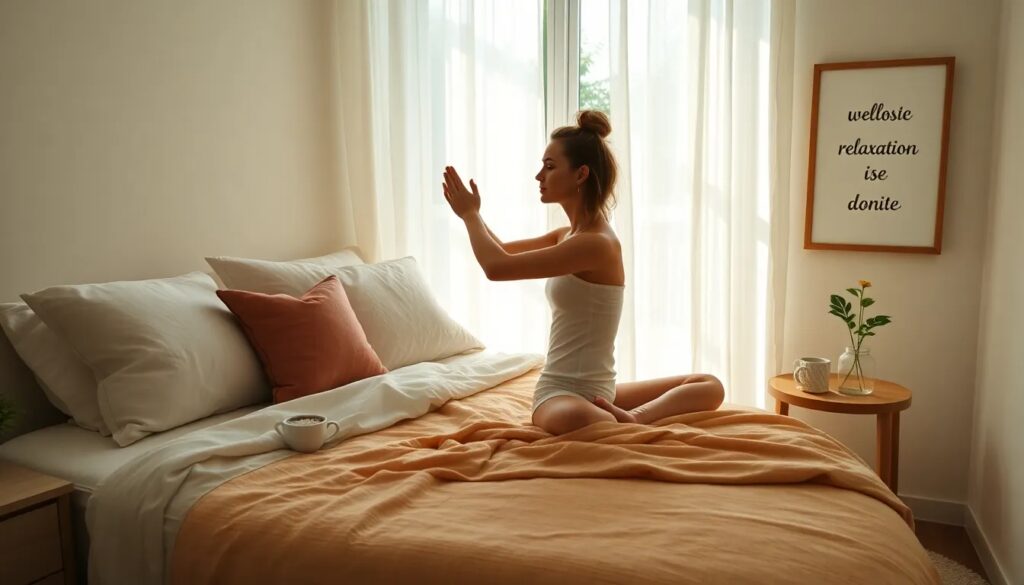
Bed yoga is exactly what it sounds like: gentle stretches and breathing done on your mattress, either to wake the body up in the morning or to wind down before sleep. Because the surface is soft, it works best with slow, low-to-the-ground movements — twists, hip openers, and supported resting poses — rather than standing or balancing work. For people with limited mobility, chronic stiffness, or simply no motivation to unroll a mat at 6 a.m., it is one of the most realistic ways to practice daily.
This guide covers which poses actually work on a mattress, a morning routine and an evening routine you can follow tonight, and the few movements you should keep off the bed entirely.
Does bed yoga actually work on a soft mattress?
Yes, with limits. A mattress is unstable, so poses that demand balance or precise joint stacking — standing poses, lunges, arm balances — become harder and riskier in bed. But poses that are reclined, seated, or on all fours translate well, and the softness can even feel kinder on knees and wrists.
The honest trade-off: bed yoga is excellent for mobility, relaxation, and consistency, but it will not build strength the way a mat practice does. Treat it as a complement to fuller sessions, not a replacement. If deep relaxation is your main goal, a prop-supported restorative yoga practice on the floor goes even further.
Morning bed yoga routine (5–8 minutes)
The aim in the morning is to gently mobilize the spine and hips before your feet hit the floor:
- Full-body stretch — on your back, reach arms overhead and point the toes; hold for 3 slow breaths.
- Knees-to-chest — hug both knees in and rock gently side to side, 5 breaths.
- Supine twist — drop both knees to one side, arms wide, 5 breaths per side.
- Cat-Cow on all fours — 6 to 8 slow rounds, syncing movement with breath.
- Seated side bend — sitting cross-legged, reach one arm overhead and lean, 3 breaths per side.
- Seated forward fold — legs loosely extended, hinge forward over them, 5 breaths.
If you want to keep going once you are up, our morning yoga stretches sequence picks up where this leaves off.
Evening bed yoga routine (8–10 minutes)
The evening version is slower, with longer holds and a focus on the exhale:
- Seated breathing — sit against the headboard, lengthen the exhale to roughly twice the inhale, 10 breaths.
- Butterfly fold — soles of the feet together, fold gently forward, 8 breaths.
- Reclined pigeon (figure-four) — on your back, ankle over opposite knee, 8 breaths per side.
- Happy Baby — hold the outsides of the feet, knees toward armpits, 8 breaths.
- Supine twist — 8 slow breaths per side.
- Legs up the headboard — hips close to the wall or headboard, legs resting vertically, 2 to 3 minutes.
- Savasana into sleep — lie flat or in your sleeping position and let the breath go natural.
This pairs well with the broader sleep-hygiene approach in our guide to yoga before bed, and the breathing piece is explained in depth in yoga for stress.
Bed yoga vs. mat yoga: what changes
| Bed yoga | Mat yoga | |
|---|---|---|
| Best for | Gentle mobility, relaxation, consistency | Strength, balance, full practice |
| Surface | Soft, unstable | Firm, stable |
| Safe pose types | Reclined, seated, all-fours | All pose types |
| Standing/balance poses | Avoid | Yes |
| Joint comfort | Very cushioned | Depends on mat thickness |
| Typical session | 5–15 minutes | 20–75 minutes |
Who benefits most from bed yoga?
Seniors and people with limited mobility get a safe way to move daily without getting down to the floor — the same logic behind chair yoga for beginners, which makes a good companion practice. People with insomnia or evening anxiety benefit from the wind-down routine, since slow stretching and extended exhales nudge the nervous system toward its rest state. Busy or low-motivation practitioners benefit most of all: a practice with zero setup is the one that actually happens every day.
One thing bed yoga is not designed for: meaningful weight loss. If that is the goal, a more vigorous, mat-based practice combined with broader lifestyle changes is the route. For the small in-bed session, all you really need is your mattress; if you do want a mat for the morning stretch once you are up, a basic option is fine.
As an Amazon Associate, we earn from qualifying purchases.

- Extra thick, cushy floor mat in Black for yoga, gym, and everyday exercise
- 1/2 inch thickness offers comfortable padded support and shock absorption; textured surface provides extra traction
- Durable foam construction offers stretchability and springs back into shape
- Elastic strap for secure rolled-up mat storage and easy over-the-shoulder carrying
- Wipes clean easily
- Product Dimensions: 74 x 24 x .5 inches (LxWxH)

What to avoid doing in bed
- Standing and balancing poses — the unstable surface makes falls likely.
- Deep backbends like full Wheel — the sinking mattress distorts alignment.
- Headstands or shoulder stands — never on a soft surface.
- Forcing depth — muscles are cold in the morning; keep every stretch at mild intensity.
- Energizing breathwork at night — fast techniques are stimulating; stick to slow breathing in the evening routine.
Frequently asked questions
Yes, for gentle reclined and seated poses. A mattress is fine for mobility and relaxation work, but skip standing poses, balances, and inversions, which need a firm surface. For strength-building practice, use a mat.
Five to ten minutes is plenty. Morning routines can be as short as five minutes of spinal movement and stretching; evening routines work best at eight to ten minutes with longer, slower holds.
Generally yes, because it avoids getting down to the floor and uses gentle, supported movements. Seniors with osteoporosis, recent surgery, or balance issues should check with a doctor or physical therapist first and avoid deep twists or forceful stretches.
This article is general information, not medical advice. If you have an injury, osteoporosis, or another health condition, talk to a healthcare professional before starting a new stretching routine.
Have a correction? Contact us.
Last update 2026-09-10. Price and product availability may change.
Recommended: