Yoga Props: What Each One Does and Which You Actually Need

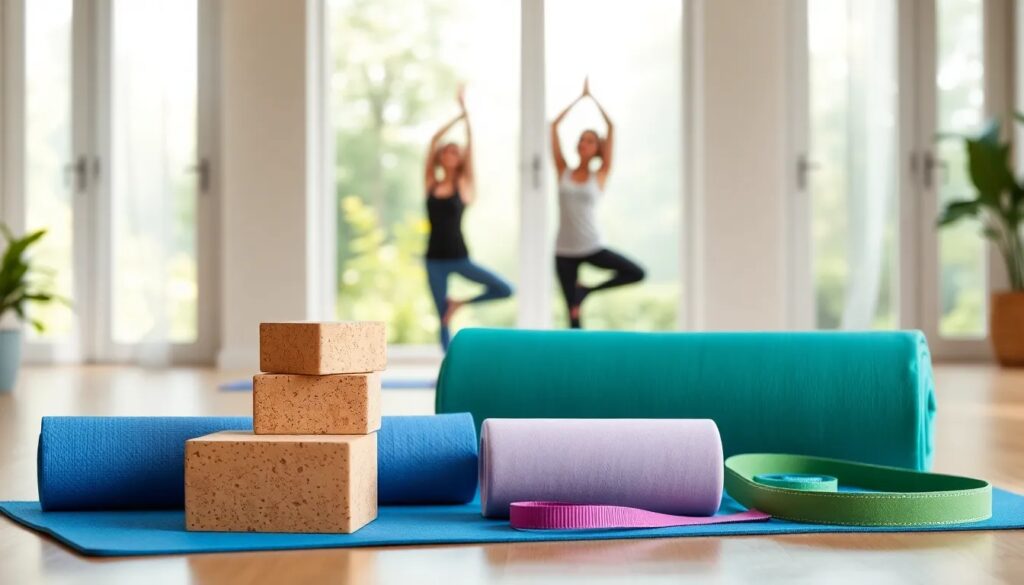
Yoga props are support tools — blocks, straps, bolsters, blankets, wheels, chairs, sandbags — that bring the floor closer, extend your reach, or hold your body so a pose works for your proportions and current flexibility. They are not training wheels to outgrow: B.K.S. Iyengar, who systematized prop use in the 20th century, used them throughout his life, and experienced teachers reach for them constantly. The practical question is not whether yoga props are legitimate but which ones earn a place in your practice. Short answer for beginners: two blocks and a strap cover most needs, a folded blanket covers most of the rest, and everything else is optional.
The Core Props and What They Actually Do
| Prop | What it does | Typical uses | Household substitute |
|---|---|---|---|
| Blocks (x2) | Raise the floor toward your hands or hips | Hands in Triangle and Half Moon, under hips in seated poses, between thighs for alignment | Thick hardcover books, sturdy box |
| Strap | Extends your arms | Reaching the foot in hamstring stretches, binds, shoulder openers | Belt, towel, dog leash |
| Blanket | Lifts hips, pads joints, adds warmth | Under hips in seated poses, under knees and ankles, cover in Savasana | Any firm household blanket |
| Bolster | Large firm cushion for supported holds | Restorative poses, supported backbends, prenatal modifications | Firm couch cushion, rolled blankets |
| Wheel | Curved support for the spine | Assisted backbends, chest opening, balance challenges | None safe — skip until needed |
| Chair | Stable raised platform | Chair yoga, balance support, Iyengar-style variations | Any sturdy armless chair |
| Sandbag | Adds grounding weight | Weighting thighs in restorative poses, deepening relaxation | Bag of rice or beans |
| Wedge | Reduces joint angle | Under palms for sore wrists, under heels in squats | Folded mat edge |
What to Buy First (and What to Skip)
- Two blocks. The single highest-impact purchase. Foam is light and softer against the body; cork is firmer and more stable under body weight. Buy two, not one — poses like Bridge with a block under the sacrum or hands-on-blocks folds often want a pair.
- One strap. A 6-foot strap with a D-ring buckle handles hamstring work and shoulder openers; taller practitioners may prefer 8 feet.
- A firm blanket. Arguably the most versatile prop in the room — hip lift, knee pad, shoulder support, Savasana cover. Our guide to what a yoga blanket is used for covers the standard folds.
- Bolster — only if you love restorative practice. It is the heart of restorative and prenatal yoga but bulky; stacked folded blankets imitate it well enough to test the waters first.
- Skip for now: wheels, sandbags, wedges, and gadget-tier accessories. Useful in specific situations, but not foundational.
A decent mat matters more than any accessory — thickness alone changes how poses feel on knees and wrists; see our yoga mat thickness guide. And socks are a worse anti-slip solution than they look; here is why most people practice barefoot.
As an Amazon Associate, we earn from qualifying purchases.


How Props Change a Pose (Three Concrete Examples)
- Triangle Pose + block. Without support, tight hamstrings make most people collapse the chest toward the floor to touch it. A block under the bottom hand restores the open chest and long spine the pose is actually about. The block does not make the pose easier — it makes it accurate.
- Seated Forward Fold + strap. Looping a strap around the feet lets you hinge from the hips with a straight spine instead of rounding to grab your toes. The stretch lands in the hamstrings, where it belongs, instead of straining the lower back. The same hip-elevation logic applies across seated yoga poses: sitting on a folded blanket tilts the pelvis forward and instantly improves every fold.
- Supported Bridge + block. A block under the sacrum converts an active backbend into a passive, restful chest-and-hip-flexor opener you can hold for minutes. One prop, an entirely different practice.

- Soft, Flexible: Our 100% cotton Yoga Strap offers a soft, comfortable grip that's easy to hold. Unlike stiff straps from other brands, ours is designed to support your yoga practice while being gentle on your hands and body.
- Multi-Purpose: Not just for yoga, our yoga belt strap can help increase your flexibility in a wide range of physical activities, including fitness, exercise, physical therapy, stretching, balance, pilates, ballet, workout, and more.
- Safe & Sturdy: With 4 mm "Welded" D-ring buckles and 2.5 mm thickness, sturdy enough to withstand heavy stretching and repeated yoga classes. Plus, the D-ring buckle is less likely to slide than rectangular buckles, ensuring your safety during use.
- Adjustable: Featuring a double D-ring design, our yoga strap allows you to easily adjust the length as needed for different poses and stretches. Its versatile length makes it a useful tool for easing into a variety of poses.
- Easy to Grip: Our Yoga Strap is outfitted with an extra loop on one end, providing you with plenty of grip and helping you maintain proper alignment during your practice. With a width of 1.5", it's easy to hold and control, allowing you to take your yoga practice to the next level.
Props for Specific Needs
- Wrist pain. A wedge under the heel of the palm reduces the extension angle in Down Dog and Plank; fists or forearm variations reduce it further. Persistent wrist pain deserves professional assessment, not just padding.
- Knees and ankles. A folded blanket under the kneecap in lunges or under the ankles in kneeling poses removes most discomfort. If knee pain shows up in your practice generally, read our guide on yoga and knee pain.
- Limited mobility or balance concerns. A chair turns standing sequences into accessible ones — chair yoga is a complete practice in its own right, not a consolation prize.
- Restorative and prenatal practice. Bolsters and blanket stacks let the body rest in supported shapes for long holds, which is the entire mechanism of restorative yoga.

- Yoga Bolster Pillow - The Gaiam yoga bolster is a soft and supportive meditation cushion for added support for the body during yoga, meditation, or general relaxation. Our pillow comes in multiple colors to match your style.
- All-Natural Filling - This pillow is filled with natural cotton batting for superior comfort and cushioning. The soft and flexible filling lets you lay against the pillow with cushioned comfort while the pillow keeps its shape.
- Handle Strap - Our yoga pillow features a built-in sturdy handle on the pillow case for hassle-free transport to easily grab the meditation cushion and go or reposition for poses or support your neck.
- Care Instructions - No need to worry about how to maintain freshness for your pillow as the cover is removable and machine washable. Easily remove to toss in the washing machine.
- Not Just for Yoga - This pillow is an ideal yoga accessory but can also be used for general support to stretch out tense muscles in your neck or prop up your legs and feet after a long day.

Material and Quality Notes
Prop quality varies less than prices suggest. Foam blocks from budget brands do the same job as premium ones; pay more only for cork or wood if you want extra stability under load. For straps, any cotton strap with a solid buckle works — the buckle is the only part that fails. For bolsters, firmness matters more than fabric: a soft bolster that compresses flat defeats its purpose. Eco-credentials (cork, recycled foam, organic cotton) are the one honest reason to pay premium prices.


Common Yoga Props List (Quick Reference)
If you came here looking for a quick list rather than a deep dive, the standard props every studio and home practice turns to are these:
- Blocks — the workhorse; foam or cork, in pairs. See yoga bolsters and blocks for material comparisons.
- Strap — cotton with a D-ring; 6 or 8 feet.
- Blanket — firm, foldable; doubles as a bolster stand-in.
- Bolster — rectangular firm cushion for restorative and Yin work.
- Wheel — curved prop for backbends; beginners can skip. See how to use a yoga wheel.
- Chair — armless, sturdy; for Iyengar-style standing support and chair yoga.
- Sandbag and wedge — situational accessories; not day-one purchases.
Yoga Props in the Iyengar Tradition
Most people who search for "yoga props" eventually meet the Iyengar method, and for good reason. B.K.S. Iyengar built a school of practice around the idea that a prop is not a crutch but a precision tool: the same triangle pose performed with a block under the bottom hand is treated as a different, more diagnostic shape than the unsupported version. That framing is why Iyengar studios tend to look like prop warehouses — walls of blocks, chairs, ropes, bolsters, and blankets used to investigate alignment rather than to soften a pose. Even if your practice is not Iyengar, the prop vocabulary is worth borrowing: when a shape is hard, the question is usually "which prop exposes the action the pose is actually asking for," not "should I try harder."
Frequently Asked Questions
No. Props serve every level: beginners use them for access, intermediate practitioners for alignment, and advanced practitioners for deeper or longer holds. The Iyengar tradition, built around prop use, treats them as precision tools rather than crutches.
Two blocks and a strap cover the most common needs, and a firm blanket handles hip lifts and joint padding. That trio costs little and supports nearly every beginner modification; bolsters and wheels can wait until you know your practice style.
Foam is lighter and softer against the body, which suits restorative use. Cork is heavier and more stable when you put real weight on it, which suits standing poses and arm balance prep. If in doubt, foam first.
Mostly yes. A belt or towel replaces a strap, thick books replace blocks for light uses, and firm blankets or couch cushions replace bolsters. The exceptions are load-bearing uses, where a stack of books is less safe than a real block, and the yoga wheel, which has no safe improvised substitute.
The opposite, in most cases. A prop lets you hold the intended shape with good alignment instead of a collapsed approximation, so the stretch or strengthening lands where it should. Removing a prop before your body is ready usually just shifts strain to the lower back, knees, or shoulders.
Have a correction? Contact us.
Last update 2026-09-10. Price and product availability may change.
Recommended: