Yoga for Preschoolers: Animal Poses, Games, and a 15-Minute Class Plan for Ages 3–5

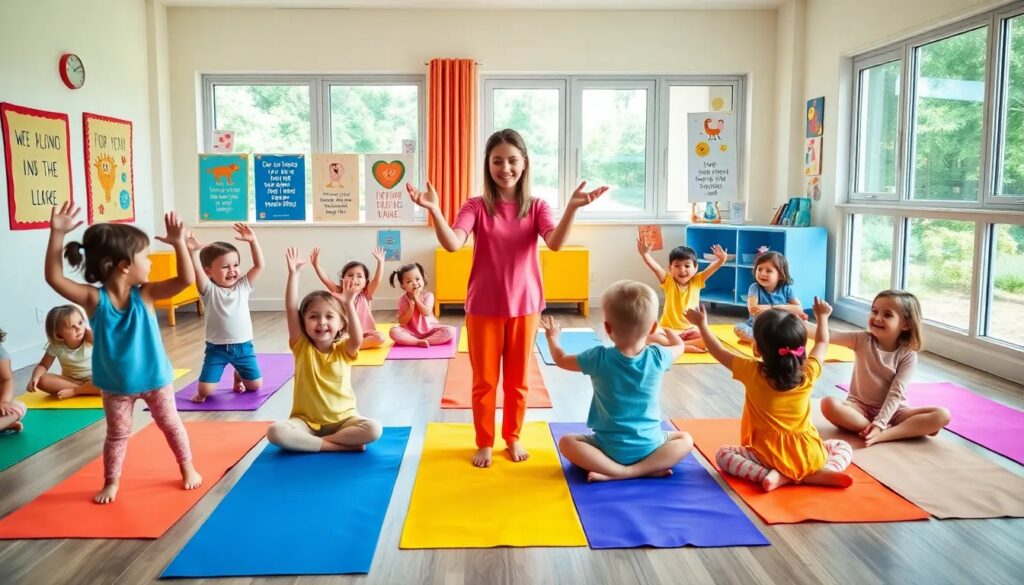
Yoga for preschoolers (ages 3–5) only works if it looks and feels like play. At this age, children cannot hold still poses or follow long verbal instructions — so effective preschool yoga uses animal poses, stories, songs, and games, in sessions of 10–15 minutes. Done that way, it genuinely helps: regular movement-and-breathing practice supports motor skills, balance, body awareness, and early self-regulation — the ability to notice big feelings and calm down. Here is what works, the best starter poses, and a class plan you can run today at home or in a classroom.
What preschoolers get out of yoga (realistically)
Set honest expectations: a 4-year-old is not going to meditate. What practitioners of early-childhood movement and kids yoga report, and what fits with what we know about how preschoolers develop, is more modest and more useful:
- Gross motor development — balancing, crossing the midline, coordinating both sides of the body.
- Body awareness — learning where their limbs are in space, which feeds into everything from dressing themselves to playground safety.
- Early self-regulation — a child who has practiced bunny breaths in calm moments has a tool available in upset moments.
- Following multi-step instructions and taking turns, embedded in a format they enjoy.
- A positive association with movement that is neither competitive nor scored.
The research angle, honestly
There is no large body of rigorous, yoga-specific trials in 3-to-5-year-olds to point to. What does exist — studies of structured movement programs, classroom-based mindfulness, and active play in preschool — points in the same direction: small, real gains in balance, attention, and emotional coping, with the effect size depending heavily on how often the practice happens. The honest read is that preschool yoga is a useful format for the things preschoolers already need to practice, not a magic intervention. If you want a number, the World Health Organization recommends at least 180 minutes of physical activity across the day for preschoolers (3–4 years), spread throughout the day rather than in one block — and a yoga session can be one of those pockets (WHO Guidelines on physical activity and sedentary behaviour, 2020).
Preschool yoga vs older kids (what changes at this age)
| Preschoolers (3–5) | School age (6–12) | |
|---|---|---|
| Session length | 10–15 minutes | 20–40 minutes |
| Format | Story, song, and game led; constant movement | Can follow short sequences and hold poses briefly |
| Pose accuracy | Irrelevant — reward participation, not form | Gentle alignment cues become useful |
| Stillness | 30–60 seconds maximum, with a prop or story | 2–5 minute relaxations possible |
| Breathing work | Playful only (bee hum, flower sniff, candle blow) | Simple counted breathing |
For the broader age-by-age picture, see our guide to yoga for kids. If you have a child under 3, our baby yoga guide covers parent-led movement for that earlier stage.
Best yoga poses for preschoolers
Animal and nature poses win because the name tells the child what to do. Strong starters:
- Cat-Cow — arch and round the back on hands and knees, with mooing and meowing strongly encouraged.
- Downward Dog — most preschoolers already do this spontaneously; add a leg lift to wag the tail.
- Cobra (snake) — lying on the belly, lift the chest and hiss.
- Tree — stand on one leg with the other foot resting on the ankle or calf (never cue the knee); arms grow up like branches.
- Butterfly — seated, soles of feet together, knees flap gently.
- Frog — a deep squat with hands on the floor, with optional hops.
- Star — stand wide with arms out; great for a freeze game.
- Child's Pose (mouse) — the resting shape between energetic poses.
Step-by-step teaching cues for these and more are in our yoga poses for kids guide.
Poses to skip at this age
At 3 to 5, the spine and neck are still developing and most children cannot accurately report discomfort. To keep the practice safe and fun, leave these out until at least age 6, ideally older:
- Headstand and shoulder stand — full inversions put adult-level load on a preschooler's neck.
- Deep backbends without support — full wheel, deep camel, or anything that asks a child to drop all the way back.
- Long seated forward folds — at this age, long holds in a forward fold can strain the lower back; keep stretches short and playful.
- Anything a child says hurts. The rule is simple: pain or "no" means we change the pose or take a break.
Five games that make preschool yoga work
- Yogi Says — Simon Says with poses. Keep everyone in even when they miss; elimination games fall apart at this age.
- Freeze Dance Yoga — music plays, kids dance; when it stops, call a pose to freeze in.
- Pose Dice — a large soft cube with a pose picture on each face; children take turns rolling.
- Story Adventure — narrate a walk through the jungle or a day at the farm, dropping into each animal pose as it appears in the story.
- Sleeping Animals — the preschool version of savasana: everyone lies still as a sleeping animal, and the teacher gently wakes one child at a time, who tiptoes to the next activity.
More game formats and classroom management tips are in how to teach yoga to kids.
Free video options for home
If you are looking for a screen-based option, two channels publish free, short yoga videos aimed at preschool and early-elementary kids: Cosmic Kids (youtube.com/@cosmickidsyoga) and The Kiboomers. Sessions typically run 5 to 20 minutes and follow a story format, which is exactly the structure that works at this age. They are a useful supplement — not a replacement — for moving together with a real adult, since preschoolers learn movement by copying the grown-ups around them, not by watching a screen.
Ready-to-use 15-minute class plan
- Hello circle (2 min): seated, everyone takes a flower breath — sniff a pretend flower in, blow a pretend candle out, three times.
- Wake up the body (2 min): Cat-Cow with animal sounds, then slow Star Pose stretches.
- Story adventure (6 min): a jungle walk hitting Tree, Snake, Frog, Butterfly, and Downward Dog, each held for a few breaths inside the narrative.
- Game (3 min): Yogi Says or Freeze Dance with the poses just practiced.
- Sleeping Animals (2 min): lights lowered, calm voice, optional stuffed animal resting on each child's belly to watch it rise and fall.
Repeat the same structure with a different story each time — preschoolers thrive on a familiar frame with novel content.
Safety and when to stop
- Praise participation, not pose accuracy. A wobbly tree is a perfect tree at four years old.
- Never push, pull, or adjust a child into a deeper position, and skip inversions beyond Downward Dog — preschool joints and necks are still developing.
- Skip the session when a child is sick, feverish, or in pain. Movement should feel good; if it doesn't, the practice can wait.
- Watch for signs of overstimulation. Flopping, giddiness, or sudden tears in an otherwise engaged child usually mean it is time to end or move into the resting shape.
- Hydration and the floor matter. Bare feet on a non-slip surface beat socks on a hard floor, and a water break mid-session helps more than a longer warm-up.
This page is general information, not medical advice. For specific health conditions, sensory differences, or developmental concerns, talk to your child's pediatrician or a qualified kids yoga teacher who has training in adaptations.
A note for parents vs preschool teachers
The same structure works in both settings, but the rhythm is different.
- At home, sessions tend to be shorter (5–10 minutes is plenty), looser on transitions, and benefit from doing it together — partner formats like mommy and me yoga are built on exactly that. A bare floor, socks off, and a follow-the-child attitude beat any equipment.
- In a classroom, the routine matters more than the content. A consistent opening and closing ritual lets children anticipate what comes next, which is what makes 12 three-year-olds sit through a circle. Mats are useful but not required; a carpeted floor and bare feet are fine. If you do buy one, a shorter, easy-clean mat is more practical — see our kids yoga mat guide.
Expect chaos and let it be fun. If half the class is hopping during Butterfly, the session is still working.
As an Amazon Associate, we earn from qualifying purchases.

- THE PERFECT STARTER MAT FOR YOGIS – This non-slip yoga mat for kids provides a safe, phthalate-free surface for yoga, stretching, and play. The 3mm cushioned mat offers comfort while improving balance, focus, and fun
- SUPER GRIP, NON - SLIPS - SAFE FOR ACTIVE KIDS – Extra textured non-slip surface keeps tiny feet steady during yoga, gymnastics, or dance. Toxic-chemical-free so parents can relax while kids stretch & play
- TAKE THE FUN ANYWHERE – Lightweight & tough, this travel-friendly & durable yoga mat survives rolls, jumps, and folds. Perfect for home, school, or trips—because playtime shouldn’t stop at the door
- WIPES CLEAN IN SECONDS – This long-lasting yoga mat for children is tear-resistant and easy to maintain. Great for home workouts, school activities, or outdoor adventures, keeping playtime mess-free
- PARENT-APPROVED – Loved by moms and dads, this easy-to-clean yoga mat measures 60" L x24" H, just right for little yogis—durable for playtime, lightweight for travel, and non-toxic for peace of mind

Children can join playful, game-based yoga from around age 3, when they can imitate poses and follow simple group activities. Before that, parent-and-baby or toddler classes work better, since the adult does most of the moving.
Ten to fifteen minutes is the sweet spot for ages 3 to 5. Attention spans at this age are short, so a brief, energetic, story-driven session repeated a few times a week beats one long class.
Yes, when kept playful and unforced. Avoid pushing children deeper into stretches, skip headstands and shoulder stands, and treat poses as games rather than exercises with correct form. Participation matters more than precision.
It can, with realistic expectations. Practicing playful breathing exercises in calm moments gives children a familiar tool to reach for when upset. Research on early-childhood mindfulness and movement programs points to small, real gains in self-regulation, with the size of the effect depending on how often the practice happens.
Have a correction? Contact us.
Last update 2026-09-10. Price and product availability may change.
Recommended: