Yoga Cave: How to Build a Quiet Home Practice Space

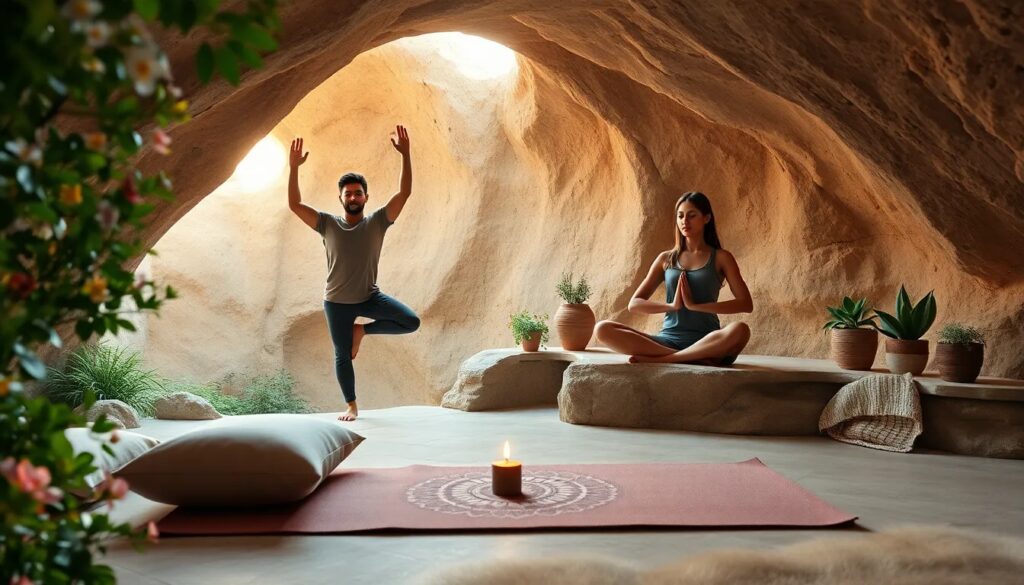
A yoga cave is a dedicated, low-stimulation space for yoga practice — dim, quiet, enclosed, and free of distractions. The term covers two related ideas: studios that build cave-like rooms (including salt caves and grotto-style spaces) for classes, and the increasingly popular home version, where you turn a spare room, basement corner, or even a closet-sized nook into your own retreat. Both work on the same principle: when the senses have less to process, attention settles inward faster.
This post focuses on the space — what a yoga cave is, why a dim and quiet room changes a practice, and exactly how to build one at home on any budget. It does not cover the cave yoga sessions held in geological caves or branded studios such as Yoga Cave in Naperville, IL; those are different experiences, and we link to them for context only.
- What Is a Yoga Cave?
- Why Practice Yoga in a Cave-Like Space?
- What Are Cave and Salt-Cave Yoga Classes Like?
- How to Build a Yoga Cave at Home
- What You Need in Your Yoga Cave
- Yoga Cave Setups by Tier
- What to Practice in Your Yoga Cave
- Cave, Salt Cave, and Yoga Cave at Home: How They Differ
- Frequently Asked Questions
What Is a Yoga Cave?
A yoga cave is not a single kind of place. It is a description of conditions: the room is dim, the air is quiet, the walls are close, and the room has one job. When you step into it, your nervous system reads the environment and starts to settle. The same effect shows up in three different real-world settings:
- Geological caves with hosted classes, such as Olentangy Caverns and Lost River Cave. The rock does most of the work: constant temperature, near-silence, almost no light.
- Studio rooms built to feel cave-like, the most common being salt caves and salt rooms — spaces lined with salt blocks or covered in fine salt, usually kept dim and warm, often associated with halotherapy marketing.
- Home yoga caves, which is what this guide is really about. A corner of a bedroom, a section of basement, a closet-sized nook, or any spot you can darken and quiet down.
Two of these three are out of reach for most readers. The third is the one that changes a daily practice, and it is the one you can build this weekend.
Why Practice Yoga in a Cave-Like Space?
Modern life is bright, loud, and interruption-heavy. A cave-like environment reverses all three conditions, and that matters for the slower, inward-facing styles of yoga. Dim light reduces visual stimulation, which makes it easier to keep attention on breath and body sensation. Enclosure and quiet dampen the startle reflex — you are not half-listening for the doorbell. And a dedicated space builds habit: when one spot in your home means practice, simply stepping into it starts the wind-down.
The styles that benefit most are the quiet ones: restorative yoga, where poses are held for many minutes with full prop support; yoga nidra, practiced lying down in darkness or near-darkness; and slow yoga breathing such as extended exhales. Vigorous flow styles work fine in a bright room — the cave concept is really about downregulation. It also pairs naturally with a yoga for stress routine, and is a strong complement to a regular yoga and meditation practice.
What Are Cave and Salt-Cave Yoga Classes Like?
Some studios and wellness centers offer classes in purpose-built cave-like rooms, the most common being salt rooms or salt caves — spaces lined with salt blocks or covered in salt granules, usually kept dim and warm. A typical session is a gentle or restorative class of 45–60 minutes, often with candlelight or soft amber lighting and a smaller group than a standard studio class.
One honest note: salt-cave businesses often promote halotherapy (dry salt aerosol) as having respiratory and skin benefits. The scientific evidence for those claims is limited and of low quality, so treat them as atmosphere rather than medicine. The real value of these classes is the same as any quiet space — low light, low noise, and a setting that encourages slowing down.
How to Build a Yoga Cave at Home
You do not need a basement or a renovation. You need roughly 6.5 by 3 feet of clear floor — enough for a mat with a little margin — and control over light and sound. A practical checklist:
- Claim a defined spot. A corner of a bedroom, an under-stair nook, a section of a home office. Mark the boundary with a rug or the mat itself; a folding screen or curtain instantly creates enclosure.
- Control the light. Blackout curtains, a dimmer, or simply a warm low-wattage lamp or salt lamp. Avoid overhead light during practice.
- Manage sound. Soft furnishings absorb echo; a white-noise machine or quiet instrumental playlist masks household noise. Earplugs work for savasana.
- Stock minimal props. Mat, two blocks, a bolster (or firm couch cushion), a blanket, and an eye pillow cover nearly every restorative setup — see our guide to restorative yoga poses for how each prop is used. A yoga pillow is a budget-friendly substitute for a full bolster.
- Remove the phone. If you use it for guided audio, switch on do-not-disturb and place it face down out of reach.
- Add one ritual cue. Lighting a candle, a specific scent, or three slow breaths at the threshold tells your nervous system the space has changed.
What You Need in Your Yoga Cave
A yoga cave runs on a small set of props, each doing one job. The list below covers everything that matters; the rest is nice to have.
As an Amazon Associate, we earn from qualifying purchases.
The mat is the foundation. A non-slip mat that grips on low-pile carpet, hardwood, or a rug keeps the practice stable when your hands and feet sweat. Pick one that lays flat and stays flat; a curled edge is the fastest way to break concentration in a quiet room.


Elevation props support the body in long holds. A bolster lifts the chest in supported backbends and the knees in supine poses. Two cork or foam blocks give you three working heights. A yoga pillow is a softer, less expensive alternative when a full bolster feels like too much.

- Yoga Bolster Pillow - The Gaiam yoga bolster is a soft and supportive meditation cushion for added support for the body during yoga, meditation, or general relaxation. Our pillow comes in multiple colors to match your style.
- All-Natural Filling - This pillow is filled with natural cotton batting for superior comfort and cushioning. The soft and flexible filling lets you lay against the pillow with cushioned comfort while the pillow keeps its shape.
- Handle Strap - Our yoga pillow features a built-in sturdy handle on the pillow case for hassle-free transport to easily grab the meditation cushion and go or reposition for poses or support your neck.
- Care Instructions - No need to worry about how to maintain freshness for your pillow as the cover is removable and machine washable. Easily remove to toss in the washing machine.
- Not Just for Yoga - This pillow is an ideal yoga accessory but can also be used for general support to stretch out tense muscles in your neck or prop up your legs and feet after a long day.

Darkness and warmth close the practice. An eye pillow blocks the last bit of light during savasana and yoga nidra. A folded blanket or shawl over the shoulders is enough to keep the body warm while the room cools; a salt lamp or single candle does the rest for mood.

- Aromatherapy eye pillows: Filled with flaxseeds and lavender buds, the soft scent of lavender is calming and soothing, making it the perfect lavender eye pillow weighted for yoga, spa and meditation. Ideal flaxseed eye pillows to relieve tension and stress during a busy day.
- Unique Dual-Fabric Design: Breathable silk eye pillow for sleeping provide extra heat retention. The Ultra-soft velvet fabric is skin-friendly even for sensitive users. This heated sleep mask blocks out all light and provides comforting stress relief and mind refresher during the journey and after work and study.
- Hot & Cold Compress: Microwave it for 30 seconds. eye sinus pillows weighted deliver moist heat and gentle pressure to relieve dry eyes, headaches, migraines, and sinus pain. Freezer for a few hours or overnight, the satin eye pillow will relieve your dark circles and puffy eyes, refreshing tired eyes strained by study or work.
- Removable & Washable Cover. RelaxCoo eye heating pad microwavable measures 5 x 9 inches, weight 9.5 oz that completely covers the eye area without slipping. A set of 2 packages is convenient for you to use alternately or you can enjoy it with your lover.
- Fully Guaranteed: Ideal Gifts for your Loves & Friends & Employees. Please feel free to reach us if you have any questions about our yoga eye pillows.
Yoga Cave Setups by Tier
| Tier | What to get | What it gives you |
|---|---|---|
| Minimal starter kit | Eye pillow, warm lamp or candles, blanket you already own | Darkness and warmth — the two essentials |
| Full prop kit | Add a bolster, two cork or foam blocks, blackout curtain | Full restorative prop kit and light control |
| True enclosure | Add a folding screen or curtain rail, rug, white-noise machine, dimmer | Real enclosure and sound control |
| Permanent studio-grade retreat | Dedicated room: paint in a dark warm tone, acoustic panels, heater for warm practice | A permanent retreat you can leave set up |
Most home practitioners land in the second or third tier. The jump from "minimal" to "full prop kit" makes the biggest difference per item, because a bolster and blocks unlock the entire restorative pose library.
What to Practice in Your Yoga Cave
Match the practice to the space. Evening sessions of 20–40 minutes of restorative poses or a guided yoga nidra recording are the natural fit, and both pair well with slow breathwork such as extended exhales. If stress relief is your main goal, our yoga for stress routine adapts easily to a small, dim space. Save strong flows and standing balance work for brighter conditions — dim light genuinely impairs balance, and the cave is not the place to test a tree pose.
Cave, Salt Cave, and Yoga Cave at Home: How They Differ
The phrase "yoga cave" pulls in three directions, and the post is more useful when those directions are not blurred. A geological cave (Olentangy, Lost River) is a real rock formation used as a venue for occasional classes — the temperature, silence, and dark are given. A salt cave is a built studio room meant to evoke that feeling while adding halotherapy marketing. A yoga cave at home is the version most readers can actually have: a defined, dim, quiet spot in their own home, set up with the props below. This post is about the third one. The first two are worth knowing about, and the links above are the best entry points.
Frequently Asked Questions
A yoga cave is a dedicated, low-stimulation practice space — dim, quiet, and enclosed. The term covers both cave-style studio rooms, such as salt caves, and home setups where a corner or spare room is converted into a distraction-free retreat for yoga and meditation.
About 6.5 by 3 feet of clear floor — enough for a standard mat with a small margin. Enclosure matters more than square footage, so a curtained-off corner often works better than a large open room.
The quiet, dim setting genuinely supports relaxation, but the specific halotherapy claims about respiratory and skin benefits are backed by limited, low-quality evidence. Enjoy salt-cave classes for the atmosphere rather than as a medical treatment.
Restorative yoga, yoga nidra, gentle stretching, and breathwork suit a yoga cave best because they benefit from reduced stimulation. Vigorous flows and balance-heavy practices are safer in a brighter room, since dim light impairs balance.
Have a correction? Contact us.
Last update 2026-09-10. Price and product availability may change.
Recommended: