Yoga Aesthetic: What It Is, Where It Came From, and How to Enjoy It Without Losing the Practice

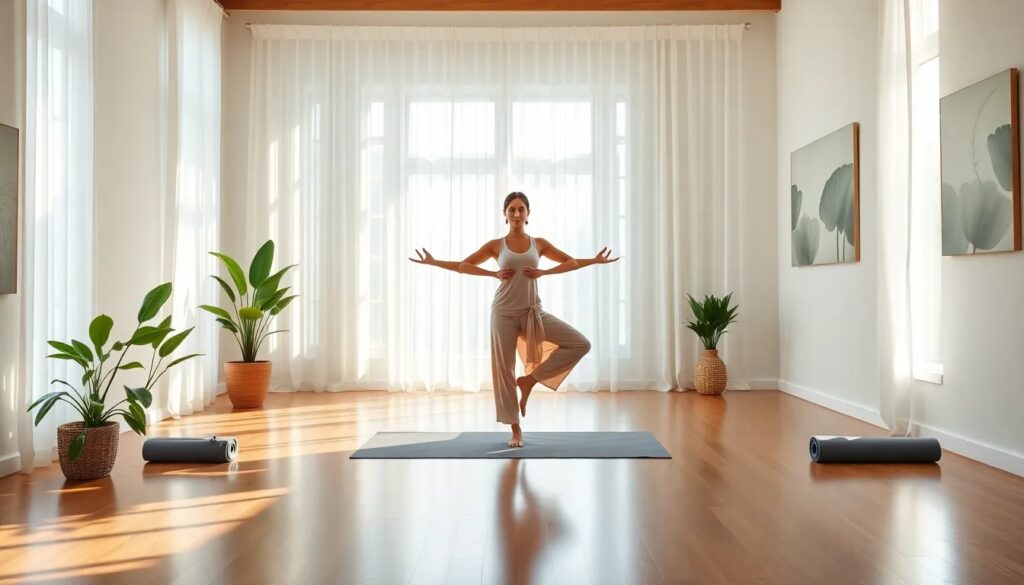
The yoga aesthetic is the visual culture that has grown up around modern yoga: photogenic poses, curated practice spaces, matching athleisure, soft natural light, and the minimalist look that fills Instagram and Pinterest feeds. It is not a style of yoga in the way vinyasa or hatha are. It is a way of presenting and surrounding the practice. That distinction matters, because the aesthetic can either support your yoga or quietly replace it.
This article traces where the yoga aesthetic came from, how it differs from function-first practice, the poses that get the most screen time, how to build a beautiful home space, what to wear, when (and whether) to photograph, and how to keep the look in service of the practice rather than the other way around.
- What "yoga aesthetic" actually means
- Where the yoga aesthetic came from
- Aesthetic-driven vs. function-driven practice
- Popular aesthetic yoga poses (and why they photograph well)
- Building a yoga aesthetic space at home
- Yoga aesthetic outfits: what to look for
- Photographing your practice (without letting the camera lead)
- The real risks of chasing the look
- Enjoying the aesthetic on your own terms
What "yoga aesthetic" actually means
In everyday use, the yoga aesthetic names a recognizable visual language: high-waisted matching sets in soft sage or warm beige, cork and pastel props, line-drawn lotus motifs, sunlit rooms with a single plant, and pose photography that emphasizes long lines and symmetry. None of that is bad in itself.
Where it gets confusing is when the term starts to be treated like a yoga method. The yoga aesthetic is not a lineage and not a curriculum. You will not find a teacher-training certificate in it, a sequence named after it, or a style of breathwork attached to it. Any practice — vinyasa, hatha, yin, restorative — can be done with the aesthetic dialed up, dialed down, or off entirely. Recognizing that is the first step in keeping the look on your side.
Where the yoga aesthetic came from
Yoga has always had a visual dimension. Classical texts describe postures partly through their shapes, and modern teachers were photographed from the start to document alignment. The most influential single source is B. K. S. Iyengar's Light on Yoga (1966), a foundational manual of asana practice built around some 600 monochrome photographs of the author demonstrating each posture — the first time a major yoga text had been illustrated this systematically. Photography of the practice was, from the beginning, a teaching tool.
What changed was the medium. Once photos of practice became shareable on social platforms, the most visually striking poses (deep backbends, arm balances, splits) and the most attractive settings (beaches, lofts, plants, neutral palettes) spread faster than the slower, less photogenic work. The result is the visual language you see today: long lines, symmetry, natural light, and a calm palette that reads as serene on a phone screen.
Aesthetic-driven vs. function-driven practice
Teachers in the alignment and anatomy world — Paul Grilley is the best-known voice here — draw a useful distinction between practicing for how a pose looks and practicing for what it does. Grilley's core argument, which he illustrates with photographs of actual human bones, is that skeletal variation is the rule, not the exception. Two students can do the same pose correctly and look completely different doing it, because hip sockets, femurs, scapulae, and spinal curves are not interchangeable.
That has practical consequences: chasing the visual ideal of a pose can mean pushing past the range your skeleton actually has, and the cost of doing that is often a compression or strain injury in a joint. A function-first approach, by contrast, sets the goal of a pose as a sensation or effect (a hip opening, a back-body stretch, a steadier breath) and lets the body's own feedback define the shape.
| Aspect | Aesthetic-driven practice | Function-driven practice |
|---|---|---|
| Goal of a pose | Match an ideal visual shape | Create a sensation or effect in your body |
| Measure of progress | Deeper, more photogenic positions | Better breath, stability, and comfort |
| Attitude to props | Often avoided (they spoil the line) | Used freely to fit the pose to the body |
| Injury risk | Higher — pushing past safe range for the shape | Lower — range is set by internal feedback |
| Relationship to anatomy | One ideal shape for everyone | Accepts skeletal variation between bodies |
Most experienced practitioners land somewhere in the middle: they appreciate the beauty of well-executed asana while letting breath and sensation, not the camera, set their limits.
Popular aesthetic yoga poses (and why they photograph well)
A handful of poses recur again and again in yoga aesthetic feeds and aesthetic yoga pose roundups. Most of them are popular because they create clean, symmetric lines from angles that read well in a still image. A few notes on each, with the same caution in every case: how a pose looks is one thing, what it does in your body is another.
Downward-Facing Dog
Long spine, straight arms, an inverted V — a clean silhouette. The shape is achievable at many levels of experience with bent knees and a high hips, which is part of why it photographs so consistently. Functionally it is a mild inversion that lengthens the back body and opens the shoulders.
Warrior II
A wide, open frame: front knee bent, back leg straight, arms extended parallel to the floor. The pose reads as strong and graceful from almost any angle, and the alignment is easier to see than in many standing poses, which is why it is a teaching staple as well as a feed staple.
Tree Pose
One foot rooted, the other placed on the inner thigh or calf, hands at the heart or overhead. The shape is simple, vertical, and easy to crop, and it foregrounds balance. If you are working on steadiness for a more advanced balance practice, our guide to yoga balance poses covers the progressions behind it.
Child's Pose
Low, folded, and visually quiet. It photographs as rest and recovery rather than achievement, and the soft roundness of the shape tends to flatter natural light. It is also a useful reminder that aesthetic yoga poses are not all standing or backbending.
Forearm stand and handstand
These appear constantly in yoga aesthetic Pinterest boards because they are dramatic and unmistakable. They are also the most common places students push past safe shoulder range for a shot. If you are working toward them, learn the line work and the spotting first; the picture can wait.
Building a yoga aesthetic space at home
A pleasant, intentional practice space genuinely helps consistency — you are more likely to roll out the mat in a corner you enjoy being in. The aesthetic is not the point; the consistency it produces is. Here is a practical setup checklist, with the design logic behind it.
- Claim a fixed spot. Even two square meters that are always available beats a beautiful space you have to assemble each time. Visibility is what makes a mat get used.
- Prioritize light. Natural light if possible; warm, dimmable lamps for early or late practice. Light is the single biggest factor in how a space feels on the mat.
- Limit the palette. Two or three calm colors (mat, blanket, wall) read as serene; clutter reads as noise. A muted palette is also what most yoga aesthetic room ideas converge on.
- Keep props visible and reachable. Blocks, a strap, and a folded blanket within arm's reach — beautiful props you actually use beat hidden ones.
- Add one living thing. A single plant does more for the atmosphere than a wall of décor, and the green fits the natural-palette look the aesthetic usually reaches for.
- Subtract before you add. The defining feature of spaces people find calming is what is not in them. Clear the floor, the shelves, the visual field, and most of the rest follows.
Yoga aesthetic outfits: what to look for
Yoga clothing only needs to do three things: stretch with you, breathe, and stay in place when you fold or invert. The aesthetic layer — colors, matching sets, fashionable cuts — is optional and entirely a matter of taste. The most common yoga aesthetic outfits are matching high-waisted sets in soft, earthy or pastel tones, often ribbed; they read as calm in a photo and, more importantly, they tend to stay put in a vinyasa class.
For a practical breakdown of fabrics and fits by class type, our guide on what clothes to wear while doing yoga and the broader overview of what people wear to yoga cover the function side. A plain, well-fitting outfit you forget about mid-practice is more functional than an expensive set that needs adjusting.
As an Amazon Associate, we earn from qualifying purchases.


Photographing your practice (without letting the camera lead)
It is not bad to want a photo of your practice. Photos can document progress, give you something to look back on, and (if you share them) keep you accountable to showing up. The question is what the camera does to what you do on the mat.
A few small habits help. Shoot at the natural end of practice, not in the middle of a flow that has just gotten interesting. Choose angles that flatter honesty over drama — a side view of a Warrior II tells the truth about your alignment better than a wide-angle from below. And when a pose does not want to be photographed (a deep hip opener, a long savasana, a quiet breath sequence), let it be unphotographed. The practices with the strongest effect on wellbeing are the ones most often skipped when the camera leads, and that is the loss you want to avoid.
The real risks of chasing the look
It is worth being direct about the downsides, because they are well documented in teaching communities:
- Injury from forcing range. Deep backbends, splits, and bound poses photograph beautifully and are the most common places students push past safe limits. A function-first approach, which respects skeletal variation, is the standard counter to this.
- Comparison and discouragement. Feeds full of advanced practitioners in ideal lighting can make a normal, healthy practice feel inadequate. It is not. The wide range of normal bodies and normal range of motion is the point, not the obstacle.
- Skipping the unphotogenic work. The practices with the strongest effect on wellbeing — slow holds, breathwork, restorative yoga, savasana — are the least visually interesting, and easy to neglect if the aesthetic drives your choices.
A simple test: if removing the camera (or the mirror) from your practice would change what you do, the aesthetic is steering. If it would change nothing, you are simply someone who enjoys a beautiful environment — which is fully compatible with serious practice, and arguably part of yoga's long tradition of treating the practice space as special.
Enjoying the aesthetic on your own terms
The yoga aesthetic is at its best when it works as an invitation: a calm corner that draws you to the mat, clothing that feels good, imagery that reminds you to practice. Build the environment, take the occasional photo if it brings you joy, pick the poses you genuinely enjoy working on — and then let the practice itself be governed by breath, sensation, and honesty about what your body needs that day. If you want to develop the steadiness that makes any pose look composed, start with fundamentals like our guide to yoga balance poses rather than with the most photogenic shapes.
No. The yoga aesthetic is a visual culture around the practice — curated spaces, athleisure, photogenic poses — not a method or lineage. Any style, from vinyasa to restorative, can be practiced with or without it.
Aesthetic-driven practice aims to match an ideal visual shape of a pose, while functional practice aims for the effect the pose creates in your particular body. Because skeletons vary, two people doing a pose correctly can look very different, so function-first teachers let sensation and breath set the limits rather than appearance.
Downward-Facing Dog, Warrior II, Tree Pose, and Child's Pose recur most often because they create clean, symmetric lines that read well in a still image. Forearm stand and handstand appear frequently too, but they carry a higher injury risk and are best worked up to gradually.
A fixed, clutter-free spot is the foundation. Add natural or warm dimmable light, a two-or-three-color palette, visible props you actually use, and a single plant. Subtract before you add — calm spaces are usually defined by what is not in them.
Not inherently. Photos can document progress and keep you motivated. It becomes a problem when the camera changes what you practice — pushing deeper for the shot, or skipping valuable but unphotogenic work like slow holds and breathwork.
Have a correction? Contact us.
Last update 2026-09-10. Price and product availability may change.
Recommended: