How to Build a Yoga Sequence: Structure, Poses, and Common Mistakes

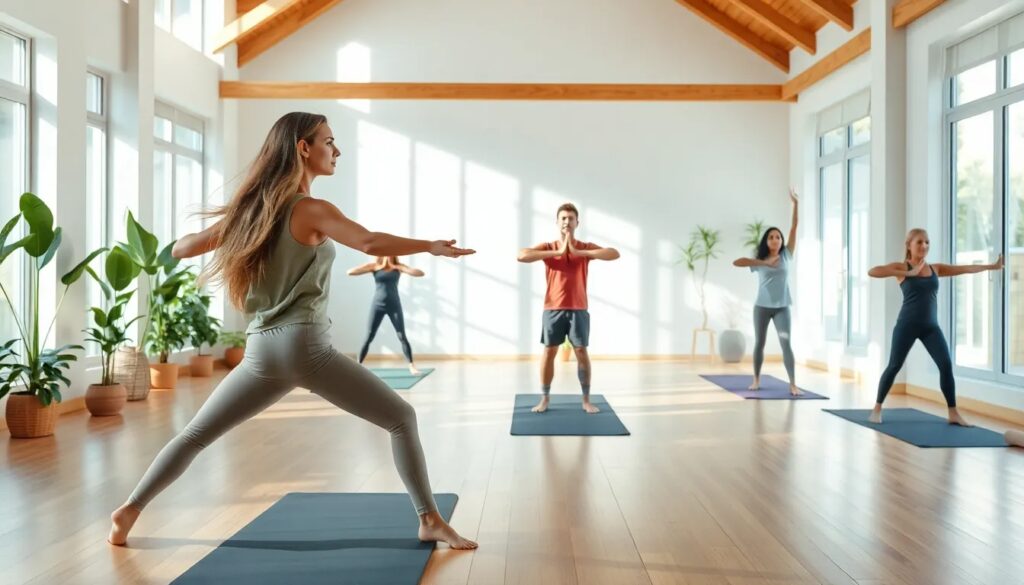
A yoga sequence is the ordered arc of poses in a practice, and nearly every well-built class follows the same six-phase structure: centering, warm-up, standing poses, peak work, cool-down, and final rest. The order is not decoration; it is what lets the body warm up before it is challenged and settle before it stops. Once you understand the arc, you can build a safe, coherent sequence of any length, from ten minutes to ninety.
This guide breaks down each phase, gives you a complete 30-minute example sequence to use as-is, and covers the sequencing mistakes that make home practices feel random or leave you sore in the wrong places. It also walks through how to design your own sequence from scratch and what the most common starting poses are, so the structure stops feeling like a list of rules and starts feeling like a tool you control.
The six phases of a well-built sequence
| Phase | Purpose | Share of practice | Typical poses |
|---|---|---|---|
| 1. Centering | Arrive, set breath rhythm | 5% | Easy Seat, breath awareness |
| 2. Warm-up | Mobilize spine and joints | 15% | Cat-Cow, Sun Salutations, low lunges |
| 3. Standing poses | Build heat, strength, balance | 30% | Warrior I and II, Triangle, Tree |
| 4. Peak work | The most demanding pose or theme | 15% | Arm balance, deep backbend, long hold |
| 5. Cool-down | Release and counterpose | 20% | Seated folds, twists, hip openers |
| 6. Final rest | Integrate, downshift the nervous system | 15% | Savasana, supported rest |
The percentages flex with the style: a vigorous vinyasa practice expands phases 3 and 4, while a gentle hatha class spends more time in phases 2 and 5. But skipping a phase entirely is what makes a practice feel abrupt or leave your body complaining the next day.
A note on framings: you may also encounter the "five element" sequencing used in some Hatha and tantric-inspired traditions, where the arc is mapped to earth, water, fire, air, and ether. It is a different overlay, not a different arc — grounding postures come first, activating postures sit in the middle, and releasing postures close the practice. If the overlay helps you remember the arc, use it; if it gets in the way, ignore it. The six phases still hold.
A complete 30-minute sequence to try
This balanced, intermediate-friendly sequence needs only a mat. Move with the breath: one slow inhale or exhale per transition.
- Easy Seat with slow breathing, 2 minutes. Lengthen the exhale.
- Cat-Cow, 8 rounds.
- Sun Salutation A, 3 rounds at an easy pace.
- Low Lunge, 45 seconds per side.
- Warrior II to Reverse Warrior flow, 4 slow rounds per side.
- Triangle Pose, 45 seconds per side.
- Tree Pose, 30 to 45 seconds per side.
- Peak: Boat Pose, 3 holds of 20 seconds, or substitute Crow Pose attempts if arm balances are your focus.
- Bridge Pose, 2 holds of 30 seconds.
- Seated Forward Fold, 1 minute.
- Supine Twist, 1 minute per side.
- Savasana, 4 to 5 minutes. Do not skip it; this is where the body integrates the work and the breath settles back to baseline.
The same arc scales up to 60 or 90 minutes without changing shape: repeat Sun Salutations, add a second standing flow, give the peak more time, and extend the cool-down. Shorten it for a 10-minute practice by trimming phases 3 and 4 and keeping centering, warm-up, one peak, and Savasana.
How to choose a peak and build toward it
The cleanest way to design your own sequence is backwards from a peak pose:
- Pick the peak. Say, Wheel Pose.
- List what it demands. Open shoulders, open hip flexors, a warm spine.
- Seed those ingredients earlier. Low Lunge for hip flexors, Downward Dog for shoulders, Cobra and Bridge as progressively deeper backbends.
- Counterpose afterward. Gentle knees-to-chest and a twist neutralize a deep backbend; a forward fold follows a twist-heavy section.
If your peak is an advanced posture, the prerequisites deserve their own training plan; our guide to hard yoga poses maps which foundations feed which peaks.
Common sequencing mistakes
- Deep stretching on a cold body. Splits or Pigeon in the first five minutes is how strains happen. Warm up first, always.
- No counterposes. Five backbends in a row with no neutralizing twist or fold leaves the lower back cranky.
- Random pose-stringing. Standing, then floor, then standing again, then floor wastes energy on transitions and breaks the flow state.
- Cutting Savasana. Two minutes of rest after thirty of effort short-changes the recovery half of the practice.
- Same sequence forever. Bodies adapt. Rotate emphasis: strength one day, hips another, backbends another.
Designing your own sequence in 5 steps
If you want to stop borrowing other people's flows and start building your own, the process is shorter than it looks. The order below is the same one the sequencing chapters in the major teacher-training manuals use; the labels vary, the logic does not.
- Build to a peak. Decide the most demanding posture of the session, then design the arc that leads into it.
- Do the same thing on both sides. Any asymmetric pose is held for an equal count on the second side, and ideally a counter-mirror follows.
- Allow at least one minute of Savasana for every ten minutes of practice. A 30-minute sequence earns roughly three minutes of final rest; 60 minutes earns six.
- Keep your real students (or your real body) in mind. Skip what today's body cannot do honestly and substitute what it can.
- Begin with a warm-up and end with a cool-down. The arc above is non-negotiable: warm-up at the front, cool-down at the back, peak in the middle.
The 7 most common starting poses in a sequence
When teachers and experienced home practitioners say "start the practice," they almost always mean a small handful of foundational shapes. These are the seven you will see at the head of nearly every well-built sequence:
- Easy Seat (Sukhasana) for centering and breath.
- Child's Pose as a default rest any time the body needs it.
- Tabletop as the launch pad for Cat-Cow and the warm-up.
- Cat-Cow to mobilize the spine in both directions.
- Downward-Facing Dog as a transitional hub used again and again.
- Mountain Pose (Tadasana) to re-establish alignment before standing work.
- Sun Salutation A as the repeatable warm-up unit that ties them together.
You do not need all seven in every session, but if a sequence is missing the spine of them — breath, a warm-up, and a way to stand tall — it is usually missing the arc.
Adapting the structure to your goal
For beginners
Use the same six phases but with simpler poses and longer instructions to yourself: fewer poses, more breaths each. Our yoga for beginners guide covers the foundational poses that slot into each phase.
For mornings
Front-load gentle spinal movement and Sun Salutations, keep the peak modest, and shorten Savasana so you finish alert rather than sleepy. See our morning yoga routine for a ready-made version.
For strength
Expand the standing and peak phases with longer holds (Chair, Warrior III, Plank variations) and reduce passive stretching, which is better placed in a separate session.
For winding down
Invert the energy curve: skip vigorous standing work, extend the floor-based cool-down, and lengthen final rest. A restorative yoga approach with props is the natural template here.
Frequently asked questions
The standard arc is centering, warm-up, standing poses, peak work, cool-down, and final rest. Within that arc, place the most demanding poses in the middle when the body is warmest, and follow intense poses with neutralizing counterposes.
Anything from 10 to 90 minutes works if the proportions hold. A 15-minute practice might be 3 minutes of warm-up, 8 of standing work, and 4 of cool-down and rest. Consistency beats duration: four short sessions a week outperform one long one.
The most demanding posture of the session, placed roughly two-thirds of the way through when the body is fully warm. Good sequences quietly rehearse its components earlier, so the peak feels like a conclusion rather than an ambush.
It is safe and some traditions, such as Ashtanga, are built on fixed sequences. The trade-off is adaptation: rotating emphasis between strength, hips, backbends, and rest develops a more balanced body and keeps practice interesting.
Have a correction? Contact us.
Recommended: