Somatic Yoga: What It Is, How It Works, and How to Start

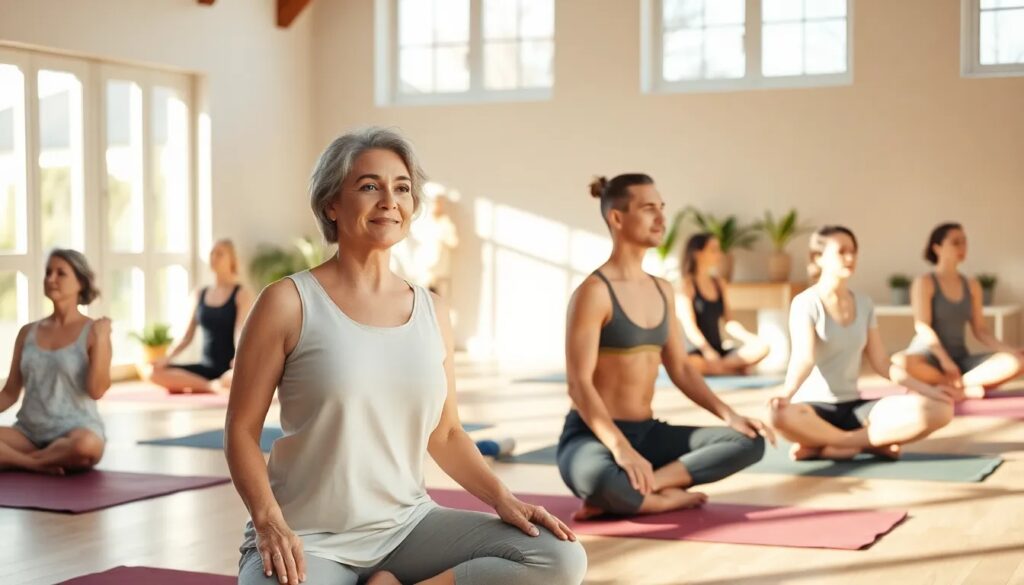
Somatic yoga is a gentle, slow style of practice that blends yoga postures with principles from somatic movement education, the field concerned with how we sense and control our bodies from the inside. Instead of stretching harder or holding poses longer, somatic yoga uses small, slow, deliberate movements with close internal attention, aiming to retrain the way the nervous system holds habitual muscle tension. The emphasis is on how a movement feels, not how it looks.
This guide explains where the approach comes from, what the evidence honestly supports, how it differs from other slow styles like yin yoga and restorative yoga, what it is not (a substitute for trauma therapy), and how to try it safely at home with a short beginner sequence.
Health note: this article is general information, not medical advice. If you have chronic pain, an injury, or a neurological condition, talk to your healthcare provider before starting any new movement practice, and work with a qualified teacher where possible.
- What is somatic yoga?
- Where does somatic yoga come from?
- What are the benefits — and what does the evidence say?
- Somatic yoga vs yin vs restorative: which slow style is which?
- Somatic yoga vs somatic experiencing: not the same thing
- A simple somatic yoga sequence for beginners
- Who is somatic yoga best for?
- How to find a good somatic yoga teacher
- Want to go deeper — or teach it?
- Frequently asked questions
What is somatic yoga?
Somatic yoga is a practice method, not a posture set. Classes and home sequences are built around small, repeated, internally focused movements rather than long-held shapes. The word somatic comes from the Greek soma, which simply means "body"; the narrower sense used here — the body as experienced from within, in the first person — is Thomas Hanna's, who redefined the term in his 1970 book Bodies in Revolt and later named the whole field somatics. A somatic approach treats the felt sense of moving as the primary material of the practice: where you feel effort, where you feel ease, where movement feels stuck, where it feels free.
Concretely, a somatic yoga class usually looks like this: long warmups with floor-based micro-movements, very few standing postures, frequent pauses to notice sensation, almost no music or fast instruction, and a teacher who repeatedly asks you to do less rather than more. The pace can feel glacial if you are used to a vinyasa-style class. The trade-off is depth of attention: many students find that moving this slowly is the first time in years they have actually felt their back, hips, or shoulders while moving them.
Where does somatic yoga come from?
The somatic side of the practice draws heavily on the work of Thomas Hanna (1928–1990), a philosophy professor who chaired the department at the University of Florida before turning to movement, and who coined the word somatics in 1976 to name the whole field. The label most often attached to his hands-on work today, Clinical Somatic Education, belongs to the practitioner training he launched in 1990, the year he died — not to the 1970s. Hanna built directly on the Feldenkrais Method: he trained as a Functional Integration practitioner and in 1975 directed the first Feldenkrais training program in the United States, the same year he and Eleanor Criswell Hanna founded the Novato Institute. She still directs it, and the somatic yoga taught there is the most direct bridge between Hanna's somatics and a yoga class. Moshe Feldenkrais himself was an Israeli engineer and physicist — and a judo black belt — who worked out much of his method while rehabilitating his own knee injury. Both traditions share a simple premise: the brain and the muscles are a feedback loop, and that loop can be re-tuned with careful, attentive practice.
Hanna named one pattern sensory-motor amnesia: the idea that chronic stress, injury, and repetitive habits teach muscles to stay partially contracted until we lose voluntary control over releasing them. The signature somatic technique for unwinding that pattern is pandiculation, a deliberate contract-then-slowly-release cycle (think of the full-body stretch-yawn a cat or dog does on waking) used to restore sensation and control. Somatic yoga takes these ideas and weaves them into familiar yoga shapes and breath awareness, producing classes that move very slowly, repeat movements several times, and constantly ask you to notice internal sensation.
What are the benefits — and what does the evidence say?
Practitioners commonly report easier movement, reduced everyday tension, better body awareness, and a calmer baseline. What research can and cannot back up splits into roughly three tiers.
- Reasonably supported. Slow, mindful, breath-led movement in general is associated with reduced perceived stress and improved body awareness across the broader yoga and movement-science literature.
- Plausible but less studied. Specific somatic techniques like pandiculation have a coherent neurological rationale, but high-quality clinical trials isolating somatic yoga as a method are scarce, so benefits are reported rather than proven in a strict sense.
- Not supported. Claims that somatic yoga cures disease, releases stored trauma on a predictable schedule, or causes meaningful weight loss by itself. Treat such claims skeptically wherever you see them.
The fair summary: it is a low-risk, genuinely pleasant practice with solid grounding in movement science, best framed as a complement to, not a replacement for, medical or psychological care.
Somatic yoga vs yin vs restorative: which slow style is which?
These three get confused constantly because all are slow and quiet. The mechanisms differ in important ways, and so do the reasons you would choose one over the others.
| Style | Core method | Primary target |
|---|---|---|
| Somatic yoga | Small, slow, repeated active movements with internal focus | Nervous system control of muscle tension |
| Yin yoga | Long passive holds, several minutes each | Connective tissue and joint mobility |
| Restorative yoga | Fully supported resting shapes with props | Deep relaxation and the rest-and-digest response |
A simple way to choose: if you want to move and re-learn, pick somatic; if you want to stretch deeply and stay, pick yin; if you want to rest completely, pick restorative. All three pair well with a more dynamic practice like vinyasa yoga on alternating days, and many teachers mix them deliberately across a week.
Somatic yoga vs somatic experiencing: not the same thing
The word somatic now appears in front of everything from stretching apps to trauma therapy, so it is worth separating two things that often get mixed up. Somatic experiencing is a specific trauma-therapy modality developed by psychologist Peter Levine, delivered one-on-one by trained therapists in a clinical context and aimed at completing defensive responses the nervous system could not finish during a traumatic event. Somatic yoga is a group movement class built around slow, internally focused movement.
The two share an interest in body sensation, but a yoga class, however gentle, is not a substitute for trauma treatment. If a studio, app, or online course markets somatic yoga as therapy for PTSD, complex trauma, or "stored trauma release," treat that as a red flag and look for appropriately licensed care instead. Likewise, a somatic yoga teacher who is not a licensed clinician should not be processing traumatic material with you on the mat, even with the best intentions.
A simple somatic yoga sequence for beginners
Try this 15-minute floor sequence. Move at perhaps a quarter of your normal speed, repeat each movement three to five times, and stop short of any pain. The point is not to reach a destination shape but to feel what changes from one repetition to the next.
- Body scan (2 minutes): lie on your back and slowly inventory sensation from feet to head without changing anything. Notice temperature, contact with the floor, ease or effort in breathing.
- Arch and flatten: with knees bent and feet flat, slowly arch the lower back on an inhale, then slowly flatten it to the floor on an exhale. Make the movement smaller and smoother with each repetition rather than larger.
- Slow cat-cow: on hands and knees, take a full breath cycle for each direction, paying attention to each segment of the spine from tailbone to crown separately.
- Side bend curls: lying on your back, slowly slide one hand toward the same-side knee, gently contracting the waist muscles, then release even more slowly than you contracted. Repeat on both sides.
- Supported rest (3 to 5 minutes): finish in Child's Pose or lying on your back with calves supported on a chair, and notice what feels different from the opening scan.
The slow release in step 4 is the heart of the method: in the somatic tradition's own account, releasing more slowly than feels natural is what gives the nervous system new information about the muscle's state, and that is what is thought to loosen the habitual tension pattern.
Who is somatic yoga best for?
Somatic yoga tends to suit people with chronic everyday tension (desk shoulders, gripping lower backs), those returning to movement after a sedentary period, older practitioners, and anyone for whom standard classes feel too fast to actually feel anything. Athletes and naturally flexible practitioners sometimes find it frustratingly subtle at first, because the gains here are in control and ease rather than range of motion or sweat.
It is also a popular complement for students working with general stress, since the practice doubles as nervous-system downtraining. Pregnant students should look for teachers with appropriate training and adapted sequencing, as discussed in our guide to prenatal yoga certification. People with chronic pain often tolerate somatic work well because movements are small and self-paced, but chronic pain has many causes, so a conversation with a healthcare provider and a teacher experienced with your specific condition is essential before beginning.
How to find a good somatic yoga teacher
Because somatic yoga is a methodology rather than a single trademarked system, class quality varies widely. Look for teachers who can explain why the movements are slow (nervous-system re-education) rather than simply offering a slower version of a regular class. Good signs include long floor-based warmups, lots of repetition, very few verbal cues about external alignment, and a willingness to suggest you do less.
Red flags include a focus on "releasing stored trauma" within a standard group class, a hard-sell approach to long teacher trainings, or instructors who cannot point to any formal training in somatic education, Hanna-style work, Feldenkrais, or a recognized somatic yoga lineage.
Want to go deeper — or teach it?
Search interest in somatic yoga has grown steadily, and demand for slow, nervous-system-aware classes has risen with it. If you are a teacher considering a specialization, our guides to somatic yoga certification and somatic yoga teacher training compare the main training pathways, what they cover, and what they actually qualify you to teach, so you can pick a program that matches the kind of class you want to offer.
Frequently asked questions
Regular yoga classes usually work toward postures and external alignment. Somatic yoga prioritizes the internal experience of small, slow movements, aiming to change how the nervous system controls muscle tension rather than to achieve shapes.
Yes, as a gentle movement practice grounded in established somatic education methods. Its core ideas are plausible and low-risk, though clinical research on somatic yoga specifically is still limited, so avoid treating it as a medical therapy.
Not directly. It burns few calories. Any contribution to weight management is indirect, through lower stress and better habits, so pair it with appropriate exercise and nutrition if weight is the goal.
Short and frequent beats long and rare: 10 to 20 minutes most days works better than one long weekly session, because the practice is about re-educating movement habits.
It is often well tolerated because movements are small and self-paced, but chronic pain has many causes. Get guidance from your healthcare provider first and choose teachers experienced with your condition.
Have a correction? Contact us.
Recommended: