Partner Yoga: 5 Beginner Duo Poses, Benefits, and Safety

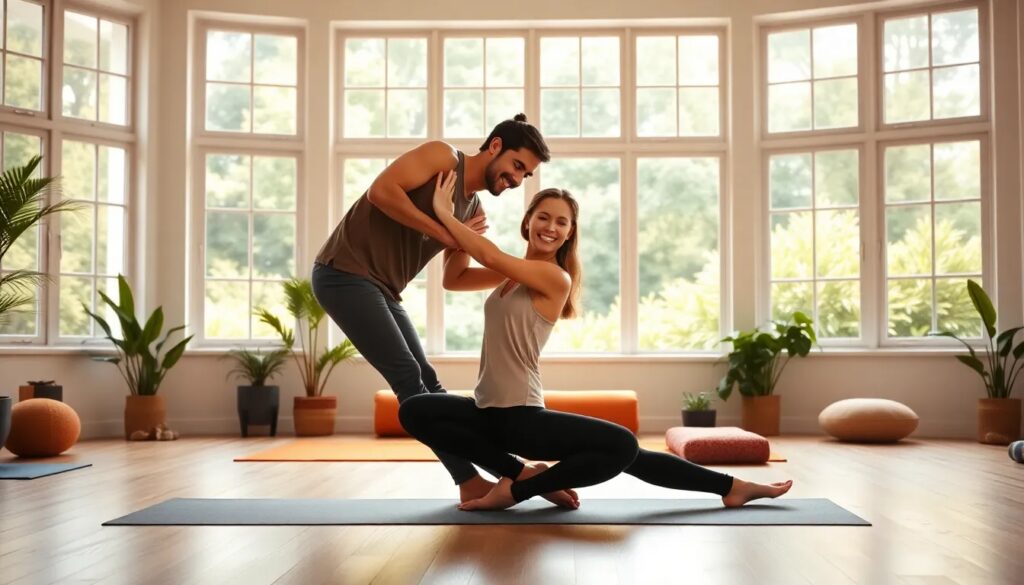
Partner yoga is yoga practiced by two people who use each other for support, resistance, or a deeper stretch in shared poses. Unlike a solo session, every pose depends on communication: one partner leaning back is only possible because the other is counterbalancing. You do not need a romantic partner, matching skill levels, or any acrobatic ability — a friend, family member, or classmate works fine for the beginner duo yoga poses below.
This guide covers what partner yoga is (and how it differs from acro yoga), the benefits that are actually supported, five beginner partner yoga poses you can try today, the safety rules that matter, and how to keep progressing.
Partner yoga vs. acro yoga vs. couples yoga
| Practice | What it is | Intensity | Who it suits |
|---|---|---|---|
| Partner yoga | Two people share grounded poses, using each other for support and stretch | Low to moderate | Any two people, including beginners |
| Acro yoga | Adds acrobatics: one partner flies on the other's feet or hands, ideally with a spotter | Moderate to high | People comfortable with inversions and falls; see our acro yoga guide |
| Couples yoga | Partner yoga framed for romantic partners, emphasizing connection and synchronized breathing | Low | Couples of any experience level |
The poses often overlap; what changes is the emphasis. Partner yoga stays grounded, acro leaves the floor, and couples yoga keeps the physical work gentle while foregrounding the relationship. The same "back-to-back breathing" shape, for instance, is a partner-yoga staple, a couples-yoga opener, and not an acro pose at all.
What partner yoga actually does for you
- Deeper, safer stretching. A partner provides gentle traction or resistance you cannot create alone — for example, a counterweight in a forward fold lets you lengthen the spine without straining.
- Built-in feedback. A partner immediately feels (and tells you) when you collapse a shoulder or shift your weight — something a mirror cannot do.
- Trust and communication. Poses fail without clear, ongoing verbal cues. Many teachers use partner work specifically to train this skill.
- Accountability. Practicing with someone makes you measurably more likely to show up — the same reason workout partners work.
Claims that partner yoga transforms relationships should be taken as plausible rather than proven; the honest case is simpler — it is enjoyable, social, and gets two people moving.
5 easy partner yoga poses (step by step)
These duo yoga poses are the standard beginner set: all grounded, all easy to learn, all good for friends, family, or romantic partners of any size. The whole sequence runs 15-25 minutes.
- Back-to-back seated breathing. Sit cross-legged, spines touching. Close your eyes and spend 2-3 minutes matching the rhythm of each other's breath. This is the standard opening — it tunes you to your partner before any physical work.
- Partner seated forward fold (seesaw). Sit facing each other, legs extended, feet touching (bend knees as needed). Hold wrists. One partner leans back slowly, drawing the other into a forward fold; hold 3-5 breaths, then reverse. The folding partner says when to stop — always.
- Double tree pose. Stand side by side, inner hips close. Each places the outer foot against the standing leg's calf or thigh (never the knee) and you press inner palms together overhead. The contact point makes balance easier than solo tree pose, which makes it ideal for beginners.
- Partner seated twist. Sit back-to-back, cross-legged. Both twist to the same side, each reaching one hand to your own knee and one to your partner's knee. The shared rotation gently deepens the twist; keep it comfortable, not forced.
- Partner boat pose. Sit facing each other, knees bent, holding hands outside your legs. Press the soles of your feet together and slowly extend the legs upward into a shared V shape. Drop one or both legs anytime — this one is meant to involve laughter.
For a wider catalogue of partner yoga poses once these feel comfortable, see our partner yoga poses list. If you are new to the underlying poses themselves, build basic familiarity first with our yoga poses for beginners guide — partner versions are easier when the solo shape is familiar.
As an Amazon Associate, we earn from qualifying purchases.

- NEW ECO FRIENDLY MATERIAL: The upgraded Gruper Yoga mat is made with premium friendly material. It costs more to make, but it is safer and more soft than traditional non-green PVC and EVA yoga mats.The exercise mats are suitable for many forms of Yoga, Pilates and fitness.
- UPGRADED ANTI-SKID DESIGN AND DOUBLE LAYER ANTI TEAR: Special sticky non slip texture on both sides , more Hard-wearing than regular yoga mats and resistant to tearing and deformation. Double layer structure coupled with a non-slip textured surface provides optimal grip without sacrificing comfort.
- TWO DIFFERENT SIZE OTPTIONAL : ①☛ Standard Size:72"(183cm) x 24" (61cm); Thickness: 0.24"(6mm); Weight: 2.6lb. ②☛ Thickened Size:72"(183cm) x 24" (61cm); Thickness: 0.32"(8mm); Weight: 3.1lb.
- CARE INSTRUCTIONS: 1.Clean with damp cloth (cold water) or mild detergent, dry flat. 2.Do not use a washing machine or dryer or exposed to the sun for extended periods of time. 3.Designed for barefoot exercise. Your shoes or your pets' paws may tear the mat.
- FREE CARRY STRAP & STORAGE BAG - No need to go buy a yoga carrying strap and bag. Easy to carry your yoga mat around with.you can carry to the gym or anywhere you want

Safety rules that actually matter
- Agree on a stop word. Any partner says it, everything unwinds slowly. Decide this before the first pose, not during it.
- Move slowly into and out of poses. Most partner yoga tweaks happen during sloppy exits, not during holds.
- Never force a stretch on your partner. The person being stretched controls the depth, full stop.
- Warm up first. A few rounds of cat-cow and gentle sun salutations — the kind of breath-linked warm-up described in our vinyasa yoga guide — prepares both bodies.
- Leave flying poses for class. Anything where one partner leaves the ground belongs in an acro setting with a spotter and mats.
- Mind medical limits. Pregnancy, recent injuries, or back problems call for professional guidance before partner work — the supported stretches can go deeper than your body is ready for.
How to keep progressing
Once the five beginner poses feel comfortable, the natural next steps are double downward dog (one partner folds, the other places feet on their lower back — sacrum, not spine), assisted backbend pairs, and eventually entry-level acro like folded leaf. Workshops are worth the money here: partner technique is much easier to learn with a teacher correcting both of you in real time. For quieter sessions together, finishing with supported restorative shapes works beautifully — see our restorative yoga guide for poses that adapt easily to two people.
When to take a class instead
If you want a real partner yoga sequence with a teacher cueing both of you, search for a partner yoga workshop or couples yoga class at a local studio. Partner yoga near me is a reasonable search when you want feedback from a teacher in real time, especially before trying any pose that has one person supporting the other's weight.
No. For grounded beginner poses, technique and communication matter far more than matching height or weight. Size becomes relevant mainly in acro-style poses where one partner supports the other off the ground, and even there, good technique lets smaller people base larger ones.
Yes. Grounded poses like back-to-back breathing, the partner forward fold, and double tree are designed for beginners and are arguably easier than their solo versions because the partner provides support and balance.
Partner yoga keeps both people grounded, using each other for support and stretch. Acro yoga adds acrobatics, with one partner balancing on the other’s feet or hands, and is normally practiced with a spotter. Partner yoga is the gentler entry point.
Not at all. Partner simply means the second person in the pose. Friends, siblings, parents and kids, or someone you met in class all work. Couples yoga is a specific framing of the same practice for romantic partners.
About 15 to 25 minutes is enough to cover four or five poses with breathing and warm-up. Longer sessions risk fatigue, and fatigue is when sloppy exits (and tweaks) happen.
Have a correction? Contact us.
Last update 2026-09-10. Price and product availability may change.
Recommended: