What Is the History of Yoga? A Clear Timeline from Ancient India to Today

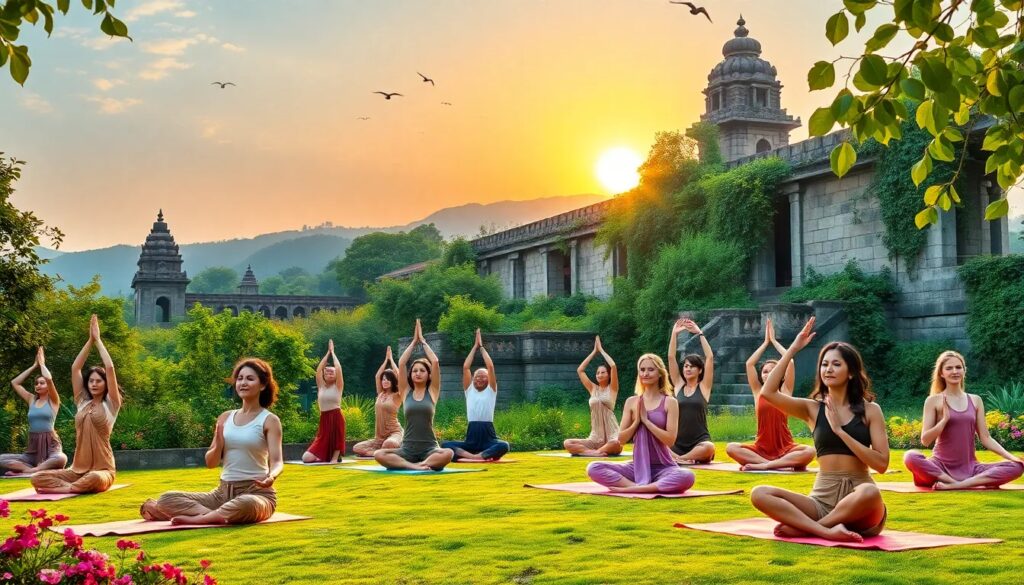
The history of yoga is the story of an ancient Indian spiritual discipline that gradually turned into a global posture-based fitness practice. What we now call "yoga" developed over roughly 2,500–3,000 years across Hindu, Buddhist, and Jain traditions, and the physical, flow-style version most people picture in a Western studio was shaped only in the twentieth century. This timeline walks through that full arc and separates what the historical record actually supports from the inflated numbers you often see in marketing copy.
- How Old Is Yoga, Really?
- The Five Main Periods of Yoga History
- Vedic and Pre-Classical Yoga: The Roots
- Classical Yoga: Patanjali and the Yoga Sutras
- Hatha Yoga: Where the Postures Come From
- From India to the World: How Yoga Went Global
- Yoga Today: An Ancient Name for a Modern Practice
- Frequently Asked Questions
How Old Is Yoga, Really?
You will often read that yoga is 5,000 or even 10,000 years old. Those numbers make for good marketing, but the evidence behind them is thin.
The most common claim rests on the Pashupati seal from the Indus Valley civilization (roughly 2350–2000 BCE), which shows a horned figure seated in what looks like a cross-legged position. Most scholars treat that interpretation with caution: a single seated figure on a small soapstone seal tells us very little about whether anything resembling a yogic practice actually existed at the time. For a more focused look at the geography of those roots, see our guide to yoga's Indian roots.
What the written record supports is still impressive. The word yoga appears in the Vedas, and the first descriptions of yoga as a discipline of mind and senses appear in the Upanishads — putting yoga as a documented practice at roughly 2,500–3,000 years old. Ancient by any standard, just not as old as the studio brochure claims. For a broader introduction to what yoga is today, see our guide to what yoga is.
The Five Main Periods of Yoga History
Historians commonly divide the history of yoga into five broad periods. The table below summarizes what changed in each one.
| Period | Approximate dates | Key texts and figures | What changed |
|---|---|---|---|
| Vedic | c. 1500–800 BCE | Rigveda and other Vedas | The word yoga appears, mostly meaning yoking or harnessing; ritual and chant dominate |
| Pre-classical | c. 800–200 BCE | Upanishads, Bhagavad Gita | Yoga becomes an inner discipline of meditation, restraint, and self-knowledge |
| Classical | c. 200 BCE–400 CE | Patanjali's Yoga Sutras | Yoga is systematized into the eight limbs; defined as stilling the mind |
| Post-classical (hatha) | c. 800–1700 CE | Tantric texts, Hatha Yoga Pradipika | Body-centered techniques emerge: postures, breath control, cleansing practices |
| Modern | 1893–today | Vivekananda, Krishnamacharya, Iyengar, Jois, Indra Devi | Postural yoga develops and spreads globally as a health and fitness practice |
Vedic and Pre-Classical Yoga: The Roots
What "Yoga" Meant in the Vedas
The Sanskrit word yoga comes from the root yuj, meaning to yoke or join. In the Rigveda (composed around 1500–1200 BCE) it mostly refers to yoking animals to chariots, with only hints of a spiritual sense. The decisive shift comes with the Upanishads: the Katha Upanishad, usually dated to around the 5th century BCE, contains one of the first explicit definitions of yoga as the firm restraint of the senses.
The Bhagavad Gita, composed in roughly the 2nd century BCE, then broadens yoga into a way of living. It describes several complementary paths — karma yoga (action), jnana yoga (knowledge), and bhakti yoga (devotion) — none of which involve physical postures in the modern sense.
Classical Yoga: Patanjali and the Yoga Sutras
Somewhere between the 2nd century BCE and the 4th century CE, the sage Patanjali is traditionally credited with compiling the Yoga Sutras — 196 short aphorisms that define yoga as the stilling of the fluctuations of the mind and lay out the eight limbs of yoga: ethical restraints, observances, posture, breath control, sense withdrawal, concentration, meditation, and absorption.
A detail that surprises many modern practitioners: in Patanjali's system, asana simply means a steady, comfortable seat for meditation. The Sutras devote only a handful of verses to it. The meditative path Patanjali describes survives today as raja yoga.
Hatha Yoga: Where the Postures Come From
Body-centered yoga developed in medieval India, shaped by tantric traditions that treated the body as a vehicle for transformation rather than an obstacle. The best-known manual, the Hatha Yoga Pradipika (15th century CE), describes only about 15 asanas — alongside breath control, cleansing techniques, and energy practices. Even at this stage, yoga looked nothing like a modern vinyasa class.
From India to the World: How Yoga Went Global
Yoga's global story usually starts with Swami Vivekananda, who presented yoga philosophy at the World's Parliament of Religions in Chicago in 1893. What he taught was meditation and philosophy — not postures — but it introduced "yoga" as a word to a Western audience.
Through the early twentieth century, European Theosophists and Indian teachers carried ideas about yoga further west, but the physical practice arrived through a different channel. In the 1930s, Tirumalai Krishnamacharya taught a dynamic, posture-based yoga at the Mysore Palace in India, drawing on hatha yoga and contemporary physical culture. His students carried it worldwide: Indra Devi opened a Hollywood studio in 1947, B.K.S. Iyengar's 1966 book Light on Yoga became the standard reference, and K. Pattabhi Jois developed Ashtanga vinyasa, the ancestor of most modern flow classes. From the 1970s onward, yoga spread through television, gyms, and dedicated studios into the mainstream wellness industry.
Yoga Today: An Ancient Name for a Modern Practice
The honest summary is that modern postural yoga is a 20th-century synthesis built on a genuinely ancient philosophical foundation. Key milestones at a glance:
- c. 1500 BCE — the word yoga appears in the Vedas
- c. 500 BCE — the Upanishads describe yoga as inner discipline
- c. 200 BCE–400 CE — Patanjali is credited with compiling the Yoga Sutras
- 15th century CE — the Hatha Yoga Pradipika codifies physical practices
- 1893 — Vivekananda introduces yoga philosophy to the West
- 1930s–1960s — Krishnamacharya and his students create modern postural yoga
- 1990s–today — yoga becomes a global fitness and wellness phenomenon
Because yoga developed across Hindu, Buddhist, and Jain traditions rather than from a single scripture, no religion "owns" it. That layered history also explains why people still debate yoga's relationship to spirituality, a question we examine in is yoga a religious practice.
Frequently Asked Questions
Yoga as a documented practice is roughly 2,500 to 3,000 years old, based on descriptions in the Upanishads. Popular claims of 5,000 or 10,000 years rest on disputed interpretations of Indus Valley artifacts and are not supported by clear evidence.
No single person invented yoga. It developed gradually in ancient India across Hindu, Buddhist, and Jain traditions. Patanjali is traditionally credited with systematizing the classical meditative path around 2,000 years ago, and Tirumalai Krishnamacharya and his students shaped the modern posture-based practice in the 20th century.
The word yoga first appears in the Vedas, but the earliest texts that describe yoga as a discipline are the Upanishads, especially the Katha Upanishad from around the 5th century BCE. Patanjali's Yoga Sutras later became the foundational systematic treatment.
Yoga philosophy reached the United States in 1893 through Swami Vivekananda. The posture-based practice grew from the late 1940s onward through teachers like Indra Devi and B.K.S. Iyengar, and yoga became a mainstream fitness activity from the 1990s.
Yoga was not created by any single religion. It developed within the broader Indian religious landscape, drawing from Hindu, Buddhist, and Jain traditions, and modern postural yoga is taught as a secular fitness and wellness practice in most Western studios.
Have a correction? Contact us
Recommended: