Restorative Yoga Sequence: A Complete 45-Minute Home Practice

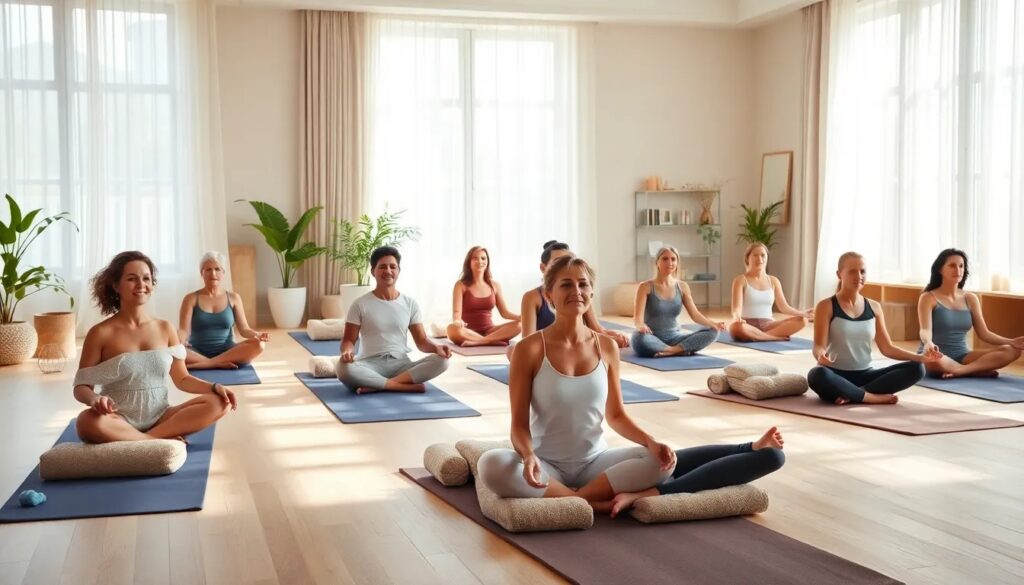
A restorative yoga sequence is a short series of fully supported poses held for 5 to 15 minutes each, arranged so the body can release tension progressively — typically moving from gentle backbends and hip openers toward inversions and final rest. Unlike an active class, you are not stretching or strengthening; props hold you in each shape so completely that the nervous system can downshift into its rest-and-digest state.
Below you will find a complete 45-minute sequence with exact setups and hold times, a 20-minute short version for busy evenings, and household substitutions for every prop. If you want the background on how this style works before practicing, start with our explainer on what restorative yoga is.
Props You Need (and Household Substitutes)
| Prop | Used for | Household substitute |
|---|---|---|
| Bolster | Main support in most poses | Two firm pillows stacked, or a rolled blanket inside a pillowcase |
| 2 blocks | Raising the bolster, supporting knees | Thick hardcover books |
| 2–3 blankets | Padding, warmth, head support | Bath towels or throw blankets |
| Strap | Securing legs in reclined poses | A bathrobe belt or scarf |
| Eye pillow | Blocking light, deepening rest | A folded washcloth |
Firmness matters more than the official label. A bolster should not collapse under your torso; if your pillow stack flattens too much, add a folded towel on top until your chest can rest without effort. Set up in a warm, quiet room with dim light. Your body temperature drops during long holds, so keep a blanket over you — being cold is the most common reason home restorative practice fails. Beginners and seniors are the core audience for this kind of substitution: nobody needs the branded gear to do the practice well.
The 45-Minute Sequence
Why this order? The sequence opens the front body first (so the breath can deepen), twists through the spine to release the muscles that guard it, then inverts gently to drain the legs, and finishes with the longest single hold — savasana — when the nervous system is ready to fully downshift. Adding a few minutes to savasana turns this 45-minute practice into a one-hour restorative sequence; subtract two minutes from the bridge and you have a 40-minute version for tight evenings.
1. Supported Child's Pose — 5 minutes
Kneel with big toes together and knees wide. Pull the bolster lengthwise between your thighs and lay your torso along it, head turned to one side (switch halfway). The bolster should be high enough that you feel zero effort holding the shape — add a blanket on top if needed. This pose signals the descent into rest and gently releases the lower back.
2. Supported Reclined Bound Angle — 8 minutes
Place a block under one end of the bolster to create a ramp. Sit with your tailbone at the low end, soles of the feet together and knees falling outward onto a block or rolled blanket under each thigh — the knee support is essential, without it the inner thighs grip. Recline back along the ramp, arms resting open. This opens the chest and hips with no muscular work.
3. Supported Bridge — 5 minutes
Lie on your back, knees bent, feet flat. Lift the hips and slide a block (low or medium height) under the sacrum — the flat triangular bone at the base of the spine, not the lumbar curve. Arms rest by your sides. A gentle, passive backbend that counters a day of sitting.
4. Supported Twist — 5 minutes per side
Sit with your right hip against the short end of the bolster, knees bent and stacked to the left. Rotate your torso toward the bolster and lay your chest down along it, head turned in whichever direction feels easier. Switch sides after five minutes. Twists release the muscles along the spine; keep them effortless rather than deep.
5. Legs-Up-the-Wall — 8 minutes
Sit sideways against a wall, then swivel to take your legs up it, hips a few inches from the baseboard (or resting on a folded blanket). Arms open at your sides. If your hamstrings complain, slide the hips farther from the wall. This mild inversion is the sequence's quiet centerpiece — many practitioners feel their breathing slow noticeably here.
6. Savasana — 8 minutes
Lie flat with the bolster under your knees, a folded blanket under your head, blanket over your body, eye pillow on. Let the breath be completely natural. Set a gentle timer so you are not checking the clock.
Short on Time? The 20-Minute Version
- Supported Child's Pose — 4 minutes
- Supported Reclined Bound Angle — 6 minutes
- Legs-Up-the-Wall — 6 minutes
- Savasana with bolster under knees — 4 minutes
For full setup details on these and other supported shapes, our guide to the seven essential restorative poses covers each one individually.
As an Amazon Associate, we earn from qualifying purchases.

- Yoga Bolster Pillow - The Gaiam yoga bolster is a soft and supportive meditation cushion for added support for the body during yoga, meditation, or general relaxation. Our pillow comes in multiple colors to match your style.
- All-Natural Filling - This pillow is filled with natural cotton batting for superior comfort and cushioning. The soft and flexible filling lets you lay against the pillow with cushioned comfort while the pillow keeps its shape.
- Handle Strap - Our yoga pillow features a built-in sturdy handle on the pillow case for hassle-free transport to easily grab the meditation cushion and go or reposition for poses or support your neck.
- Care Instructions - No need to worry about how to maintain freshness for your pillow as the cover is removable and machine washable. Easily remove to toss in the washing machine.
- Not Just for Yoga - This pillow is an ideal yoga accessory but can also be used for general support to stretch out tense muscles in your neck or prop up your legs and feet after a long day.

If you want to make the 20-minute version a nightly routine, the same four poses in the same order work; the only change is the day you do it.
Principles That Make a Sequence Work
- Comfort is the technique. If you are enduring a position, add props until you are not. There is no benefit to tolerating discomfort here.
- Fewer poses, longer holds. Four to six poses is a complete practice. Rushing through ten defeats the purpose — and answers the most common sequencing question: hold longer, not add more.
- Order matters loosely: ground first (child's pose), open the front body, twist, invert, then rest. But any sequence of supported shapes you can relax in beats a perfect sequence you cannot.
- Transitions are slow. Move between poses like you are half asleep — because ideally, you nearly are.
- Consistency beats duration. Twenty minutes three evenings a week usually does more than a single long session once a month. If you find yourself drawn deeper into this style, there are even restorative yoga teacher trainings dedicated to the craft of prop setup.
Restorative work also pairs well with more active practice — it is the natural recovery complement to stronger styles, as covered in our overview of restorative yoga benefits.

- Natural Cork: Elevate your yoga practice with our eco-friendly, non-slip Gaiam Cork Yoga Brick, perfect for yoga, Pilates, and more.
- Modify Your Poses: Ideal for all skill levels; shorten or deepen your stretches effortlessly. Dimensions: 9"W x 5.5"H x 3"D, lightweight at 1.5 lbs.
- Rounded Edges & Superior Grip: Designed for your comfort, the rounded edges and textured surface provide excellent grip and control during challenging poses.
- Perfect Dimensions: Measuring at 9"W x 5.5"H x 3"D, this yoga brick provides ample support for optimal alignment and posture.
- Versatile & Portable: Compact and lightweight, this cork yoga brick is your go-to fitness accessory for home or gym workouts.
This article is general information, not medical advice. If you are pregnant, recovering from surgery or injury, or have glaucoma, uncontrolled blood pressure, or acid reflux that worsens when reclined, ask a qualified healthcare professional or experienced teacher how to adapt these poses — several have simple modifications.
Frequently Asked Questions
Anywhere from 20 to 75 minutes. A complete home practice can be four poses in 20 minutes, while studio classes typically run an hour. What matters is holding each pose long enough — usually 5 to 15 minutes — for the body to actually release.
Usually four to six. Because each pose is held for many minutes, a restorative sequence contains far fewer shapes than an active class. More poses with shorter holds works against the deep-rest effect the practice is designed for.
You need support, but not official props. Pillows, towels, blankets, books, and a wall substitute for bolsters, blocks, and straps. The one non-negotiable is that every part of your body feels held — improvised props that achieve that are completely fine.
Yes, and it is common, especially in savasana and legs-up-the-wall. Falling asleep usually signals that you needed the rest. If you would rather stay aware, practice earlier in the day or keep the eyes softly open during long holds.
Evening is the most popular choice because the practice prepares the body for sleep, but any time works. Many people use a short sequence after intense workouts as recovery, or midday as a reset during stressful periods.
Have a correction? Contact us
Last update 2026-09-10. Price and product availability may change.
Recommended: