New Moon Yoga: A Gentle Practice for Intention-Setting and Rest

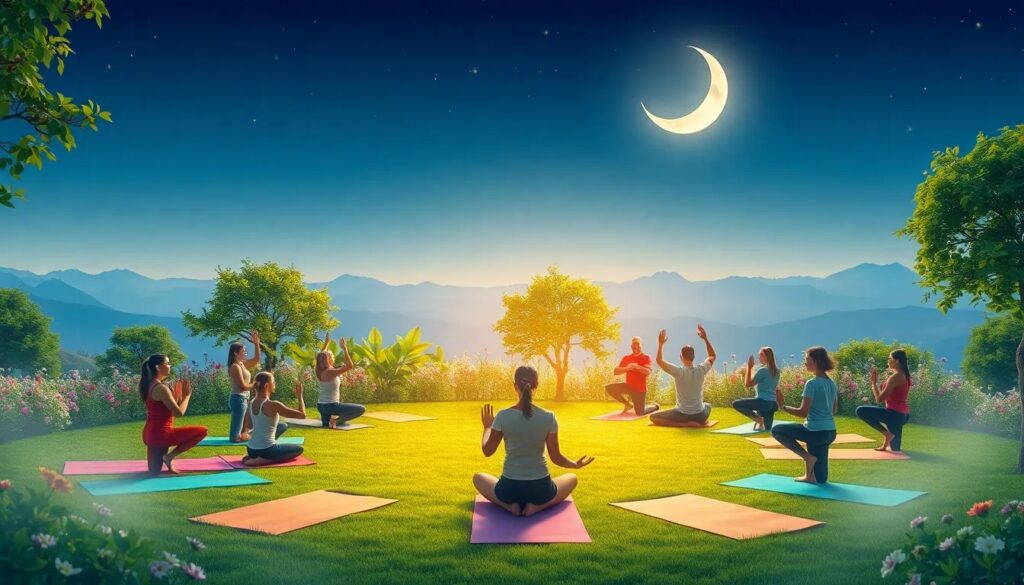
New moon yoga is a slow, restorative practice timed to the new moon phase of the lunar cycle, roughly once a month. The new moon is the moment the moon sits between the earth and the sun, its illuminated face turned away from us, so it is not visible in the night sky. In many contemplative traditions this darkness is associated with inwardness and rest, a window for setting intentions before the cycle begins to build again. New moon yoga translates that orientation into a physical practice: quieter breath, longer holds, supportive props, and a few minutes of reflection rather than vigorous flow.
If you are looking for new moon yoga poses you can do at home with a mat and a couple of blankets, or for a new moon yoga class that respects the receptive quality of the phase, the approach below is built around both.
The Logic Behind Lunar-Timed Yoga
Lunar-aware yoga is not a recent invention. The Hatha yoga tradition acknowledges the significance of the lunar cycle, and the Ashtanga tradition observes rest days on both full and new moon days, rooted in the belief that the body's rhythms are subtly influenced by lunar gravity. Whether or not you accept the metaphysical framing, there is practical wisdom in building intentional pauses into a regular practice. A monthly new moon session functions as a structured reset: a guaranteed time to slow down, check in, and set direction.
The new moon is associated with apana energy in yogic physiology, the downward-moving force linked with elimination and release. New moon practices honor this quality by favoring grounding shapes, forward folds, and restorative postures over backbends and energizing inversions. The sequence is designed to support letting go of what is no longer useful and creating internal space for what is beginning.
How New Moon Yoga Differs from a Regular Practice
| Feature | Standard Vinyasa Class | New Moon Yoga |
|---|---|---|
| Pace | Moderate to brisk | Slow, unhurried |
| Primary focus | Strength, mobility, breath-movement link | Rest, introspection, release |
| Pose types | Active standing and balancing poses | Restorative, seated, and supine poses |
| Props | Optional | Strongly encouraged (bolster, blankets, blocks) |
| Intention-setting | Sometimes, at the teacher's discretion | Central to the practice |
New moon yoga overlaps significantly with gentle yoga and yin yoga in its physical character. The key distinction is the ritual framing: a specific time of month, intentional reflection, and the practice of setting intentions that turns a restorative class into a monthly anchor.
Setting Intentions: What It Means and How to Do It
Intention-setting in a new moon yoga context is not the same as goal-setting. A goal is outcome-focused ("I want to lose ten pounds" or "I want to get a promotion"). An intention is quality-focused: it describes how you want to show up, what attitude or value you want to cultivate, or what you are choosing to release. Examples of new moon intentions include:
- Patience in difficult conversations
- Letting go of a habitual self-critical thought pattern
- Bringing more consistency to a specific area of life
- Opening to a possibility that anxiety has been blocking
Writing down an intention before or after the physical practice is common. Some practitioners use a journal; others simply sit in silence with the intention for a few minutes at the end of Savasana. The writing is not magic, it is a commitment device. Articulating something clearly, even only to yourself, increases the likelihood that you will act in accordance with it.
A New Moon Yoga Sequence
This gentle sequence is suitable for practicing on or around the new moon, ideally the night of the new moon itself or the day before or after, depending on your own schedule. It takes roughly 45 minutes at a slow pace. Use a bolster, two blankets, and a block if you have them; substitute folded towels and firm pillows as needed.
- Centering (3–5 min): Sit comfortably or lie on your back. Close your eyes and take ten slow breaths, lengthening the exhale to roughly twice the length of the inhale. Let the body become heavy. Before moving, bring to mind one thing you are ready to release this lunar cycle.
- Supine Twist (2–3 min each side): Lying on your back, draw the right knee to the chest, then guide it across the body to the left. Extend the right arm out to the right. Breathe slowly. Repeat on the other side. Let gravity do the work; do not force the twist.
- Supported Child's Pose (5 min): Place a bolster or folded blankets lengthwise on the mat. Kneel, toes together, knees wide, and drape the torso over the support. Rest the forehead on the prop. Breathe into the back body.
- Seated Forward Fold — Paschimottanasana (3–5 min): Sit with legs extended. Place a bolster across the thighs if available. Hinge at the hips and fold forward, resting the forehead on the prop or on stacked fists. This is a releasing shape; avoid pulling aggressively on the feet.
- Butterfly — Baddha Konasana (3–5 min): Soles of the feet together, knees falling to the sides. Fold forward gently, rounding the spine. Support the outer thighs with blocks or rolled blankets if the hips are tight.
- Legs Up the Wall — Viparita Karani (5–10 min): Scoot the hips close to a wall and extend the legs up. Place a folded blanket under the lower back if helpful. This gentle inversion calms the nervous system and encourages venous return. Remain here for several minutes, simply breathing.
- Savasana with Intention (5–10 min): Lie flat, arms slightly away from the body, palms up. Let the body be completely still. Revisit your intention quietly. When you are ready, roll to one side before sitting up slowly.
New moon yoga poses if you have no props
Props make the practice more comfortable, but they are not the point. Without a bolster, roll a firm blanket into a short cylinder and use it under the knees in Savasana, between the thighs and calves in Butterfly, and lengthwise along the spine in a reclined version of the sequence. Without blocks, a stack of hardcover books or a firm pillow serves the same role in seated forward folds. The principle is the same: support the body so the breath can stay slow and the mind can stay with the intention.
What to Avoid on the New Moon
New moon yoga is not the time for peak-effort classes, new pose challenges, or intensive training. The same Ashtanga tradition that observes moon day rest also recommends against beginning new intensive physical practices on these days and against pushing through fatigue or pain to complete a full-intensity sequence. This is not superstition but practical wisdom about recovery: the body benefits from cyclical variation, and building planned low-intensity periods into your monthly schedule supports long-term consistency.
If you normally practice vigorous yoga daily and the new moon falls on a regular practice day, use it as a recovery session rather than skipping practice entirely. The sequence above works well in this context. If you are attending a new moon yoga class that day, ask the teacher in advance for the slower version of the flow. For thoughts on how to balance intensity and recovery in a weekly schedule, see how many days a week to do yoga.
Full Moon vs. New Moon Yoga
Full moon yoga tends to be more energizing and expansive: the full moon is associated with peak energy, outward expression, and release through effort. Practices on or around the full moon often incorporate more vigorous flows, backbends, and shapes that open and expand. New moon yoga is the complement: quiet, receptive, grounding. Together they create a natural monthly rhythm of effort and recovery, expansion and consolidation. Practitioners who observe both often describe a sharpened awareness of how energy fluctuates across the month in ways they had not previously noticed.
Should I take a new moon yoga class or self-practice?
Both work, and they answer slightly different needs. A guided new moon yoga class gives you the pacing, the held silence, and the reflection prompts that are easy to skip at home. Self-practice is more flexible and lets you stay in a shape for as long as your body wants. Many people do both: a class for the new moon itself, and the home sequence above on the night before or after to extend the reflective window.
For a restorative approach that complements new moon practice at any time of month, explore our articles on yin yoga, slow flow yoga, and the complementary full moon yoga practice.
Frequently asked questions
Once a month, around the date of the new moon. The lunar cycle is approximately 29.5 days, so new moon yoga is practiced roughly monthly. Some practitioners also observe the full moon with a complementary energizing practice, creating a twice-monthly rhythm of intentional, cycle-aware practice.
It is particularly well-suited to beginners. The pace is slow, the poses are accessible, and the emphasis on breath and reflection rather than physical achievement removes the performance pressure that can make vigorous yoga classes intimidating. Props are actively encouraged, which makes it easy to modify every shape.
No. Whatever your view on the metaphysical aspects, the practical value of a slow, restorative monthly practice is independent of those beliefs. Setting aside time once a month for reflection, light movement, and intentional breathing is beneficial on its own terms. The lunar framing is a structure that many people find meaningful, but it is not a prerequisite.
A yoga mat, one or two firm blankets, and a bolster or firm pillow cover most situations. Blocks are useful for supported seated shapes. None of these are strictly required, since rolled towels and bed pillows work in a home practice. The goal is comfort and support, not specific equipment.
Have a correction or a question about this article? Reach us via our contact page.
Recommended: