How Long Does It Take to Become a Yoga Instructor?

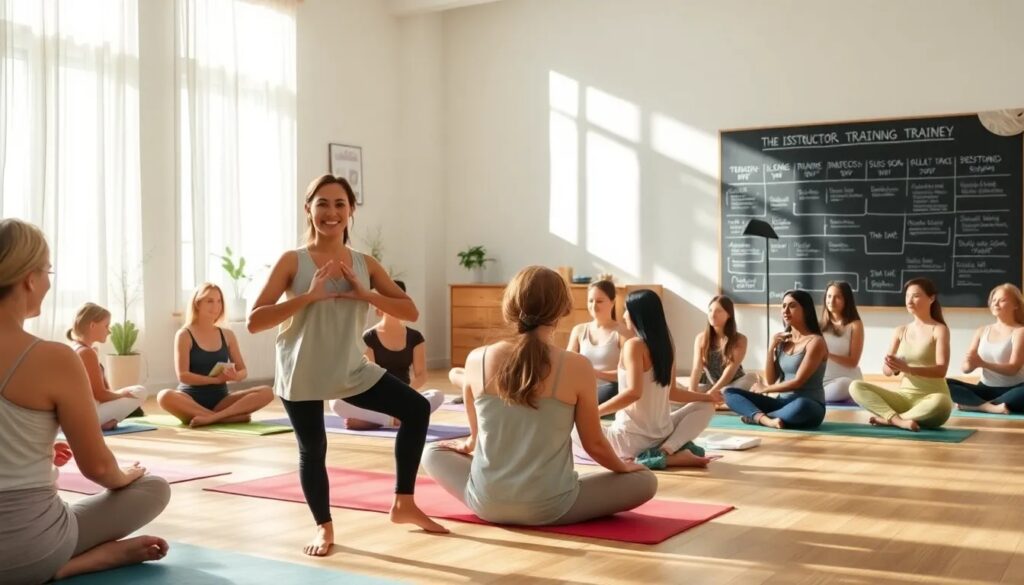
Most people become certified yoga instructors in three weeks to twelve months. The industry-standard credential is a 200-hour teacher training: a full-time program can be finished in roughly 3 to 5 weeks, a part-time weekend program usually takes 3 to 6 months, and a self-paced online program can take anywhere from one month to about a year, depending on how many hours you put in each week. Advanced 300-hour and 500-hour credentials add roughly another six months to two years on top of that.
The honest answer, then, is that the timeline depends far more on the format you choose than on the training itself. This guide breaks down each path so you can pick the one that fits your life.
The Short Answer: Typical Timelines at a Glance
| Training path | Typical duration | Best for |
|---|---|---|
| 200-hour intensive (full-time, in person) | 3–5 weeks | People who can take time off and want full immersion |
| 200-hour part-time (weekends/evenings) | 3–6 months | Working professionals and parents |
| 200-hour online (self-paced) | 1–12 months | Flexible schedules, remote locations, tighter budgets |
| 300-hour advanced training | 6 months–2 years | Teachers deepening skills after a 200-hour |
| 500-hour combined credential | 1–3 years total | Career teachers and future trainers |
Note that the hours are contact and study hours, not calendar time. Two students in the same 200-hour program can finish months apart simply because one studies ten hours a week and the other studies three.
How Long Does the Standard 200-Hour Certification Take?
The 200-hour yoga teacher training (YTT) is the baseline qualification accepted by most studios and gyms. It covers asana technique, anatomy, yoga philosophy, teaching methodology, and supervised practice teaching.
Intensive format: 3–5 weeks
Immersion programs — often held at retreat centers — run six days a week, usually 8–10 hours a day. You finish fast, but the pace is demanding and you absorb a lot in a short window. Many graduates say they needed several months of teaching afterward for the material to fully settle.
Part-time format: 3–6 months
The most common format for people with jobs: one or two weekends per month, or two evenings a week. The slower pace gives you time to practice teaching between modules, which many trainers consider an advantage rather than a delay.
Online format: 1–12 months
Self-paced online programs let you set your own speed. A motivated student studying 15–20 hours a week can finish in 6–10 weeks; someone fitting study around a full-time job often takes 6–12 months. If you are weighing this route, our guide to 200-hour yoga teacher training online covers how to evaluate program quality.
What Comes After 200 Hours? Advanced Credentials
Many teachers stop at 200 hours and build experience. Those who continue typically pursue:
- 300-hour training — an advanced curriculum taken after the 200-hour, usually completed in 6 months to 2 years part-time.
- 500-hour credential — the combination of a 200-hour plus a 300-hour (or a single 500-hour program). Plan on 1–3 years total from your first day of training.
- Specialty certifications — prenatal, children's, or accessible yoga add-ons usually run 30–95 hours each.
If you intend to register your credential, programs registered with Yoga Alliance follow set curriculum standards; our overview of the Yoga Alliance certificate explains what registration does and does not give you.
From Certification to Actually Teaching
Finishing training is not the same as being a working instructor. Most new graduates spend an additional 2–6 months building toward regular paid classes: auditioning at studios, subbing, teaching community classes, and getting liability insurance. Factor this in if your goal is income rather than just the certificate. For a broader look at choosing a program in the first place, see our guide to yoga teacher training, and for the credentialing side, yoga teacher certification explains the different certificate types.
How long until you can earn money teaching yoga?
There is no fixed answer, because local market conditions, your willingness to start with community or subbing slots, and how aggressively you audition all matter. A reasonable planning window is 2 to 6 months between finishing your 200-hour and teaching a regular paid weekly class. Some graduates land a recurring slot within a few weeks; others spend the better part of a year. Until you have a steady schedule, most new teachers supplement with private sessions, workshops, or online classes to bridge the gap.
What Affects Your Personal Timeline?
- Prior practice. Most programs recommend (and some require) 6–12 months of consistent personal practice before enrolling. If you are brand new to yoga, add that runway to your plan.
- Weekly availability. Ten hours a week finishes a part-time program roughly twice as fast as five.
- Program structure. Cohort-based programs have fixed end dates; self-paced ones depend entirely on you.
- Practicum requirements. Programs requiring supervised in-person teaching hours can extend your timeline if sessions are scheduled monthly.
- Certification paperwork. After graduating, registering with a credentialing body typically takes days to a few weeks.
Starting From Zero? Plan on One to Two Years
If you have never taken a yoga class, the honest total timeline is not the 3–6 months quoted above for the 200-hour training alone — it is closer to one to two years from your first class to your first paid teaching slot. The extra time is not the training itself; it is the practice you build beforehand. Most programs expect you to already recognize common poses and alignment cues on day one, and building that comfort typically takes about a year of regular classes. Add a part-time 200-hour program (3–6 months) and the 2–6 months most new graduates spend building toward a regular paid class, and the full arc runs roughly a year to two years. Our guide on how many days a week to do yoga can help you plan a realistic weekly load while you build that base.
Age is rarely a barrier — people regularly start their 200-hour training in their 30s, 40s, 50s, and beyond, and many studios value the life experience older trainees bring to the room. What actually shapes your timeline at any age is the same list above: available time, prior practice, and how quickly you build practice-teaching hours. A 45-year-old starting from zero should expect roughly the same one-to-two-year arc as a 25-year-old beginner — the calendar does not stretch just because you started later.
The 200-hour curriculum itself is not intellectually difficult, but it is full: most trainees underestimate the reading load (anatomy, philosophy, sequencing) and the number of supervised practice-teaching hours required. The skills that take the most work are not the poses — they are cueing clearly in front of a room, holding space for a struggling beginner, and sequencing a class that flows. Those are teachable, but they also benefit most from repetition, which is one reason in-person programs with live practicums tend to produce teachers who feel job-ready faster than fully self-paced online options.
Frequently Asked Questions
Yes. Full-time intensive 200-hour programs run 3 to 5 weeks and are a legitimate, widely accepted path. The trade-off is pace: you cover in days what part-time students cover in weeks, so expect long days and plan time afterward to consolidate what you learned before teaching regularly.
No. A 200-hour certification is the standard entry requirement at most studios and gyms. The 300-hour and 500-hour credentials are advanced education for teachers who want to deepen their skills, specialize, or eventually train other teachers.
Most programs recommend at least 6 to 12 months of consistent practice. Some accept beginners, but you will get far more from the anatomy and sequencing material if the poses are already familiar in your own body.
It can be either faster or slower. Self-paced online programs can be finished in 6 to 10 weeks with heavy weekly study, but most students take 6 to 12 months because they fit study around work. In-person intensives remain the fastest fixed route at 3 to 5 weeks.
Most graduates need 2 to 6 months of building a schedule — auditioning, subbing, and teaching community or private sessions — before landing a regular paid weekly class. Timing depends heavily on your local market and how quickly you start auditioning after certification.
Have a correction? Contact us.
Recommended: