Half Moon Yoga: How to Do Ardha Chandrasana Safely

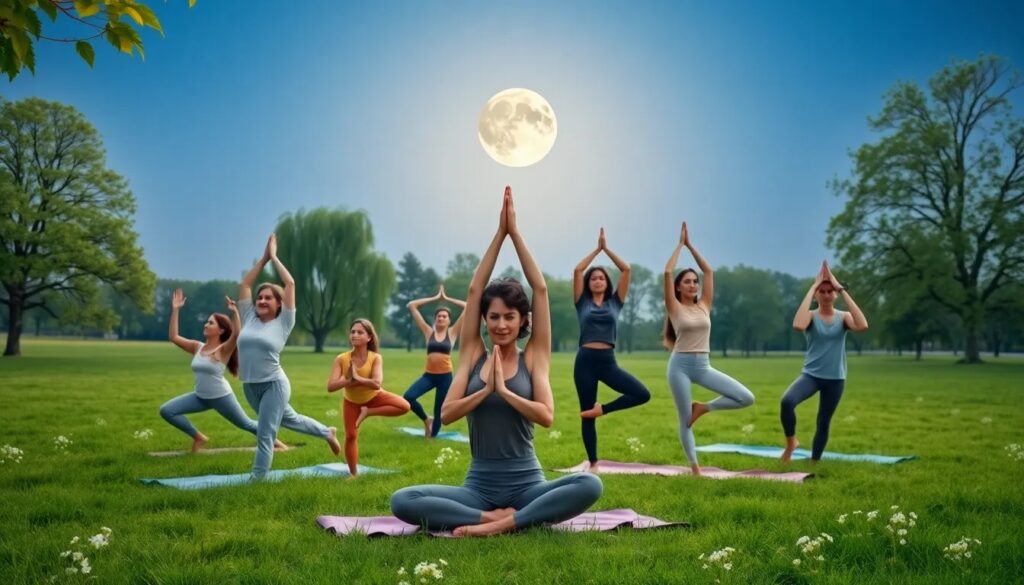
Half Moon yoga — Ardha Chandrasana in Sanskrit — is a standing balance in which you rest on one straight leg and the fingertips of one hand while the other leg lifts parallel to the floor and the chest rotates open to the side. It is one of the most useful single-leg balances in a vinyasa or hatha class because it trains the standing hip and ankle, opens the chest, and asks for focus without demanding advanced flexibility. Most students meet it as a transition out of Triangle Pose (Trikonasana).
The name comes from ardha (half) and chandra (moon): with one line of energy running through the standing leg and torso and another through the lifted leg, the body forms a half-moon shape.
How to Do Half Moon Pose Step by Step
The most reliable entry is from Triangle Pose on the right side. If you can hold Triangle with the chest open, you can hold Half Moon — the mechanics of the standing leg, the position of the bottom hand, and the rotation of the ribcage are the same.
- From Triangle, bend your right knee slightly and shift your weight into the right foot.
- Walk your right hand forward of the right foot, toward the pinky-toe side, and place your fingertips on the floor or, more commonly, on a block at its tallest height.
- Begin to straighten the right leg as you float the left leg up until it is roughly parallel to the floor. Flex the lifted foot as if pressing it into an invisible wall behind you.
- Stack your left hip over your right hip and rotate the chest toward the left wall. The lifted hip tends to fall back; press the outer left hip forward to find the line.
- Keep the left hand on your hip for now, or reach it toward the ceiling. Gaze can go down at the floor (easiest), straight ahead, or up at the top hand (hardest).
- Hold for several steady breaths, then bend the standing knee, lower the back leg with control, and return to Triangle. Repeat on the left side.
Common Mistakes That Throw Off Your Balance
Most wobbles in Half Moon are setup problems, not strength problems. Five patterns show up again and again in beginner classes:
- Dumping weight into the bottom hand. The hand is a kickstand, not a pillar. Aim for roughly 90 percent of your weight in the standing leg; if you can lift the bottom hand briefly without falling, the line is right.
- Reaching the hand straight down under the shoulder. Placing the hand forward and slightly outside the standing foot gives the hips room to stack on top of each other.
- Locking the standing knee. A micro-bend keeps the leg muscles, not the joint, doing the work and protects the knee on the way out.
- Letting the lifted leg droop. A sagging back leg pulls the pelvis down and closes the hips. Keep the foot active and the leg at hip height or just below.
- Looking up too soon. Turning the gaze upward is the variable that most often breaks the balance. Earn the upward gaze by first holding the pose steadily with the eyes down.
Modifications That Make Half Moon Easier
Half Moon is far more about smart setup than raw flexibility. The block and the wall are not lesser versions of the pose — they are the standard teaching tools in most classes because they let the chest open instead of collapsing toward the floor.
- Use a block under the bottom hand at its tallest height. This keeps the chest lifted and the standing leg closer to vertical, which protects the lower back. If you do not own one, a yoga block is the most useful prop to start with.
- Practice with your back against a wall. The wall supports the lifted leg and back body so you can learn the shape of the pose without fighting for balance. Slide the back heel down the wall as the lifted leg rises.
- Keep the top hand on your hip and the gaze down. Reduce the variables one at a time. Once the standing leg feels reliable, lift the gaze; once the gaze is steady, reach the top arm up.
Half Moon Pose Variations Compared
| Variation | What changes | Difficulty |
|---|---|---|
| Supported Half Moon (block or wall) | Hand on a block, or back body against a wall | Beginner |
| Classic Ardha Chandrasana | Fingertips on the floor, gaze forward or up | Intermediate |
| Sugarcane Pose (Ardha Chandra Chapasana) | Lifted leg bends; top hand catches the foot for a backbend and a quad stretch | Intermediate to advanced |
| Revolved Half Moon (Parivrtta Ardha Chandrasana) | Opposite hand comes down and the torso twists toward the standing leg | Advanced |
| Hands-free Half Moon | Both hands off the floor, torso supported purely by leg and core strength | Advanced |
Half Moon vs Extended Side Angle vs Triangle
These three poses share the same leg line — straight front leg, hips open to the side — but the load is different in each. The table below is a quick reference if you are trying to understand why Half Moon feels wobblier than its neighbors.
| Pose | Base of support | Main work | When to use it |
|---|---|---|---|
| Triangle (Trikonasana) | Both feet on the floor | Spine rotation, hamstring length, chest opening | Setup pose for Half Moon; teaches the leg line first |
| Extended Side Angle | Both feet on the floor, bent front knee | Side-body length, thigh strength, hip opening | Warmer for the side body and inner thigh than Half Moon |
| Half Moon (Ardha Chandrasana) | One foot (single-leg balance) | Standing-leg strength, balance, chest rotation | Single-leg balance with the chest open; a step up from Triangle |
Benefits of Half Moon Yoga
- Standing-leg and hip strength. The gluteus medius and the muscles around the standing knee and ankle work hard to keep you upright. Single-leg balance work is one of the most practical skills yoga builds, and it tends to improve with consistent practice. For more on balance work in general, see our yoga for balance guide.
- Hip and hamstring mobility. The pose stretches the standing-leg hamstring and opens the inner thigh and chest of the lifted side.
- Core control. Keeping the chest open while one leg is in the air requires the obliques and the deep core to stabilize the spine.
- Focus. Balancing poses demand a steady gaze and steady breath; mind-wandering shows up immediately as a wobble.
Strength in the hips and core carries over directly to this pose — if it feels shaky, supplementary work like the sequences in our guides to yoga for core strength and yoga for strength helps more than simply repeating the pose.
Poses That Prepare You for Half Moon
- Triangle Pose — teaches the leg line and chest rotation that Half Moon uses.
- Warrior III — builds the standing-leg strength and hip-hinge control that Half Moon demands.
- Tree Pose — develops basic single-leg balance with both feet available for support.
- Extended Side Angle — opens the side body and inner thigh before asking the same leg to hold your weight in the air.
In a flowing class you will often meet Half Moon inside a standing sequence — our explainer on vinyasa yoga covers how those sequences are built. And if balance postures are the part of practice you find hardest, you are in good company: see our breakdown of the hardest yoga poses and what actually makes them difficult.
How Often Should You Practice Half Moon?
Half Moon is a standing pose that most students meet one or two times per week in a regular vinyasa or hatha class, usually as part of a standing sequence rather than on its own. Daily practice is not necessary, and a rest day between balance-heavy sessions is reasonable. What matters more than frequency is that the setup is consistent: every time you come into the pose, the bottom hand is forward of the foot, the standing knee has a micro-bend, and the gaze is steady before you reach or look up.
As an Amazon Associate, we earn from qualifying purchases.

- Natural Cork: Elevate your yoga practice with our eco-friendly, non-slip Gaiam Cork Yoga Brick, perfect for yoga, Pilates, and more.
- Modify Your Poses: Ideal for all skill levels; shorten or deepen your stretches effortlessly. Dimensions: 9"W x 5.5"H x 3"D, lightweight at 1.5 lbs.
- Rounded Edges & Superior Grip: Designed for your comfort, the rounded edges and textured surface provide excellent grip and control during challenging poses.
- Perfect Dimensions: Measuring at 9"W x 5.5"H x 3"D, this yoga brick provides ample support for optimal alignment and posture.
- Versatile & Portable: Compact and lightweight, this cork yoga brick is your go-to fitness accessory for home or gym workouts.

Safety Notes
Move into and out of the pose slowly, and keep a block or wall nearby if your balance is unreliable. Take extra care, or skip the full version, if you have low blood pressure, vertigo or inner-ear issues, a recent ankle, knee, or hip injury, or late-stage pregnancy — a wall-supported version with the gaze down is a sensible substitute. If you prefer to build mobility without balance demands at all, seated yoga poses are a good complement.
This article is for general information only and is not medical advice. If you are pregnant, recovering from an injury, or managing a health condition, check with a qualified health professional before practicing.
Frequently Asked Questions
Half Moon Pose builds single-leg balance, strengthens the standing hip and leg, stretches the hamstrings and inner thighs, and trains focus. It is one of the most useful standing balances for everyday stability.
Yes, with support. Beginners should use a block under the bottom hand or practice with the back against a wall and the gaze down. The unsupported version with the gaze lifted is an intermediate pose.
The usual causes are placing the bottom hand directly under the shoulder instead of forward of the foot, putting too much weight into that hand, locking the standing knee, and turning the gaze up before the standing leg is stable. Fix the setup first, then progress the gaze.
Sugarcane Pose (Ardha Chandra Chapasana) starts from Half Moon: the lifted leg bends and the top hand reaches back to catch the foot, adding a backbend and a quadriceps stretch. It demands more balance and more spinal extension than classic Half Moon.
Yes. Half Moon is a single-leg standing balance: you support your weight on one foot while the other leg lifts parallel to the floor. The challenge is the standing leg, not the lifted one, and the chest rotation has to happen on top of that single-leg base.
Have a correction? Contact us.
Last update 2026-09-10. Price and product availability may change.
Recommended: